
Pulp Fiction, 1955 · page 47 of 100
2-Gun Western, November 1955 — page 47: what you’re looking at
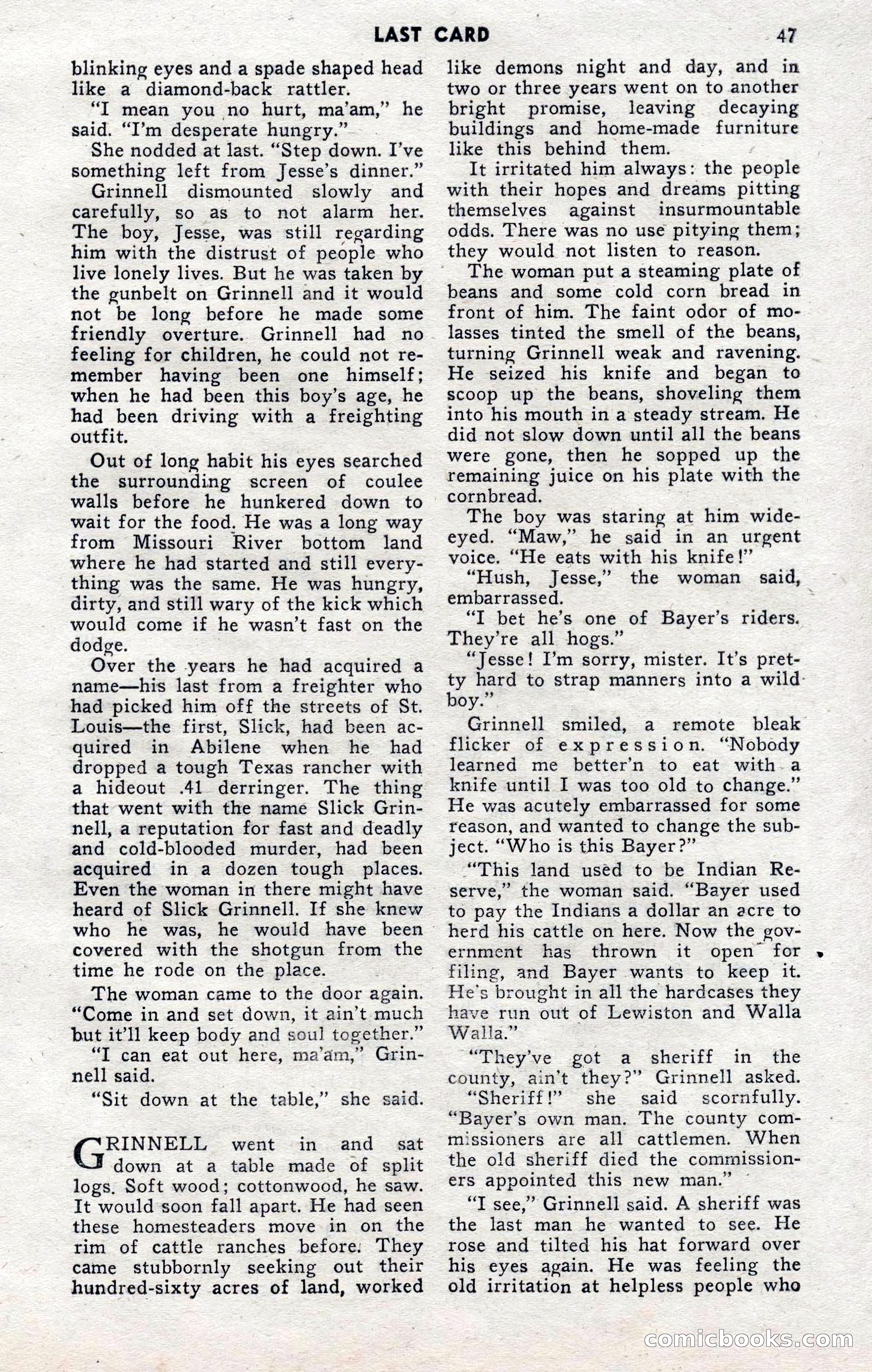
A restored page from Pulp Fiction, 1955. Page through the whole issue in the reader above.
📄 Transcribed text from this page (OCR, searchable)
Machine-transcribed from the original scan — historical spelling and the odd misread are preserved.
LAST CARD blinking eyes and a spade shaped head like a diamond-back rattler. “I mean you no hurt, ma’am,” he said. “I’m desperate hungry.” . She nodded at last. “Step down. I’ve something left from Jesse’s dinner.” Grinnell dismounted slowly and carefully, so as to not alarm her. The boy, Jesse, was still regarding him with the distrust of people who live lonely lives. But he was taken by the gunbelt on Grinnell and it would not be long before he made some friendly overture. Grinnell had no feeling for children, he could not re- member having been one himself; when he had been this boy’s age, he had been driving with a freighting outfit. Out of long habit his eyes searched the surrounding screen of coulee walls before he hunkered down to wait for the food. He was a long way from Missouri River bottom land where he had started and still every- thing was the same. He was hungry, dirty, and still wary of the kick which would come if he wasn’t fast on the dodge. Over the years he had acquired a name—his last from a freighter who had picked him off the streets of St. Louis—the first, Slick, had been ac- quired in Abilene when he _ had dropped a tough Texas rancher with a hideout .41 derringer. The thing that went with the name Slick Grin- nell, a reputation for fast and deadly and cold-blooded murder, had been acquired in a dozen tough places. Even the woman in there might have heard of Slick Grinnell. If she knew who he was, he would have been covered with the shotgun from the time he rode on the place. The woman came to the door again. “Come in and set down, it ain’t much but it'll keep body and soul together.” “T can eat out here, ma’dm,”’ Grin- nell said. “Sit down at the table,” she said. RINNELL went in and _ sat down at a table made of split logs. Soft wood; cottonwood, he saw. It would soon fall apart. He had seen these homesteaders move in on the rim of cattle ranches before: They came stubbornly seeking out their hundred-sixty acres of land, worked 47 like demons night and day, and in two or three years went on to another bright promise, leaving decaying buildings and home-made furniture like this behind them. It irritated him always: the people with their hopes and dreams pitting themselves against insurmountable odds. There was no use pitying them; they would not listen to reason. The woman put a steaming plate of beans and some cold corn bread in front of him. The faint odor of mo- lasses tinted the smell of the beans, turning Grinnell weak and ravening. He seized his knife and began to scoop up the beans, shoveling them into his mouth in a steady stream. He did not slow down until all the beans were gone, then he sopped up the remaining juice on his plate with the - cornbread. The boy was staring at him wide- eyed. “Maw,” he said in an urgent voice. “He eats with his knife!” “Hush, Jesse,” embarrassed. “T bet he’s one of Bayer’s riders. They're all hogs.” “Jesse! I’m sorry, mister. It’s pret- the woman said, ty hard to strap manners into a wild- boy.” Grinnell smiled, flicker of expression. “Nobody learned me better’n to eat with-a knife until I was too old to change.” He was acutely embarrassed for some reason, and wanted to change the sub- ject. “Who is this Bayer?” “TYhis land used to be Indian Re- serve,” the woman said. “Bayer used to pay the Indians a dollar an acre to herd his cattle on here. Now the gov- ernment has thrown it open for filing, and Bayer wants to keep it. He’s brought in all the hardcases they have run out of Lewiston and Walla Walla.” “They've got a sheriff in the county, ain’t they?” Grinnell asked. “Sheriff!” she said scornfully. “Bayer’s own man. The county com- missioners are all cattlemen. When the old sheriff died the commission- ers appointed this new man.” — “T see,’ Grinnell said. A sheriff was the last man he wanted to see. He rose and tilted his hat forward over his eyes again. He was feeling the old irritation at helpless people who oO GComichoo S a remote bleak CO) Al)