
Pulp Fiction, 1954 · page 6 of 116
Fifteen Western Tales, March 1954 — page 6: what you’re looking at
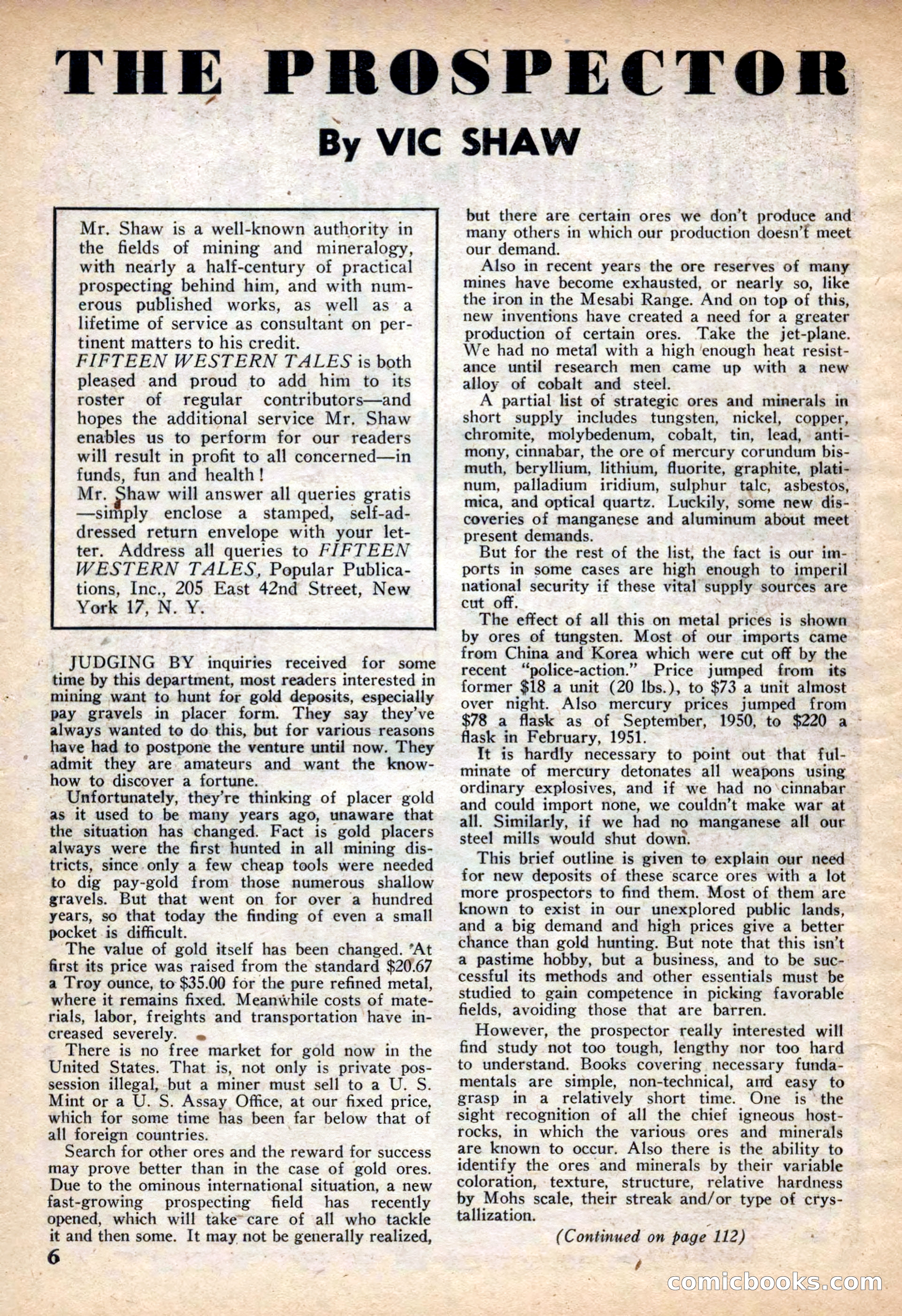
A restored page from Pulp Fiction, 1954. Page through the whole issue in the reader above.
📄 Transcribed text from this page (OCR, searchable)
Machine-transcribed from the original scan — historical spelling and the odd misread are preserved.
og St ee a ad se ns * , eS a a ba ‘oa —— . eS =, a ly See. 84 Pn ae RINE eee . By VIC SHAW Mr. Shaw is a well-known authority in the fields of mining and mineralogy, with nearly a half-century of practical prospecting behind him, and with num- erous published works, as well as a lifetime of service as consultant on per- tinent matters to his credit. FIFTEEN WESTERN TALES is both pleased and proud to add him to its roster of regular contributors—and hopes the additional service Mr. Shaw enables us to perform for our readers will result in profit to all concerned—in funds, fun and health! Mr. Shaw will answer all queries gratis —simply enclose a stamped, self-ad- dressed return envelope with your let- ter. Address all queries to FIFTEEN WESTERN TALES, Popular Publica- tions, Inc,, 205 East 42nd Street, New York 17, N. Y. JUDGING BY inquiries received for some time by this department, most readers interested in mining want to hunt for gold deposits, especially pay gravels in placer form. They say they’ve always wanted to do this, but for various reasons have had to postpone the venture until now. They admit they are amateurs and want the know- how to discover a fortune. Unfortunately, they’re thinking of placer gold as it used to be many years ago, unaware that the situation has changed. Fact is gold placers always were the first hunted in all mining dis- tricts, since.only a few cheap tools were needed to dig pay-gold from those numerous shallow gravels. But that went on for over a hundred years, so that today the finding of even a small pocket is difficult. The value of gold itself has been changed. *At first its price was raised from the standard $20.67 a Troy ounce, to $35.00 for the pure refined metal, where it remains fixed. Meanwhile costs of mate- rials, labor, freights and transportation have in- creased severely. « There is no free market for gold now in the United States. That is, not only is private pos- session illegal, but a miner must sell to a U. S. Mint or a U. S. Assay Office, at our fixed price, which for some time has been far below that of all foreign countries. Search for other ores and the reward for success may prove better than in the case of gold ores. Due to the ominous international situation, a new fast-growing prospecting field has_ recently opened, which will take-care of all who tackle it and then some. It may not be generally realized, 6 but there are certain ores we don’t produce and ~ many others in which our production doesn’t meet our demand. Also in recent years the ore reserves of many mines have become exhausted, or nearly so, like the iron in the Mesabi Range. And on top of this, new inventions have created a need for a greater production of certain ores. Take the jet-plane. We had no metal with a high ‘enough heat resist- ance until research men came up with a new alloy of cobalt and steel. A partial list of strategic ores and minerals in short supply includes tungsten, nickel, copper, chromite, molybedenum, cobalt, tin, lead, anti- mony, cinnabar, the ore of mercury corundum bis- muth, beryllium, lithium, fluorite, graphite, plati- num, palladium iridium, sulphur talc, asbestos, mica, and optical quartz. Luckily, some new dis-- coveries of manganese and aluminum ae meet present demands. : But for the rest of the list, the fact is our im-~ ports in some cases are high enough to imperil | national security if these vital supply sources are cut off. The effect of all this on metal priceés is shied by ores of tungsten. Most of our imports came from China and Korea which were cut off by the recent “police-action.” Price jumped from its former $18 a unit (20 lbs.), to $73 a unit almost over night. Also mercury prices jumped from $78 a flask as of September, 1950, to $220 a - flask in February, 1951. : It is hardly necessary to point out that ful- minate of mercury detonates all weapons using ordinary explosives, and if we had no‘cinnabar and could import none, we couldn’t make war at all. Similarly, if we had no manganese all our steel mills would shut down. This brief outline is given to explain our need for new deposits of these scarce ores with a lot more prospectors to find them. Most of them are known to exist in our unexplored public lands, and a big demand and high prices give a better chance than gold hunting. But note that this isn’t a pastime hobby, but a business, and to be suc-. cessful its methods and other essentials must be studied to gain competence in picking favorable — fields, avoiding those that are barren. However, the prospector really interested will find study not too tough, lengthy nor too hard to understand. Books covering necessary funda- mentals are simple, non-technical, amd easy to grasp in a relatively short time. One is ‘the sight recognition of all the chief igneous host- rocks, in which the various ores and minerals are known to occur. Also there is the ability to identify the ores and minerals by their variable coloration, texture, structure, relative hardness by Mohs scale, their streak and/or type of crys- tallization. (Continued on page 112) rd EOMICGLOCKSs€O©