
Pulp Fiction, 1954 · page 42 of 116
Fifteen Western Tales, March 1954 — page 42: what you’re looking at
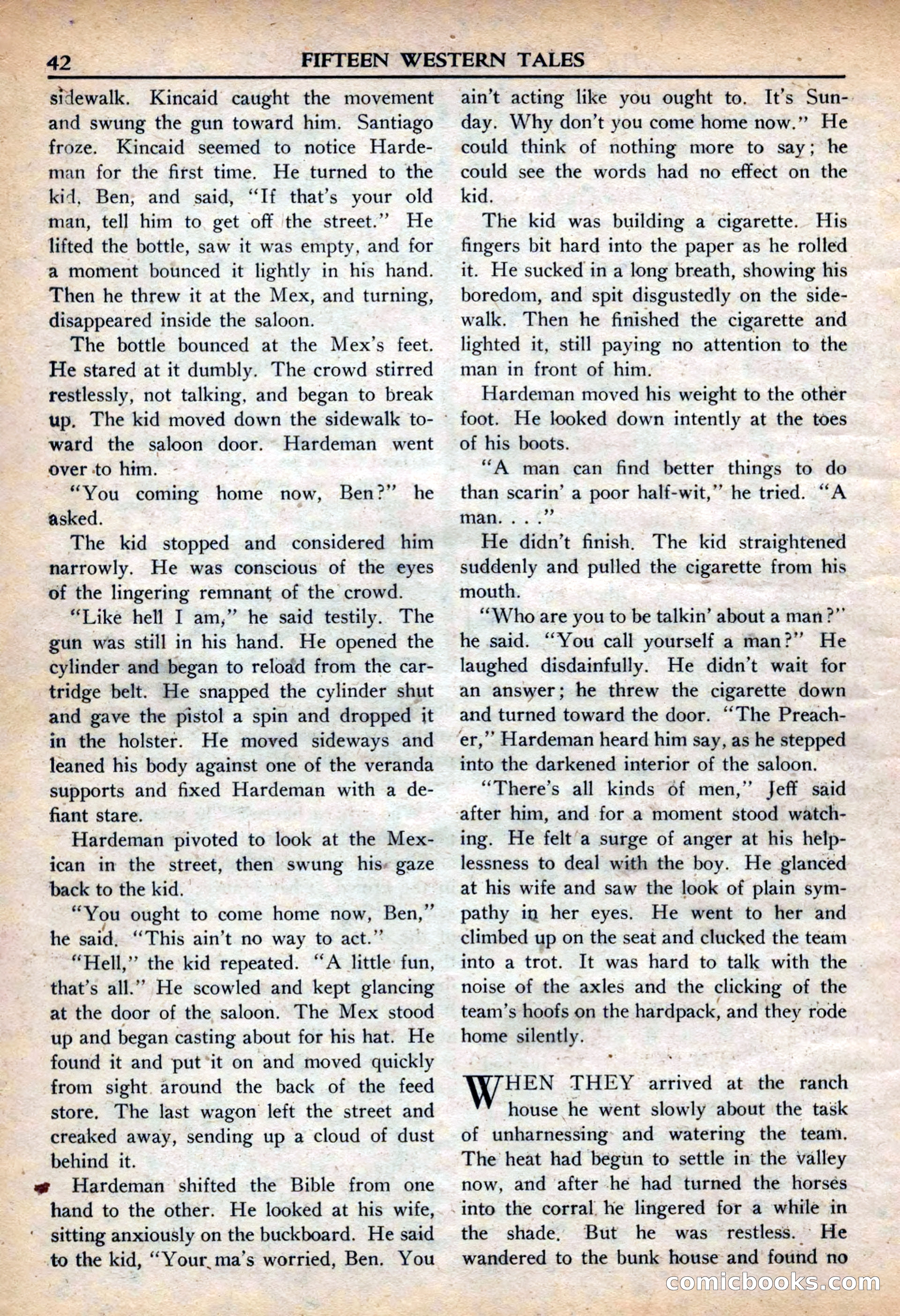
A restored page from Pulp Fiction, 1954. Page through the whole issue in the reader above.
📄 Transcribed text from this page (OCR, searchable)
Machine-transcribed from the original scan — historical spelling and the odd misread are preserved.
he said. ae | _- BIETEEN WESTERN TALES a sidewalk. Kincaid caught the movement and swung the gun toward him. Santiago froze. Kincaid seemed to notice Harde- man for the first time. He turned to the kid, Ben; and said, “If that’s your old man, tell him to get off the street.’’ He _ lifted the bottle, saw it was empty, and for a moment bounced it lightly in his hand. Then he threw it at the Mex, and turning, disappeared inside the saloon. The bottle bounced at the Mex’s feet. He stared at it dumbly. The crowd stirred restlessly, not talking, and began to break up. The kid moved down the sidewalk to- ~ ward the saloon door. Hardeman went over ‘to htm. “Vou coming home now, Ben?” he asked. The kid stopped and considered him narrowly. He was conscious of the eyes of the lingering remnant of the crowd. “Like hell I am,” he said testily. The gun was still in his hand. He opened the cylinder and began to relodd from the car- tridge belt. He snapped the cylinder shut and gave the pistol a spin and dropped it in the holster. He moved sideways and ‘leaned his body against one of the veranda supports and fixed Hardeman with a de- fant stare. Hardeman pivoted to look at the nies! ican in the street, then swung his+ gaze back to the kid. “You ought to come home now, Ben,” “This ain’t no way to act.’ “Hell,” the kid repeated. “A little fun, ‘that’s all.”” He scowled and kept glancing at the door of the saloon. The Mex stood up and began casting about for his hat. He found it and put*it on and moved quickly from sight. around the back of the feed store. The last wagon left the street and creaked away, sending up a cloud of dust behind it. a Hardeman shifted the Bible from one hand to the other. He looked at his wife, sitting anxiously on the buckboard. He said to the kid, ““Your.ma’s worried, Ben. You ain't acting like you ought to. It’s Sun-. day. Why don’t you come home now.” He could think of nothing more to say; he could see the words had no effect on the kid. : The kid was building a cigarette. His fingers bit hard into the paper as he rolled it. He sucked in a long breath, showing his boredom, and spit disgustedly on the side- walk. Then he finished the cigarette and lighted it, still paying no attention to the man in front of him. Hardeman moved his weight to the othér foot. He looked down intently at the toes of his boots. Be, “A man can find better things to do than scarin’ a poor half-wit,’”’ he tried. “A thas <5 He didn’t finish. The kid straightened suddenly and pulled the cigarette from his mouth. “Who are you to be talkin’ about a man ?”’ he said. “You call yourself a man?” He laughed disdainfully. He didn’t wait for an answer; he threw the cigarette down and turned toward the door. “The Preach- er,’ Hardeman heard him say, as he stepped into the darkened interior of the saloon. “There's all kinds of men,’’ Jeff said ‘after him, and for a moment stood watch- ing. He felt'a surge of anger at his help- lessness to deal with the boy. He glanced at his wife and saw the look of plain sym- pathy in her eyes. He went to her and climbed up on the seat and clucked the team into a trot. It was hard to talk with the noise of the axles and the clicking of the team’s hoofs on the hardpack, and they rode home sestly HEN THEY arrived at the ranch house he went slowly about the task of unharnessing- and watering the team, The heat had begun to settle in the valley now, and after he had turned the horsés -into the corral, he lingered for a while in the shade. But he was restless. He wandered to the bunk house and found no © ECOMICDOOKS- co