
Pulp Fiction, 1939 · page 90 of 114
Cowboy Short Stories, November 1939 — page 90: what you’re looking at
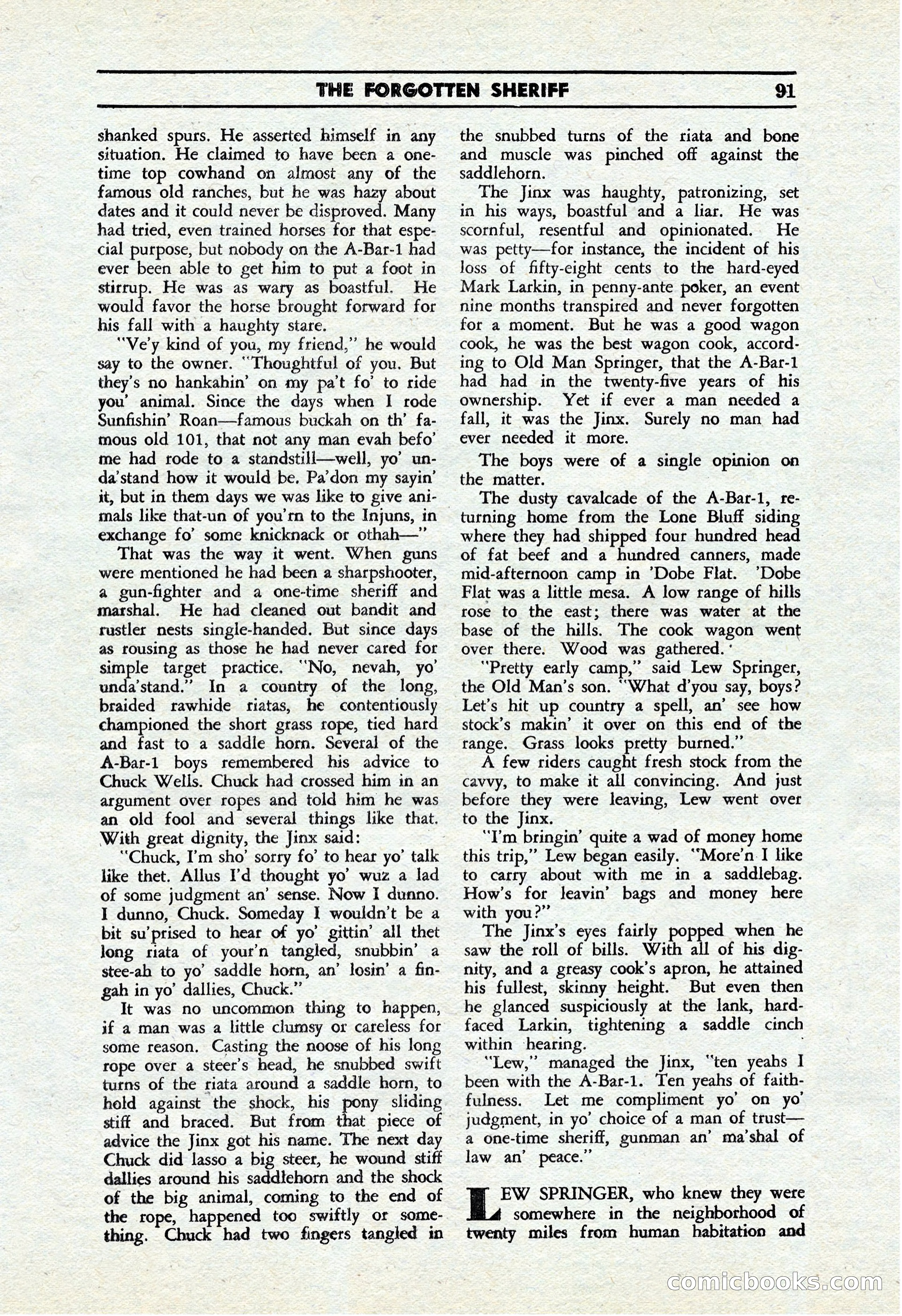
A restored page from Pulp Fiction, 1939. Page through the whole issue in the reader above.
📄 Transcribed text from this page (OCR, searchable)
Machine-transcribed from the original scan — historical spelling and the odd misread are preserved.
THE FORGOTTEN SHERIFF 91 shanked spurs. He asserted himself in any situation. He claimed to have been a one- time top cowhand on almost any of the famous old ranches, but he was hazy about dates and it could never be disproved. Many had tried, even trained horses for that espe- cial purpose, but nobody on the A-Bar-1 had ever been able to get him to put a foot in stirrup. He was as wary as boastful. He would favor the horse brought forward for his fall with a haughty stare. “Ve’y kind of you, my friend,” he would say to the owner. ‘Thoughtful of you. But they’s no hankahin’ on my pa't fo’ to ride you’ animal. Since the days when I rode Sunfishin’ Roan—famous buckah on th’ fa- mous old 101, that not any man evah befo’ me had rode to a standstili—well, yo’ un- da’stand how it would be, Pa’don my sayin’ it, but in them days we was like to give ani- mals like that-un of you'r to the Injuns, in | exchange fo’ some knicknack or othah—”’ That was the way it went. When guns were mentioned he had been a sharpshooter, a gun-fighter and a one-time sheriff and marshal. He had cleaned out bandit and rustler nests single-handed. But since days as rousing as those he had never cared for simple target practice. “‘No, nevah, yo’ unda’stand.” In a country of the long, braided rawhide riatas, he contentiously championed the short grass rope, tied hard and fast to a saddle horn. Several of the A-Bat-1 boys remembered his advice to Chuck Wells. Chuck had crossed him in an argument over ropes and told him he was an old fool and several things like that. With great dignity, the Jinx said: “Chuck, I’m sho’ sorry fo’ to hear yo’ talk like thet. Allus I'd thought yo’ wuz a lad of some judgment an’ sense. Now I dunno. I dunno, Chuck. Someday I wouldn’t be a bit su’prised to hear of yo’ gittin’ all thet long riata of your’n tangled, snubbin’ a stee-ah to yo’ saddle horn, an’ losin’ a fin- gah in yo’ dallies, Chuck.” It was no uncommon thing to happen, if a man was a little clumsy or careless for some reason. Casting the noose of his long rope over a steet’s head, he snubbed swift turns of the riata around a saddle horn, to hold against the shock, his pony sliding stiff and braced. But from that piece of advice the Jinx got his name. The next day Chuck did lasso a big steer, he wound stiff dallies around his saddlehorn and the shock of the big animal, coming to the end of the rope, happened too swiftly or some- thing. Chuck had two fingers tangled in the snubbed turns of the riata and bone and muscle was pinched off against the saddlehorn. The Jinx was haughty, patronizing, set in his ways, boastful and a liar. He was scornful, resentful and opinionated. He was petty—for instance, the incident of his Joss of fifty-eight cents to the hard-eyed Mark Larkin, in penny-ante poker, an event nine months transpired and never forgotten for a moment. But he was a good wagon cook, he was the best wagon cook, accord- ing to Old Man Springer, that the A-Bar-1 had had in the twenty-five years of his ownership. Yet if ever a man needed a fall, it was the Jinx. Surely no man had ever needed it more. The boys were of a single opinion on the matter. The dusty cavalcade of the A-Bar-1, re- turning home from the Lone Bluff siding where they had shipped four hundred head of fat beef and a hundred canners, made mid-afternoon camp in "Dobe Flat. “Dobe Flat was a little mesa. A low range of hills rose to the east; there was water at the base of the hills. The cook wagon went over there. Wood was gathered. “Pretty early camp,” said Lew Springer, the Old Man’s son. “What d’you say, boys? Let’s hit up country a spell, an’ see how stock’s makin’ it over on this end of the range. Grass looks pretty burned.” A few riders caught fresh stock from the cavvy, to make it all convincing. And just before they were leaving, Lew went over to the Jinx. | “I’m bringin’ quite a wad of money home this trip,” Lew began easily. ““More’n.I like to carry about with me in a saddlebag. How’s for leavin’ bags and money here with you?” The Jinx’s eyes fairly popped when he saw the roll of bills. With all of his dig- nity, and a greasy cook’s apron, he attained his fullest, skinny height. But even then he glanced suspiciously at the lank, hard- faced Larkin, tightening a saddle cinch within ‘hearing. ‘Lew,’ managed the Jinx, “ten yeahs I been with the A-Bar-1. Ten yeahs of faith- fulness. Let me compliment yo’ on yo’ judgment, in yo’ choice of a man of trust— a one-time sheriff, gunman an’ ma’shal of law an’ peace.” EW SPRINGER, who knew they were somewhere in the neighborhood of twenty miles from human habitation and CoOnniclooo S Go