
Pulp Fiction, 1939 · page 85 of 114
Cowboy Short Stories, November 1939 — page 85: what you’re looking at
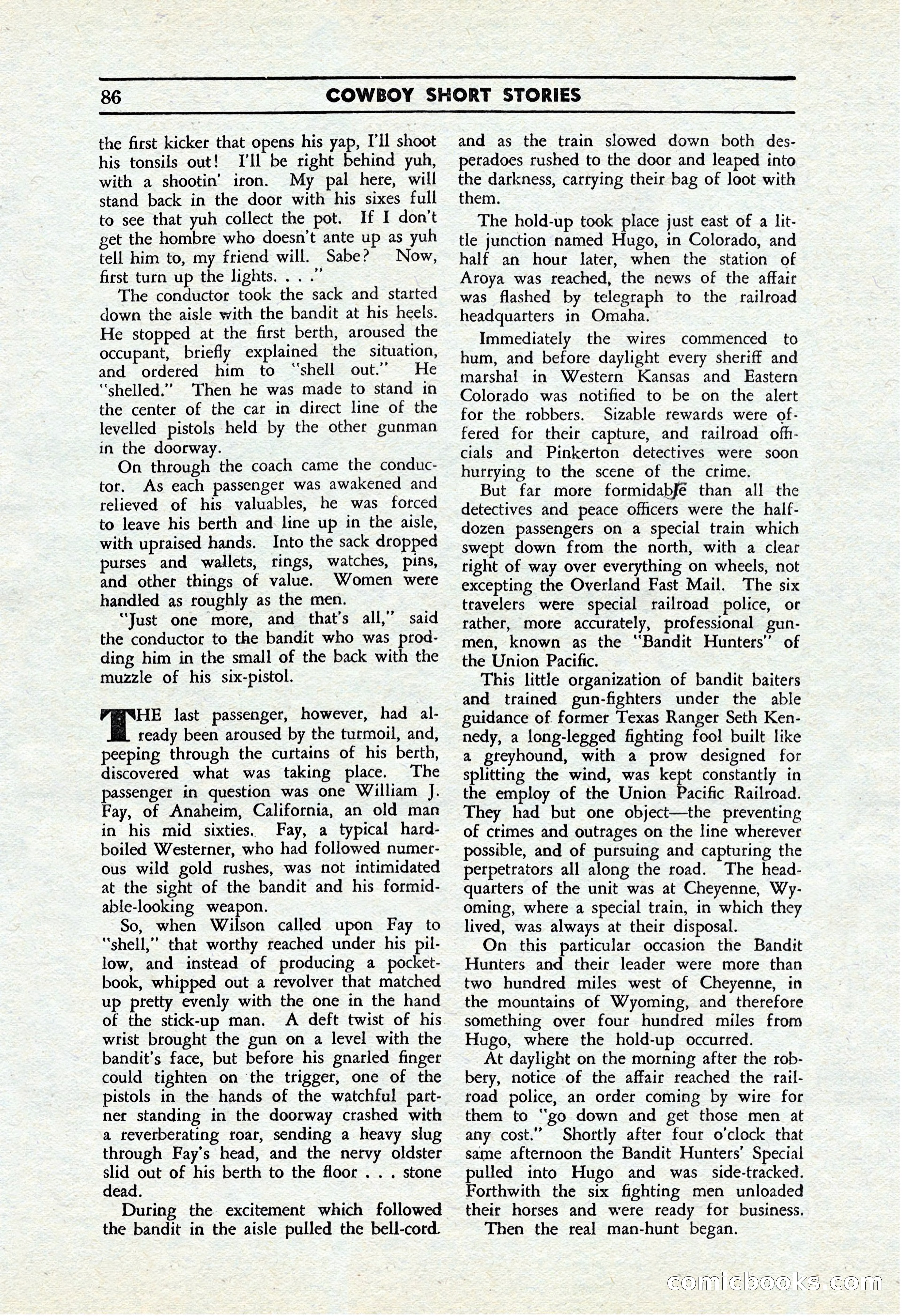
A restored page from Pulp Fiction, 1939. Page through the whole issue in the reader above.
📄 Transcribed text from this page (OCR, searchable)
Machine-transcribed from the original scan — historical spelling and the odd misread are preserved.
86 COWBOY SHORT STORIES the first kicker that opens his yap, I'll shoot his tonsils out! I'll be right behind yuh, with a shootin’ iron. My pal here, will stand back in the door with his sixes full to see that yuh collect the pot. If I don't get the hombre who doesn’t ante up as yuh tell him to, my friend will. Sabe? Now, first turn up the lights... .” The conductor took the sack and started down the aisle with the bandit at his heels. He stopped at the first berth, aroused the occupant, briefly explained the situation, and ordered him to “shell out.” He “shelled.” Then he was made to stand in the center of the car in direct line of the levelled pistols held by the other gunman in the doorway. On through the coach came the conduc- tor. As each passenger was awakened and relieved of his valuables, he was forced to leave his berth and line up in the aisle, with uptaised hands. Into the sack dropped purses and wallets, rings, watches, pins, and other things of value. Women were handled as roughly as the men. ‘Just one more, and that’s all,” said the conductor to the bandit who was prod- ding him in the small of the back with the muzzle of his six-pistol. HE last passenger, however, had al- ready been aroused by the turmoil, and, peeping through the curtains of his berth, discovered what was taking place. The passenger in question was one William J. Fay, of Anaheim, California, an old man in his mid sixties. Fay, a typical hard- boiled Westerner, who had followed numer- ous wild gold rushes, was not intimidated at the sight of the bandit and his formid- able-looking weapon. So, when Wilson called upon Fay to “shell,” that worthy reached under his pil- low, and instead of producing a pocket- book, whipped out a revolver that matched up pretty evenly with the one in the hand of the stick-up man. A deft twist of his wrist brought the gun on a level with the bandit’s face, but before his gnarled finger could tighten on the trigger, one of the pistols in the hands of the watchful part- net standing in the doorway crashed with a reverberating roar, sending a heavy slug through Fay’s head, and the nervy oldster slid out of his berth to the floor . . . stone dead. During the excitement which followed the bandit in the aisle pulled the bell-cord. and as the train slowed down both des- peradoes rushed to the door and leaped into the darkness, carrying their bag of loot with them. The hold-up took place just east of a lit- tle junction named Hugo, in Colorado, and half an hour later, when the station of Aroya was reached, the news of the affair was flashed by telegraph to the railroad headquarters 1n Omaha. Immediately the wires commenced to hum, and before daylight every sheriff and marshal in Western Kansas and Eastern Colorado was notified to be on the alert for the robbers. Sizable rewards were of- fered for their capture, and railroad ofh- cials and Pinkerton detectives were soon hurrying to the scene of the crime. But far more formidabfé than all the detectives and peace officers were the half- dozen passengers on a special train which swept down from the north, with a clear right of way over everything on wheels, not excepting the Overland Fast Mail. The six travelers were special railroad police, or rather, more accurately, professional gun- men, known as the “Bandit Hunters’ of the Union Pacific. This little organization of bandit baiters and trained gun-fighters under the able guidance of former Texas Ranger Seth Ken- nedy, a long-legged fighting fool built like a greyhound, with a prow designed for splitting the wind, was kept constantly in the employ of the Union Pacific Railroad. They had but one object—the preventing of crimes and outrages on the line wherever possible, and of pursuing and capturing the perpetrators all along the road. The head- quarters of the unit was at Cheyenne, Wy- oming, where a special train, in which they lived, was always at their disposal. On this particular occasion the Bandit Hunters and their leader were more than two hundred miles west of Cheyenne, in the mountains of Wyoming, and therefore something over four hundred miles from Hugo, where the hold-up occurred. At daylight on the morning after the rob- bery, notice of the affair reached the raitl- road police, an order coming by wire for them to “go down and get those men at any cost.” Shortly after four o'clock that same afternoon the Bandit Hunters’ Special pulled into Hugo and was side-tracked. Forthwith the six fighting men unloaded their horses and were ready for business. Then the real man-hunt began. GOMIGIOO (C@