
Pulp Fiction, 1939 · page 83 of 114
Cowboy Short Stories, November 1939 — page 83: what you’re looking at
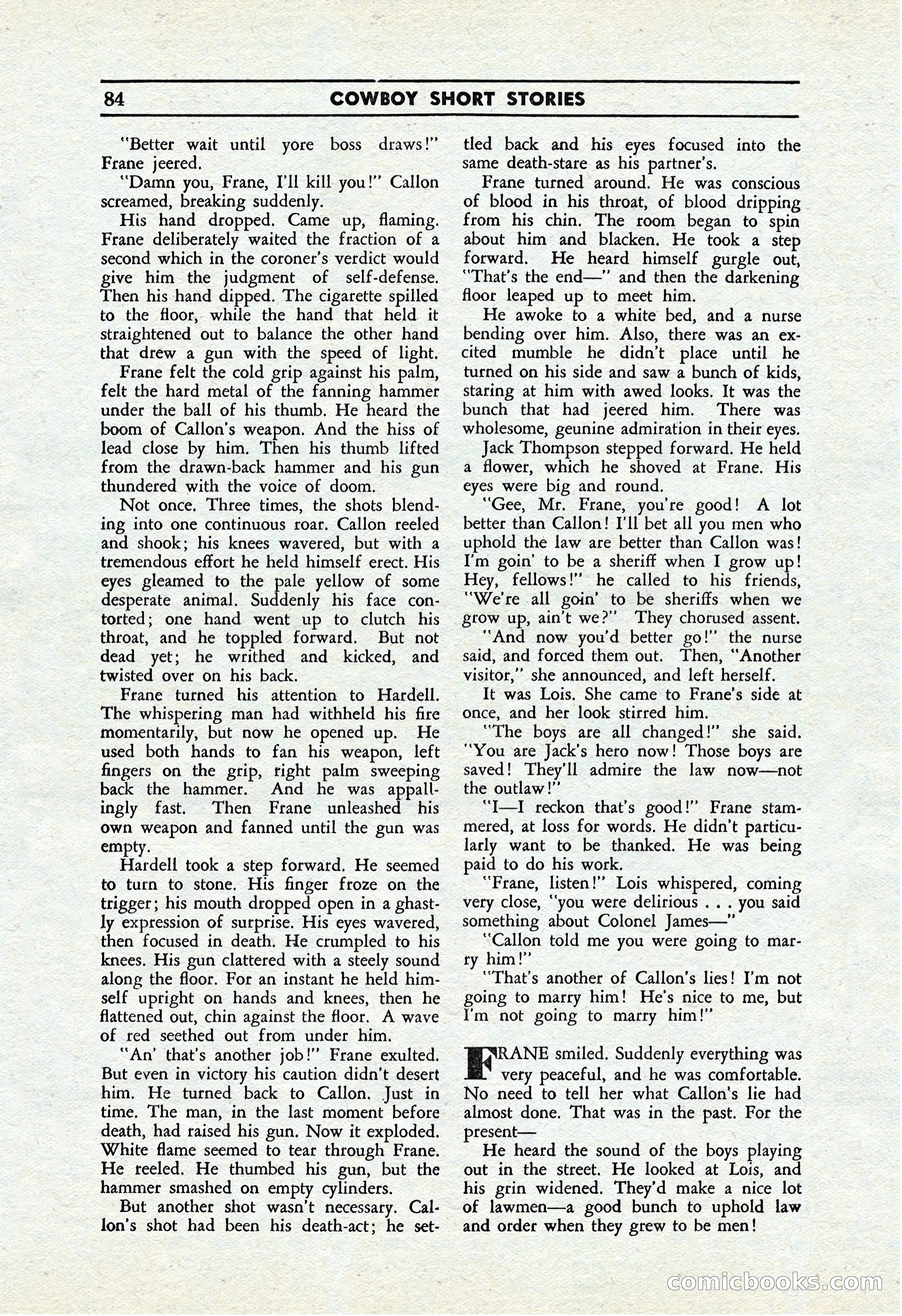
A restored page from Pulp Fiction, 1939. Page through the whole issue in the reader above.
📄 Transcribed text from this page (OCR, searchable)
Machine-transcribed from the original scan — historical spelling and the odd misread are preserved.
84 COWBOY SHORT STORIES “Better wait until yore boss draws!” Frane jeered. ‘Damn you, Frane, I'll kill you!’’ Callon screamed, breaking suddenly. His hand dropped. Came up, flaming. Frane deliberately waited the fraction of a second which in the coroner’s verdict would give him the judgment of self-defense. Then his hand dipped. The cigarette spilled to the floor, while the hand that held. it straightened out to balance the other hand that drew a gun with the speed of light. Frane felt the cold grip against his palm, felt the hard metal of the fanning hammer under the ball of his thumb. He heard the boom of Callon’s weapon. And the hiss of lead close by him. Then his thumb lifted from the drawn-back hammer and his gun thundered with the voice of doom. Not once. Three times, the shots blend- ing into one continuous roar. Callon reeled and shook; his knees wavered, but with a tremendous effort he held himself erect. His eyes gleamed to the pale yellow of some desperate animal. Suddenly his face con- torted; one hand went up to clutch his throat, and he toppled forward. But not dead yet; he writhed and kicked, and twisted over on his back. Frane turned his attention to Hardell. The whispering man had withheld his fire momentarily, but now he opened up. He used both hands to fan his weapon, left fingers on the grip, right palm sweeping back the hammer. And he was appall- ingly fast. Then Frane unleashed his own weapon and fanned until the gun was empty. Hardell took a step forward. He seemed to turn to stone. His finger froze on the trigger; his mouth dropped open in a ghast- ly expression of surprise. His eyes wavered, then focused in death. He crumpled to his knees. His gun clattered with a steely sound along the floor. For an instant he held him- self upright on hands and knees, then he flattened out, chin against the floor. A wave of red seethed out from under him. ‘An’ that’s another job!’ Frane exulted. But even in victory his caution didn’t desert him. He turned back to Callon. Just in time. The man, in the last moment before death, had raised his gun. Now it exploded. White flame seemed to tear through Frane. He reeled. He thumbed his gun, but the hammer smashed on empty cylinders. But another shot wasn’t necessary. Cal- lon’s shot had been his death-act; he set- tled back and his eyes focused into the same death-stare as his partner’s. Frane turned around. He was conscious of blood in his throat, of blood dripping from his chin. The room began to spin about him and blacken. He took a step forward. He heard himself gurgle out, “That's the end—’’ and then the darkening floor leaped up to meet him. He awoke to a white bed, and a nurse bending over him. Also, there was an ex- cited mumble he didn’t place until he turned on his side and saw a bunch of kids, staring at him with awed looks. It was the bunch that had jeered him. There was wholesome, geunine admiration in their eyes. Jack Thompson stepped forward. He held a flower, which he shoved at Frane. His eyes were big and round. “Gee, Mr. Frane, you're good! A lot better than Callon! I'll bet all you men who uphold the law are better than Callon was! I’m goin’ to be a sheriff when I grow up! Hey, fellows!” he called to his friends, “We're .all goin’ to be sheriffs when we gtow up, ain't we?” They chorused assent. ‘And now you'd better go!” the nurse said, and forced them out. Then, “Another visitor,’ she announced, and left herself. It was Lois. She came to Frane’s side at once, and her look stirred him. ‘The boys are all changed!” she said. “You are Jack’s hero now! Those boys are saved! They'll admire the law now—not the outlaw!’’ ‘“‘I—I reckon that’s good!” Frane stam- mered, at loss for words. He didn’t particu- larly want to be thanked. He was being paid to do his work. ‘‘Frane, listen!’ Lois whispered, coming very close, “‘you were delirious . . . you said something about Colonel James—” “Callon told me you were going to mar- ty him!” “That's another of Callon’s lies! I’m not going to marry him! He’s nice to me, but I'm not going to marry him!” RANE smiled. Suddenly everything was very peaceful, and he was comfortable. No need to tell her what Callon'’s lie had almost done. That was in the past. For the present— He heard the sound of the boys playing out in the street. He looked at Lois, and his grin widened. They’d make a nice lot of lawmen—a good bunch to uphold law and order when they grew to be men! GOMIGIOO (©