
Pulp Fiction, 1939 · page 74 of 114
Cowboy Short Stories, November 1939 — page 74: what you’re looking at
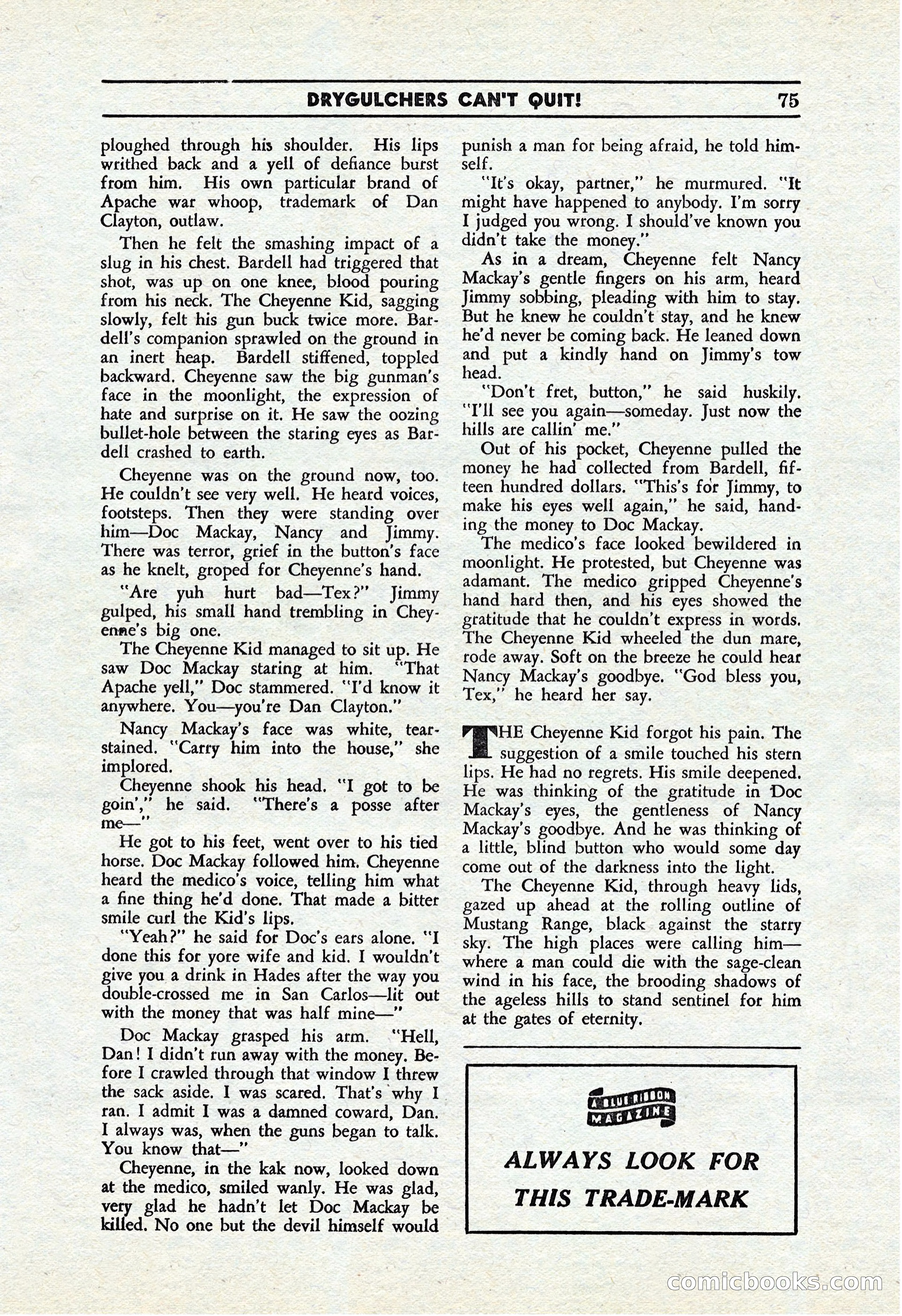
A restored page from Pulp Fiction, 1939. Page through the whole issue in the reader above.
📄 Transcribed text from this page (OCR, searchable)
Machine-transcribed from the original scan — historical spelling and the odd misread are preserved.
DRYGULCHERS CAN'T QUIT! ploughed through his shoulder. His lips writhed back and a yell of defiance burst from him. His own particular brand of Apache war whoop, trademark of Dan Clayton, outlaw. Then he felt the smashing impact of a slug in his chest. Bardell had triggered that shot, was up on one knee, blood pouring from his neck. The Cheyenne Kid, sagging slowly, felt his gun buck twice more. Bar- dell’s companion sprawled on the ground in an inert heap. Bardell stiffened, toppled backward. Cheyenne saw the big gunman’s face in the moonlight, the expression of hate and surprise on it. He saw the oozing bullet-hole between the staring eyes as Bar- dell crashed to earth. Cheyenne was on the ground now, too. He couldn’t see very well. He heard voices, footsteps. Then they were standing over him—Doc Mackay, Nancy and Jimmy. There was terror, grief in the button’s face as he knelt, groped for Cheyenne’s hand. “Ate yuh hurt bad—Tex?” Jimmy gulped, his small hand trembling in Chey- enne’s big one. The Cheyenne Kid managed to sit up. He saw Doc Mackay staring at him. “That Apache yell,” Doc stammered. ‘I'd know it anywhere. You—you'’re Dan Clayton.” Nancy Mackay’s face was white, tear- stained, ‘‘Carry him into the house,” she implored. Cheyenne shook his head. “I got to be goin’,”” he said. “There’s a posse after me—" He got to his feet, went over to his tied horse. Doc Mackay followed him. Cheyenne heard the medico’s voice, telling him what a fine thing he’d done. That made a bitter smile curl the Kid’s lips. “Yeah?” he said for Doc’s ears alone. “I done this for yore wife and kid. I wouldn’t give you a drink in Hades after the way you double-crossed me in San Carlos—lit out with the money that was half mine—’’ Doc Mackay grasped his arm. “Hell, Dan! I didn’t run away with the money. Be- fore I crawled through that window I threw the sack aside, I was scared. That’s why I ran. I admit I was a damned coward, Dan. I always was, when the guns began to talk. You know that—” Cheyenne, in the kak now, looked down at the medico, smiled wanly. He was glad, vety glad he hadn’t let Doc Mackay be killed. No one but the devil himself would 75 punish a man for being afraid, he told him- self. “It’s okay, partner,” he murmured. “It might have happened to anybody. I’m sorry I judged you wrong. I should’ve known you didn’t take the money.” As in a dream, Cheyenne felt Nancy Mackay’s gentle fingers on his arm, heard Jimmy sobbing, pleading with him to stay. But he knew he couldn't stay, and he knew he’d never be coming back. He leaned down and put a kindly hand on Jimmy's tow head. “Don’t fret, button,” he said huskily. “T'll see you again—someday. Just now the hills are callin’ me.” Out of his pocket, Cheyenne pulled the money he had collected from Bardell, fif- teen hundred dollars. ““This’s for Jimmy, to make his eyes well again,” he said, hand- ing the money to Doc Mackay. The medico’s face looked bewildered in moonlight. He protested, but Cheyenne was adamant. The medico gripped Cheyenne’s hand hard then, and his eyes showed the gratitude that he couldn’t express in words, The Cheyenne Kid wheeled the dun mare, rode away. Soft on the breeze he could hear Nancy Mackay’s goodbye. “God bless you, Tex,’ he heard her say. HE Cheyenne Kid forgot his pain. The suggestion of a smile touched his stern lips. He had no regrets. His smile deepened. He was thinking of the gratitude in Doc Mackay’s eyes, the gentleness of Nancy Mackay’s goodbye. And he was thinking of a little, blind button who would some day come out of the darkness into the light. The Cheyenne Kid, through heavy lids, gazed up ahead at the rolling outline of Mustang Range, black against the starry sky. The high places were calling him— where a man could die with the sage-clean wind in his face, the brooding shadows of the ageless hills to stand sentinel for him at the gates of eternity. arly ALWAYS LOOK FOR THIS TRADE-MARK Conniclooo® EO