
Pulp Fiction, 1939 · page 72 of 114
Cowboy Short Stories, November 1939 — page 72: what you’re looking at
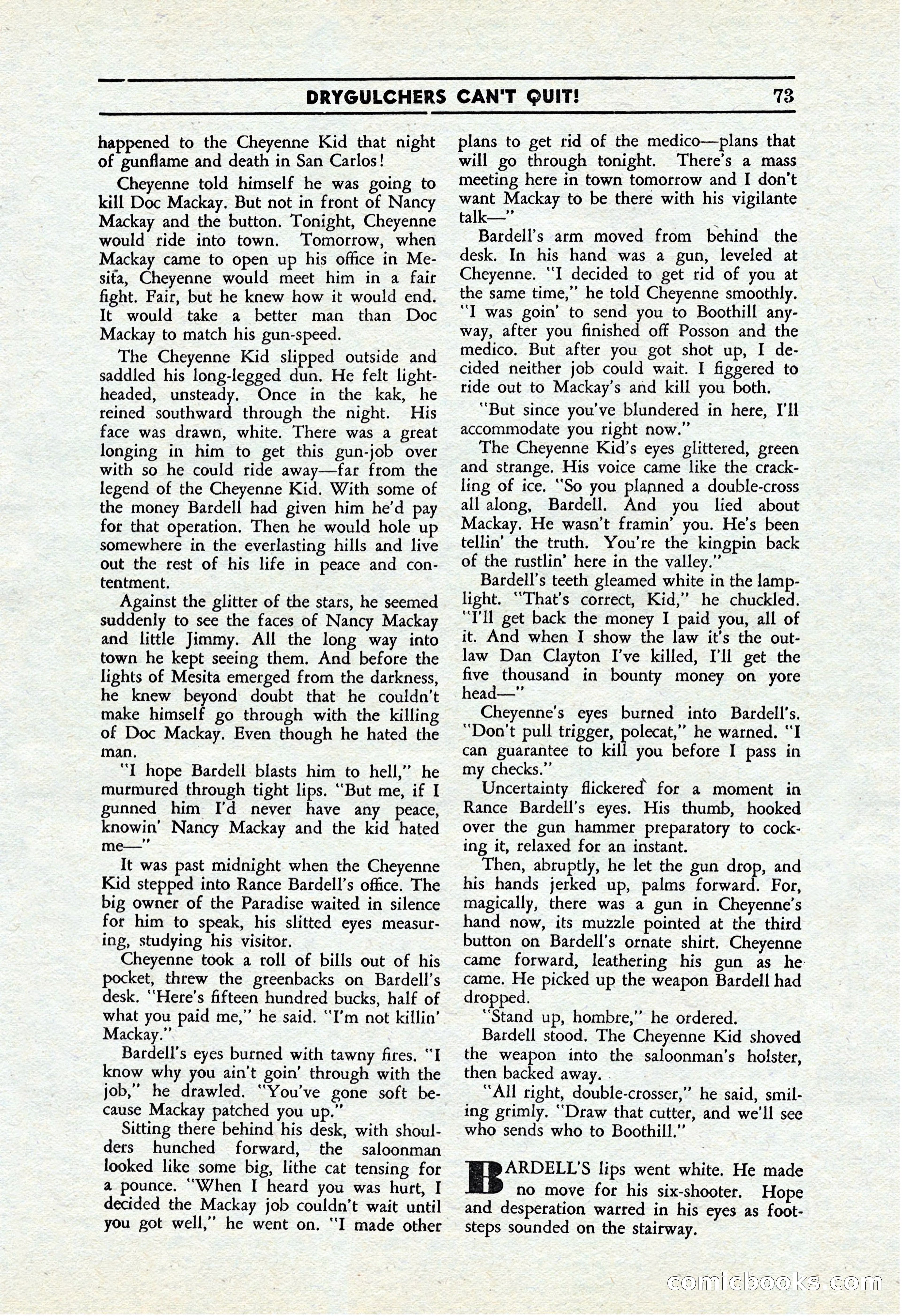
A restored page from Pulp Fiction, 1939. Page through the whole issue in the reader above.
📄 Transcribed text from this page (OCR, searchable)
Machine-transcribed from the original scan — historical spelling and the odd misread are preserved.
DRYGULCHERS CAN'T QUIT! happened to the Cheyenne Kid that night of gunflame and death in San Carlos! Cheyenne told himself he was going to kill Doc Mackay. But not in front of Nancy Mackay and the button. Tonight, Cheyenne would ride into town. Tomorrow, when Mackay came to open up his office in Me- sita, Cheyenne would meet him in a fair fight. Fair, but he knew how it would end. It would take a better man than Doc Mackay to match his gun-speed. The Cheyenne Kid slipped outside and saddled his long-legged dun. He felt light- headed, unsteady. Once in the kak, he reined southward through the night. His face was drawn, white. There was a great longing in him to get this gun-job over with so he could ride away—far from the legend of the Cheyenne Kid. With some of the money Bardell had given him he’d pay for that operation. Then he would hole up somewhere in the everlasting hills and live out the rest of his life in peace and con- tentment. Against the glitter of the stars, he seemed suddenly to see the faces of Nancy Mackay and little Jimmy. All the long way into town he kept seeing them. And before the lights of Mesita emerged from the darkness, he knew beyond doubt that he couldn't make himself go through with the killing of Doc Mackay. Even though he hated the man. “I hope Bardell blasts him to hell,” he murmured through tight lips. “But me, if I gunned him I'd never have any peace, knowin’ Nancy Mackay and the kid hated me—’’ It was past midnight when the Cheyenne Kid stepped into Rance Bardell’s office. The big owner of the Paradise waited in silence for him to speak, his slitted eyes measur- ing, studying his visitor. Cheyenne took a roll of bills out of his pocket, threw the greenbacks on Bardell’s desk. “‘Here’s fifteen hundred bucks, half of what you paid me,” he said. “I’m not killin’ Mackay.” Bardell’s eyes burned with tawny fires. “I know why you ain’t goin’ through with the job,” he drawled. “You've gone soft be- cause Mackay patched you up.” Sitting there behind his desk, with shoul- dets hunched forward, the saloonman looked like some big, lithe cat tensing for a pounce. “When I heard you was hurt, I decided the Mackay job couldn’t wait until you got well,” he went on. “I made other 73 plans to get rid of the medico—plans that will go through tonight. There’s a mass meeting here in town tomorrow and I don’t want Mackay to be there with his vigilante talk—” : Bardell’s arm moved from behind the desk. In his hand was a gun, leveled at Cheyenne. “I decided to get rid of you at the same time,’’ he told Cheyenne smoothly. “I was goin’ to send you to Boothill any- way, after you finished off Posson and the medico, But after you got shot up, I de- cided neither job could wait. I figgered to ride out to Mackay’s and kill you both. ‘But since you’ve blundered in here, I'll accommodate you right now.” The Cheyenne Kid's eyes glittered, green and strange. His voice came like the crack- ling of ice. “So you planned a double-cross all along, Bardell. And you lied about Mackay. He wasn’t framin’ you. He’s been tellin’ the truth. You're the kingpin back of the rustlin’ here in the valley.” Bardell’s teeth gleamed white in the lamp- light. ““That’s correct, Kid,’ he chuckled. “Til get back the money I paid you, all of it. And when I show the law it’s the out- law Dan Clayton I’ve killed, I'll get the five thousand in bounty money on yore head—”’ Cheyenne’s eyes burned into Bardell’s. “Don't pull trigger, polecat,’’ he warned. “I can guarantee to kill you before I pass in my checks.” Uncertainty flickered for a moment in Rance Bardell’s eyes. His thumb, hooked over the gun hammer preparatory to cock- ing it, relaxed for an instant. Then, abruptly, he let the gun drop, and his hands jerked up, palms forward. For, magically, there was a gun in Cheyenne’s hand now, its muzzle pointed at the third button on Bardell’s ornate shirt. Cheyenne came forward, leathering his gun as he came. He picked up the weapon Bardell had dropped. “Stand up, hombre,” he ordered. Bardell stood. The Cheyenne Kid shoved the weapon into the saloonman’s holster, then backed away. . “AIL right, double-crosser,” he said, smil- ing grimly, “Draw that cutter, and we'll see who sends who to Boothill.” | | Seen lips went white. He made no move for his six-shooter. Hope and desperation warred in his eyes as foot- steps sounded on the stairway. CoOnniclooo (C@