
Pulp Fiction, 1939 · page 61 of 114
Cowboy Short Stories, November 1939 — page 61: what you’re looking at
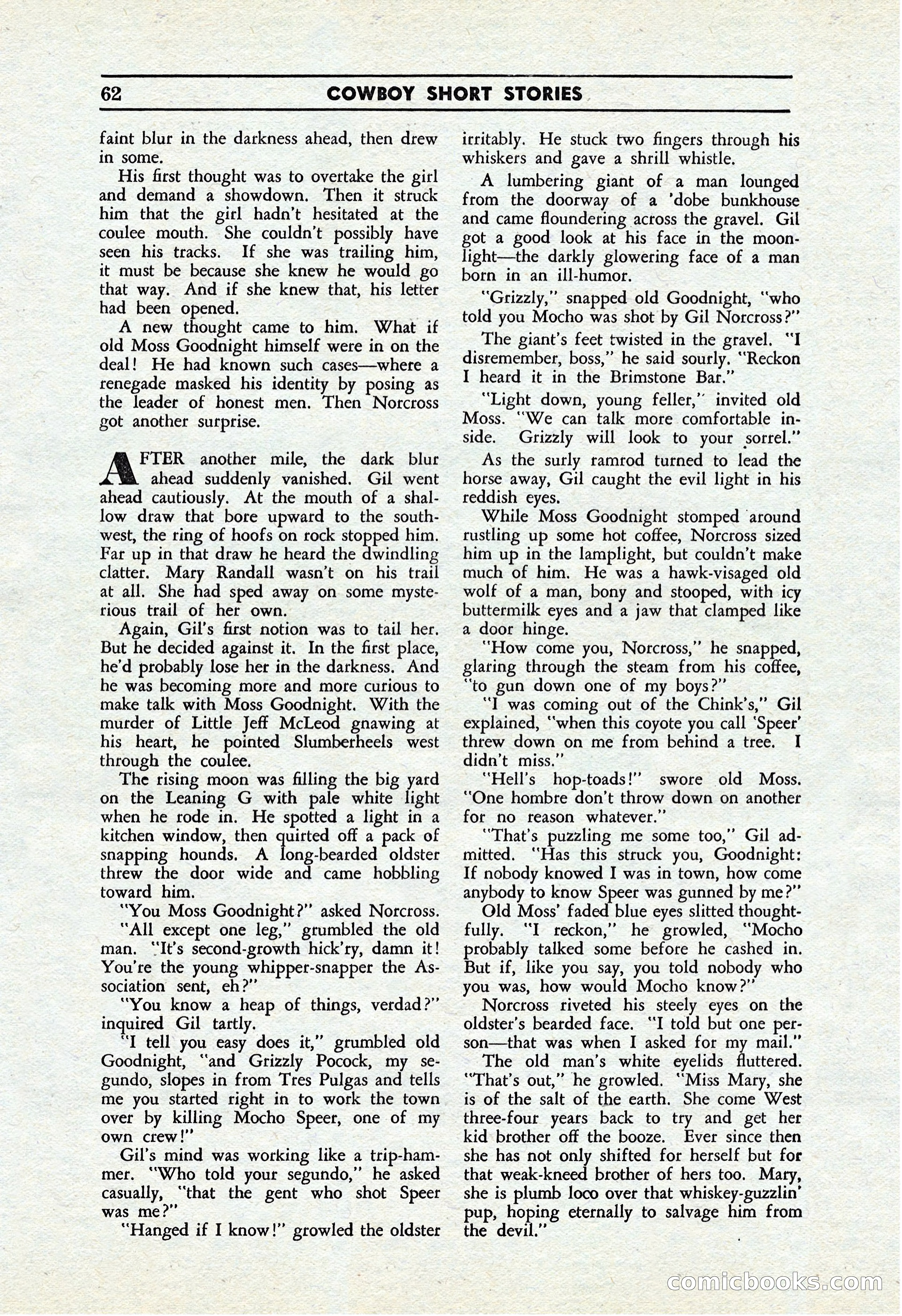
A restored page from Pulp Fiction, 1939. Page through the whole issue in the reader above.
📄 Transcribed text from this page (OCR, searchable)
Machine-transcribed from the original scan — historical spelling and the odd misread are preserved.
62 COWBOY SHORT STORIES faint blur in the darkness ahead, then drew in some. His first thought was to overtake the girl and demand a showdown. Then it struck him that the girl hadn’t hesitated at the coulee mouth. She couldn’t possibly have seen his tracks. If she was trailing him, it must be because she knew he would go that way. And if she knew that, his letter had been opened. A new thought came to him. What if old Moss Goodnight himself were in on the deal! He had known such cases—where a renegade masked his identity by posing as the leader of honest men. Then Norcross got another surprise. FTER another mile, the dark blur ahead suddenly vanished. Gil went ahead cautiously. At the mouth of a shal- low draw that bore upward to the south- west, the ring of hoofs on rock stopped him. Far up in that draw he heard the dwindling clatter. Mary Randall wasn’t on his trail at all. She had sped away on some myste- rious trail of her own. : Again, Gil’s first notion was to tail her. But he decided against it. In the first place, he'd probably lose her in the darkness. And he was becoming more and mote curious to make talk with Moss Goodnight. With the murder of Little Jeff McLeod gnawing at his heart, he pointed Slumberheels west through the coulee. The rising moon was filling the big yard on the Leaning G with pale white light when he rode in. He spotted a light in a kitchen window, then quirted off a pack of snapping hounds. A long-bearded oldster threw the door wide and came hobbling toward him. “You Moss Goodnight?” asked Norcross. “All except one leg,” grumbled the old man. “It’s second-growth hick’ry, damn it! You're the young whipper-snapper the As- sociation sent, eh?” ‘You know a heap of things, verdad?” inquired Gil tartly. “I tell you easy does it,” grumbled old Goodnight, ‘and Grizzly Pocock, my _ se- gundo, slopes in from Tres Pulgas and tells me you started right in to work the town over by killing Mocho Speer, one of my own crew!” Gil’s mind was working like a trip-ham- mer. “Who told your segundo,” he asked casually, “that the gent who shot Speer was me?” “Hanged if I know!” growled the oldster irritably. He stuck two fingers through his whiskers and gave a shrill whistle. A lumbering giant of a man lounged from the doorway of a ‘dobe bunkhouse and came floundering actoss the gravel. Gil got a good look at his face in the moon- light—the darkly glowering face of a man born in an ill-humor. “Grizzly,” snapped old Goodnight, “who told you Mocho was shot by Gil Norcross ?”’ The giant’s feet twisted in the gravel. “I disremember, boss,” he said sourly. ‘‘Reckon I heard it in the Brimstone Bar.” “Light down, young feller,’’ invited old Moss. ‘““We can talk more comfortable in- side. Grizzly will look to your sorrel.” As the surly ramrod turned to lead the horse away, Gil caught the evil light in his reddish eyes. While Moss Goodnight stomped ‘around rustling up some hot coffee, Norcross sized him up in the lamplight, but couldn’t make much of him. He was a hawk-visaged old wolf of a man, bony and stooped, with icy buttermilk eyes and a jaw that clamped like a door hinge. ‘How come you, Norcross,” he snapped, glaring through the steam from his coffee, “to gun down one of my boys?” “I was coming out of the Chink’s,” Gil explained, “when this coyote you call ‘Speer’ threw down on me from behind a tree. I didn’t miss.” “Hell’s hop-toads!”” swore old Moss. “One hombre don’t throw down on another for no reason whatever.” ‘That's puzzling me some too,”’ Gil ad- mitted. “Has this struck you, Goodnight: If nobody knowed I was in town, how come anybody to know Speer was gunned by me?” Old Moss’ faded blue eyes slitted thought- fully. ‘I reckon,” he growled, “Mocho probably talked some before he cashed in. But if, like you say, you told nobody who you was, how would Mocho know?” Norcross riveted his steely eyes on the oldster’s bearded face. “I told but one per- son—that was when I asked for my mail.” The old man’s white eyelids fluttered. “That’s out,’ he growled. ‘Miss Mary, she is of the salt of the earth. She come West three-four years back to try and get her kid brother off the booze. Ever since then she has not only shifted for herself but for that weak-kneed brother of hers too. Mary, she is plumb loco over that whiskey-guzzlin’ pup, hoping eternally to salvage him from the devil.” CoOnniclooo S (©