
Pulp Fiction, 1955 · page 92 of 101
15 Western Short Stories — page 92: what you’re looking at
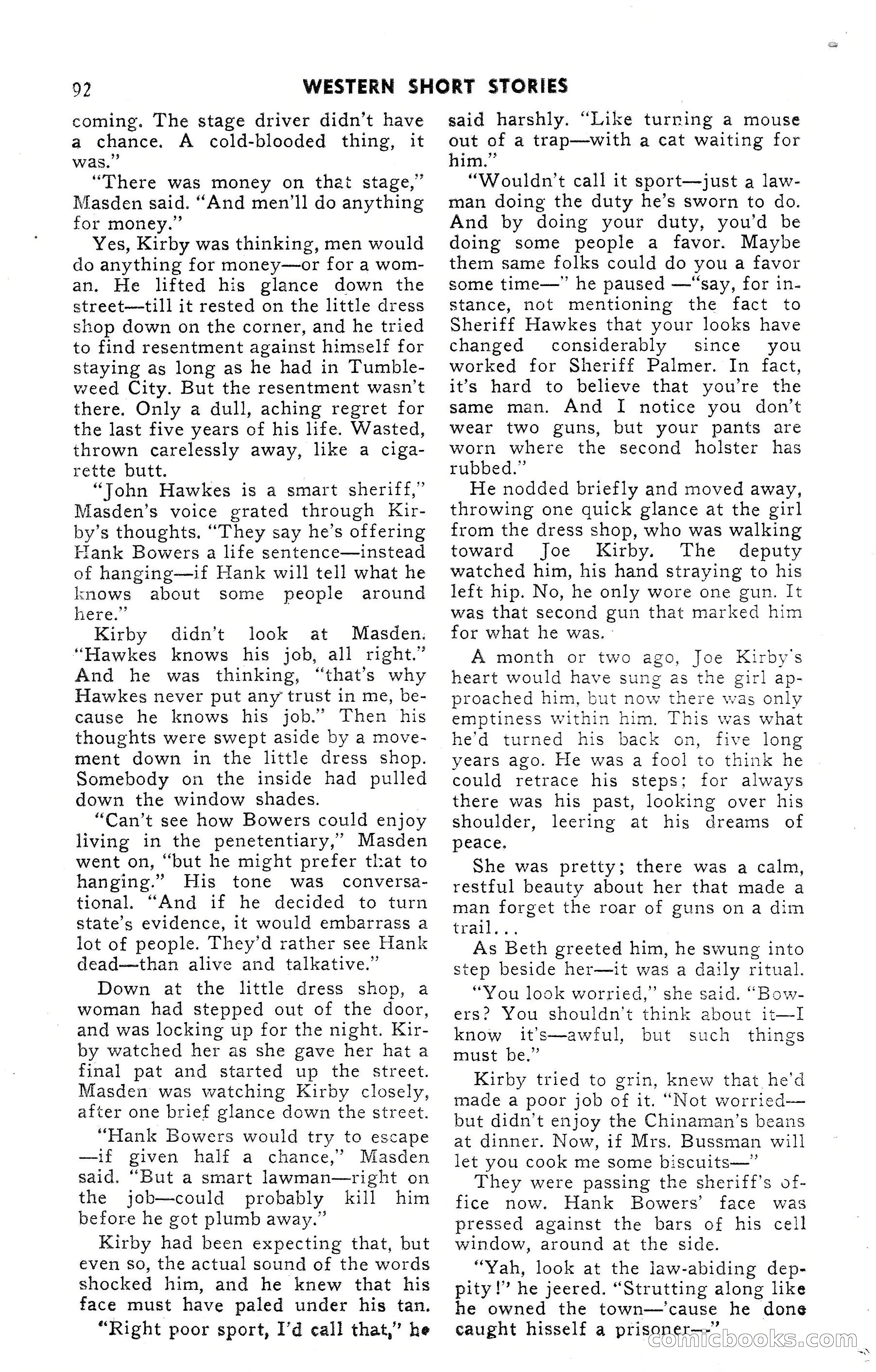
A restored page from Pulp Fiction, 1955. Page through the whole issue in the reader above.
📄 Transcribed text from this page (OCR, searchable)
Machine-transcribed from the original scan — historical spelling and the odd misread are preserved.
92 WESTERN SHORT STORIES coming. The stage driver didn’t have a chance. A cold-blooded thing, it was.” “There was money on that stage,” IMasden said. “And men’ll do anything for money.” Yes, Kirby was thinking, men would do anything for money—or for a wom- an. He lifted his glance down the street—till it rested on the little dress shop down on the corner, and he tried to find resentment against himself for staying as long as he had in Tumble- weed City. But the resentment wasn’t there. Only a dull, aching regret for the last five years of his life. Wasted, thrown carelessly away, like a ciga- rette butt. “John Hawkes is a smart sheriff,” Masden’s voice grated through Kir- by’s thoughts. “They say he’s offering Flank Bowers a life sentence—instead of hanging—if Hank will tell what he knows about some people around here.” Kirby didn’t look at Masden. “Hawkes knows his job, all right.” And he was thinking, “that’s why Hawkes never put any trust in me, be- cause he knows his job.” Then his thoughts were swept aside by a move- ment down in the little dress shop. Somebody on the inside had pulled down the window shades. “Can’t see how Bowers could enjoy living in the penetentiary,’ Masden went on, “but he might prefer that to hanging.” His tone was conversa- tional. “And if he decided to turn state’s evidence, it would embarrass a lot of people. They’d rather see Hank dead—than alive and talkative.” Down at the little dress shop, a woman had stepped out of the door, and was locking up for the night. Kir- by watched her as she gave her hat a final pat and started up the street. Masden was watching Kirby closely, after one brief glance down the street. “Hank Bowers would try to escape —if given half a chance,’ Masden said. “But a smart lawman—right on the job—could probably kill him before he got plumb away.” Kirby had been expecting that, but even so, the actual sound of the words shocked him, and he knew that his face must have paled under his tan. “Right poor sport, I’d call that,” he said harshly. “Like turning a mouse out of a trap—with a cat waiting for him.” “Wouldn’t call it sport—just a law- man doing the duty he’s sworn to do. And by doing your duty, you’d be doing some people a favor. Maybe them same folks could do you a favor some time—” he paused —“‘say, for in- stance, not mentioning the fact to Sheriff Hawkes that your looks have changed considerably since you worked for Sheriff Palmer. In fact, it’s hard to believe that you’re the same man. And I notice you don’t wear two guns, but your pants are worn where the second holster has rubbed.” He nodded briefly and moved away, throwing one quick glance at the girl from the dress shop, who was walking toward Joe Kirby. The deputy watched him, his hand straying to his left hip. No, he only wore one gun. It was that second gun that marked him for what he was. ° A month or two ago, Joe Kirby's heart would have sung as the girl ap- proached him, but now there was only emptiness within him, This was what he’d turned his back on, five long years ago. He was a fool to think he could retrace his steps; for always there was his past, looking over his shoulder, leering at his dreams of peace. She was pretty; there was a calm, restful beauty about her that made a man forget the roar of guns on a dim trail... As Beth greeted him, he swung into step beside her—it was a daily ritual. “You look worried,” she said. ‘“Bow- ers? You shouldn't think about it—I know it's—awful, but such things must be.” Kirby tried to grin, knew that_he’d made a poor job of it. “Not worried— but didn’t enjoy the Chinaman’s beans at dinner. Now, if Mrs. Bussman will let you cook me some biscuits—” They were passing the sheriff’s of- fice now. Hank Bowers’ face was pressed against the bars of his cell window, around at the side. “Yah, look at the law-abiding dep- pity!” he jeered. “Strutting along like he owned the town—’cause he done caught hisself a prisoner=- = GDOOKShEO