
Pulp Fiction, 1955 · page 45 of 101
15 Western Short Stories — page 45: what you’re looking at
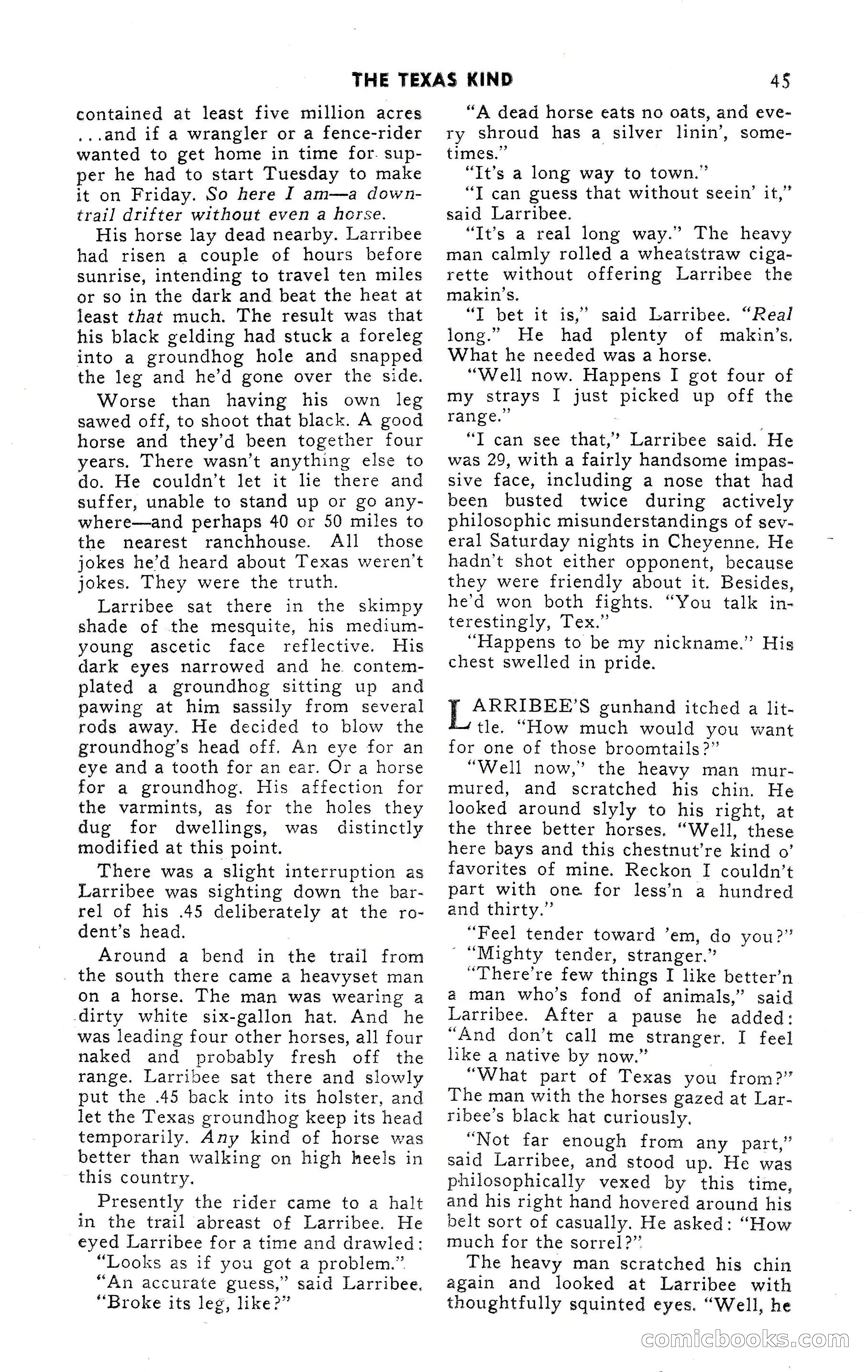
A restored page from Pulp Fiction, 1955. Page through the whole issue in the reader above.
📄 Transcribed text from this page (OCR, searchable)
Machine-transcribed from the original scan — historical spelling and the odd misread are preserved.
THE TEXAS KIND contained at least five million acres ...and if a wrangler or a fence-rider wanted to get home in time for. sup- per he had to start Tuesday to make it on Friday. So here I am—a down- trail drifter without even a herse. His horse lay dead nearby. Larribee had risen a couple of hours before sunrise, intending to travel ten miles or so in the dark and beat the heat at least that much. The result was that his black gelding had stuck a foreleg into a groundhog hole and snapped the leg and he’d gone over the side. Worse than having his own leg sawed off, to shoot that black. A good horse and they’d been together four years. There wasn’t anything else to do. He couldn’t let it lie there and suffer, unable to stand up or go any- where—and perhaps 40 or 50 miles to the nearest ranchhouse. All those jokes he’d heard about Texas weren't jokes. They were the truth. Larribee sat there in the skimpy shade of the mesquite, his medium- young ascetic face reflective. His dark eyes narrowed and he. contem- plated a groundhog sitting up and pawing at him sassily from several rods away. He decided to blow the groundhog’s head off. An eye for an eye and a tooth for an ear. Or a horse for a groundhog. His affection for the varmints, as for the holes they dug for dwellings, was distinctly modified at this point. There was a slight interruption as Larribee was sighting down the bar- rel of his .45 deliberately at the ro- dent’s head. Around a bend in the trail from . the south there came a heavyset man on a horse. The man was wearing a dirty white six-gallon hat. And he was leading four other horses, all four naked and probably fresh off the range. Larribee sat there and slowly put the .45 back into its holster, and let the Texas groundhog keep its head temporarily. Any kind of horse was better than walking on high heels in this country. Presently the rider came to a halt in the trail abreast of Larribee. He eyed Larribee for a time and drawled: “Looks as if you got a problem.” “An accurate guess,” said Larribee. “Broke its leg, like?” 45 “A dead horse eats no oats, and eve- ry shroud has a silver linin’, some- times.” “It’s a long way to town.” “I can guess that without seein’ it,” said Larribee. “It’s a real long way.” The heavy man calmly rolled a wheatstraw ciga- rette without offering Larribee the makin’s. | “T bet it is,’ said Larribee. “Real long.” He had plenty of makin’s. What he needed was a horse. “Well now. Happens I got four of my strays I just picked up off the range.” : “T can see that,’ Larribee said. He was 29, with a fairly handsome impas- sive face, including a nose that had been busted twice during actively philosophic misunderstandings of sev- eral Saturday nights in Cheyenne. He hadn’t shot either opponent, because they were friendly about it. Besides, he'd won both fights. “You talk in- terestingly, Tex.” “Happens to be my nickname.” His chest swelled in pride. | Faraai ese gunhand itched a lit- tle. “How much would you want for one of those broomtails 2” “Well now,’ the heavy man mur- mured, and scratched his chin. He looked around slyly to his right, at the three better horses. “Well, these here bays and this chestnut’re kind o’ favorites of mine. Reckon I couldn’t part with one for less’n a hundred and thirty.” “Feel tender toward ’em, do you?” “Mighty tender, stranger.” “There’re few things I like better’n a man who’s fond of animals,” said Larribee. After a pause he added: “And don’t call me stranger. I feel like a native by now.” . “What part of Texas you from?” The man with the horses gazed at Lar- ribee’s black hat curiously. “Not far enough from any part,” said Larribee, and stood up. He was philosophically vexed by this time, and his right hand hovered around his belt sort of casually. He asked: “How much for the sorrel?” The heavy man scratched his chin again and looked at Larribee with thoughtfully squinted eyes. “Well, he CoMmiclboo nn S CO