
Pulp Fiction, 1955 · page 42 of 101
15 Western Short Stories — page 42: what you’re looking at
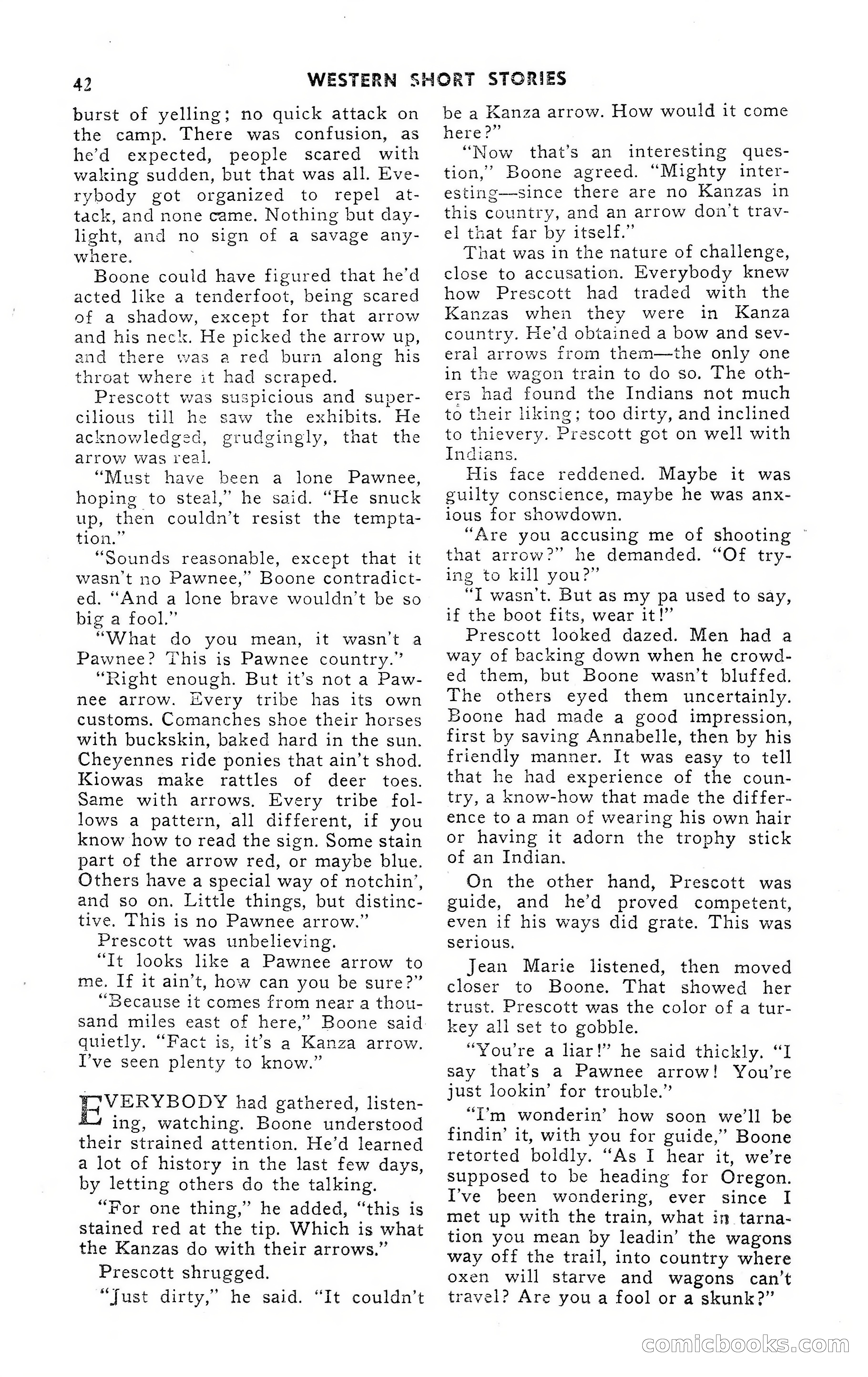
A restored page from Pulp Fiction, 1955. Page through the whole issue in the reader above.
📄 Transcribed text from this page (OCR, searchable)
Machine-transcribed from the original scan — historical spelling and the odd misread are preserved.
42 burst of yelling; no quick attack on the camp. There was confusion, as he’d expected, people scared with waking sudden, but that was all. Eve- rybody got organized to repel at- tack, and none came. Nothing but day- light, and no sign of a savage any- where. Boone could have figured that he’d acted like a tenderfoot, being scared of a shadow, except for that arrow and his neck. He picked the arrow up, and there was a red burn along his throat where it had scraped. Prescott was suspicious and super- cilious till he saw the exhibits. He acknowledged, grudgingly, that the arrow was real. “Must have been a lone Pawnee, hoping to steal,” he said. “He snuck up, then couldn’t resist the tempta- tion.” “Sounds reasonable, except that it wasn't no Pawnee,” Boone contradict- ed. “And a lone brave wouldn't be so big a fool.” “What do you mean, it wasn’t a Pawnee? This is Pawnee country.” “Right enough. But it’s not a Paw- nee arrow. very tribe has its own customs. Comanches shoe their horses with buckskin, baked hard in the sun. Cheyennes ride ponies that ain’t shod. Kiowas make rattles of deer toes. Same with arrows. Every tribe fol- lows a pattern, all different, if you know how to read the sign. Some stain part of the arrow red, or maybe blue. Others have a special way of notchin’, and so on. Little things, but distinc- tive. This is no Pawnee arrow.” Prescott was unbelieving. “It looks like a Pawnee arrow to me. If it ain’t, how can you be sure?” “Because it comes from near a thou- sand miles east of here,’ Boone said quietly. “Fact is, it’s a Kanza arrow. I’ve seen plenty to know.” | Eee had gathered, listen- ing, watching. Boone understood their strained attention. He’d learned a lot of history in the last few days, by letting others do the talking. “For one thing,” he added, “this is stained red at the tip. Which is what the Kanzas do with their arrows.” Prescott shrugged. “Just dirty,” he said. “It couldn’t WESTERN SHORT STORIES be a Kanza arrow. How would it come ere?” “Now that’s an interesting ques- tion,’ Boone agreed. “Mighty inter- esting—since there are no Kanzas in this country, and an arrow don't trav- el that far by itself.” That was in the nature of challenge, close to accusation. Everybody knew how Prescott had traded with the Kanzas when they were in Kanza country. He’d obtained a bow and sev- eral arrows from them—the only one in the wagon train to do so. The oth- ers had found the Indians not much to their liking; too dirty, and inclined to thievery. Prescott got on well with Indians. His face reddened. Maybe it was gullty conscience, maybe he was anx- ious for showdown. “Are you accusing me of shooting © that arrow?” he demanded. “Of try- ing to kill you?” “T wasn’t. But as my pa used to say, if the boot fits, wear it!” Prescott looked dazed. Men had a way of backing down when he crowd- ed them, but Boone wasn’t bluffed. The others eyed them uncertainly. Boone had made a good impression, first by saving Annabelle, then by his friendly manner. It was easy to tell that he had experience of the coun- try, a know-how that made the differ- ence to a man of wearing his own hair or having it adorn the trophy stick of an Indian. On the other hand, Prescott was guide, and he’d proved competent, even if his ways did grate. This was serious, Jean Marie listened, then moved closer to Boone. That showed her trust. Prescott was the color of a tur- key all set to gobble. “You're a liar!” he said thickly. “I say that’s a Pawnee arrow! You're just lookin’ for trouble.” “I’m wonderin’ how soon we’ll be findin’ it, with you for guide,” Boone retorted boldly. “As I hear it, we’re supposed to be heading for Oregon. I’ve been wondering, ever since I met up with the train, what in tarna- tion you mean by leadin’ the wagons way off the trail, into country where oxen will starve and wagons can’t travel? Are you a fool or a skunk?” CoMmiclboo S CO