
Pulp Fiction, 1955 · page 13 of 101
15 Western Short Stories — page 13: what you’re looking at
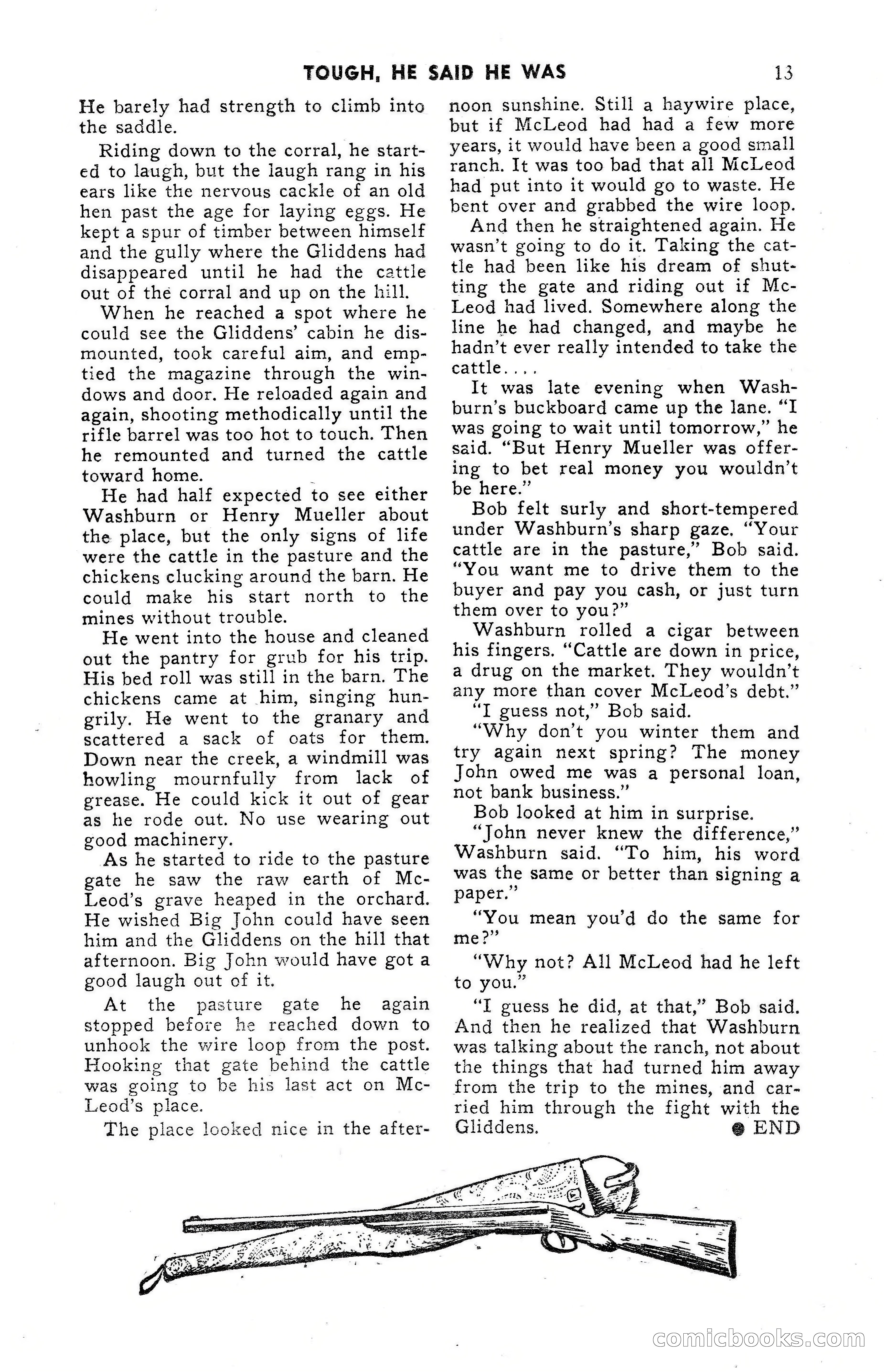
A restored page from Pulp Fiction, 1955. Page through the whole issue in the reader above.
📄 Transcribed text from this page (OCR, searchable)
Machine-transcribed from the original scan — historical spelling and the odd misread are preserved.
TOUGH, HE SAID HE WAS He barely had strength to climb into the saddle. Riding down to the corral, he start- ed to laugh, but the laugh rang in his ears like the nervous cackle of an old hen past the age for laying eggs. He kept a spur of timber between himself and the gully where the Gliddens had disappeared until he had the cattle out of the corral and up on the hill. When he reached a spot where he could see the Gliddens’ cabin he dis- mounted, took careful aim, and emp- tied the magazine through the win- dows and door. He reloaded again and again, shooting methodically until the rifle barrel was too hot to touch. Then he remounted and turned the cattle toward home. ; He had half expected to see either Washburn or Henry Mueller about the place, but the only signs of life were the cattle in the pasture and the chickens clucking around the barn. He could make his start north to the mines without trouble. He went into the house and cleaned out the pantry for grub for his trip. His bed roll was still in the barn. The chickens came at him, singing hun- grily. He went to the granary and scattered a sack of oats for them. Down near the creek, a windmill was howling mournfully from lack of grease. He could kick it out of gear as he rode out. No use wearing out good machinery. As he started to ride to the pasture gate he saw the raw earth of Mc- Leod’s grave heaped in the orchard. He wished Big John could have seen him and the Gliddens on the hill that afternoon. Big John would have gota good laugh out of it. At the pasture gate he again stopped before he reached down to unhook the wire loop from the post. Hooking that gate behind the cattle was going to be his last act on Mc- Leod’s place. The place loo q KE d nice in the after- 13 noon sunshine. Still a haywire place, but if McLeod had had a few more years, it would have been a good small ranch. It was too bad that all McLeod had put into it would go to waste. He bent over and grabbed the wire loop. And then he straightened again. He wasn't going to do it. Taking the cat- tle had been like his dream of shut- ting the gate and riding out if Mc- Leod had lived. Somewhere along the line he had changed, and maybe he hadn’t ever really intended to take the cattle.... It was late evening when Wash- burn’s buckboard came up the lane. “I was going to wait until tomorrow,” he said. “But Henry Mueller was offer- ing to bet real money you wouldn't be here.” Bob felt surly and short-tempered under Washburn’s sharp gaze, “Your cattle are in the pasture,’ Bob said. “You want me to drive them to the buyer and pay you cash, or just turn them over to you?” Washburn rolled a cigar between his fingers. “Cattle are down in price, a drug on the market. They wouldn’t any more than cover McLeod’s debt.” “T guess not,” Bob said. “Why don’t you winter them and try again next spring? The money John owed me was a personal loan, not bank business.” Bob looked at him in surprise. “John never knew the difference,” Washburn said. “To him, his word was the same or better than signing a paper.” “You mean you'd do the same for me?” “Why not? All McLeod had he left to you.” “I guess he did, at that,” Bob said. And then he realized that Washburn was talking about the ranch, not about the things that had turned him away from the trip to the mines, and car- ried him through the fight with the Gliddens. @ END COMiclooo (CO