
Pulp Fiction, 1950 · page 91 of 132
15 Story Detective, April 1950 — page 91: what you’re looking at
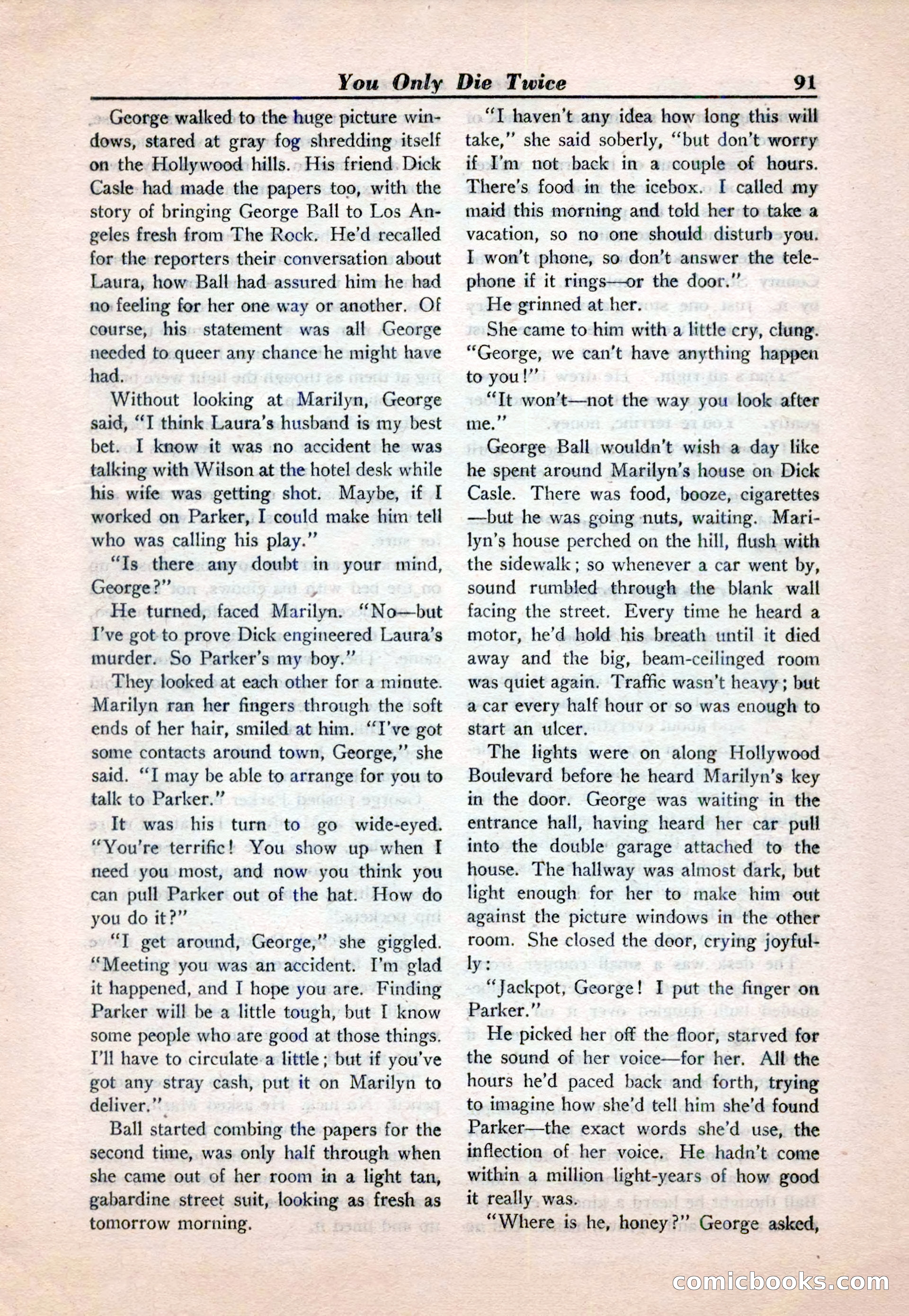
A restored page from Pulp Fiction, 1950. Page through the whole issue in the reader above.
📄 Transcribed text from this page (OCR, searchable)
Machine-transcribed from the original scan — historical spelling and the odd misread are preserved.
You Only Die Twice George walked: to the huge picture win- dows, stared at gray fog shredding. itself on the Hollywood hills. His friend. Dick Casle had made the papers too, with the story of bringing George Ball to Los An- geles fresh from The Reck. He’d recalled for the reporters their conversation about Laura, how Ball had assured him he had no feeling for her one way or another. Of course, his statement was all George needed to queer any chance he might have had. Without looking at Marilyn, George said, “I think Laura’s husband is my best bet. I know it was no accident he was talking with Wilson at the hotel desk while his. wife was getting shot. Maybe, if I worked on Parker, I could make him tell who was calling his play.” “Is there any doubt in your mind, George?” ; He turned, faced Marilyn. “No—but I’ve got-to prove Dick engineered Laura’s murder. So Parker’s my boy.” They looked at each other for a minute. Marilyn ran her fingers through the soft ends of her hair, smiled at him. “I’ve got some contacts around town, George,’’ she said. “I may be able to arrange for you to talk to Parker.” It was his turn to go wide-eyed. “You're terrific! You show up when I need you most, and now you think you can pull Parker out of the hat. How do you do it?” “I get around, George,” she giggled. “Meeting you was an accident. I’m glad it happened, and I hope you are. Finding Parker will be a little tough, but I know some people who are good at those things. I'll have to circulate-a little; but if you've got any stray cash, put it on Marilyn to deliver,” Ball started combing the papers for the second time, was only half through when she came out of her room in a light tan, gabardine street suit, looking as fresh as tomorrow morning. 91 “T haven’t any idea how long this will take,”’ she said soberly, “but don’t worry if I’m not back in a couple of hours. There’s food in the icebox. I[ called my maid this morning and told her to take a vacation, so no one should disturb you. I won't phone, so. don’t answer the tele- phone if it rings—or the door.” He grinned at her. She came to him with a little ery, clung. “George, we can’t have anything happen to you!” “It won’t—not the way you look after me,” George Ball wouldn’t wish a day like he spent around Marilyn’s house on Dick Casle. There was food, booze, cigarettes —but he was going nuts, waiting. Mari- lyn’s house perched on the hill, flush with the sidewalk; so whenever a car went by, sound rumbled through the blank wall facing the street. Every time he heard a motor, he’d hold his breath until it died away and the big, beam-ceilinged room was quiet again. Traffic wasn’t heavy; but a car every half hour or so was enough to start an ulcer. The lights were on along Hollywood Boulevard before he heard Marilyn’s key in the door. George was waiting in the entrance hall, having heard her car pull into the double garage attached to the house. The hallway was almost dark, but light enough for her to make him out against the picture windows in the other room. She closed the door, crying joyful- ly: “Jackpot, George! I put the finger on Parker.” He picked her off the floor, starved for the sound of her voice—for her. All the hours he’d paced back and forth, trying to imagine how she’d tell him she’d found Parker—the exact words she’d use, the inflection of her voice. He hadn’t come within a million light-years of how good it really was. “Where is. he, honey?” George asked, EOPNICGLOOO “S) (E@)