
Pulp Fiction, 1950 · page 85 of 132
15 Story Detective, April 1950 — page 85: what you’re looking at
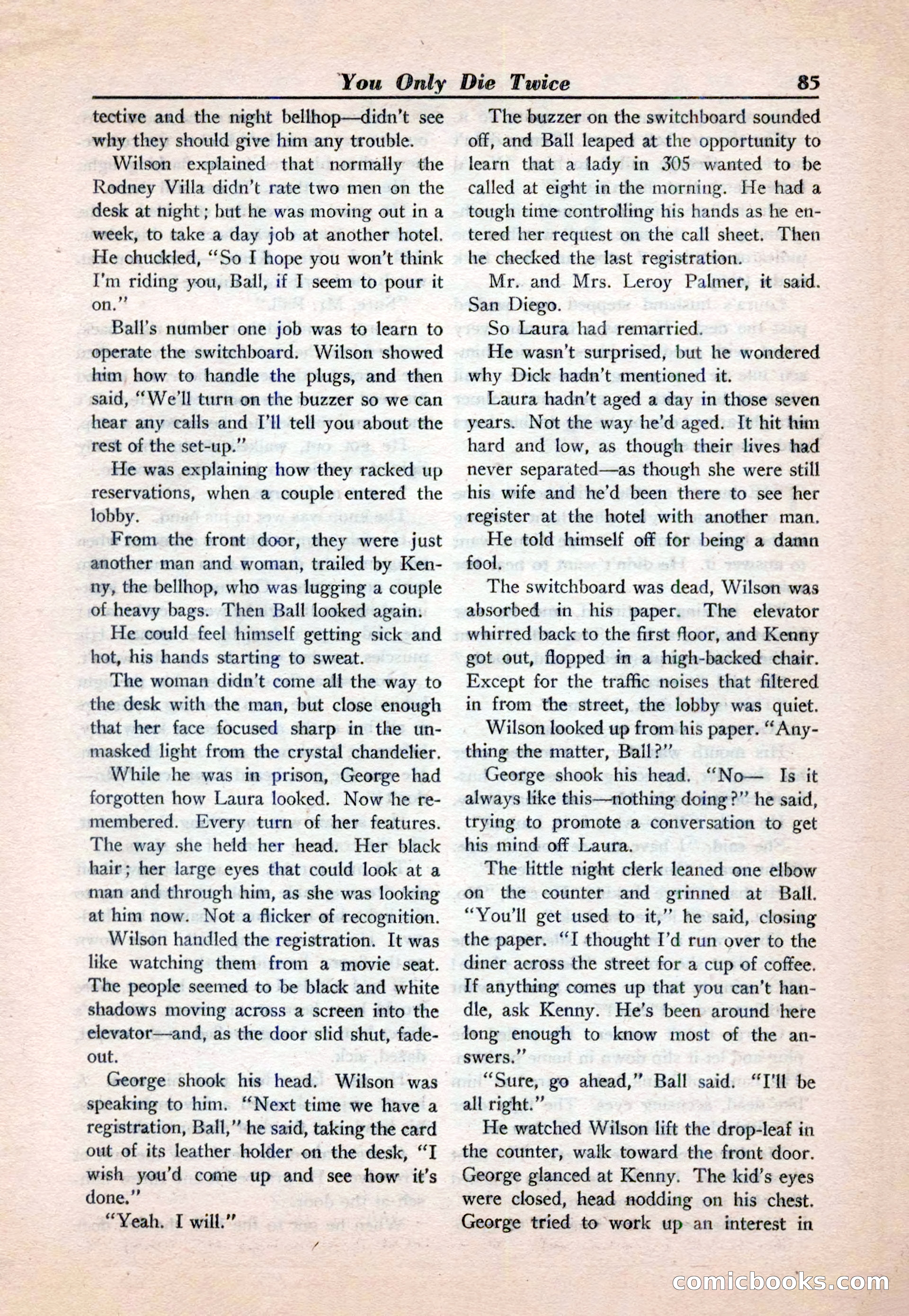
A restored page from Pulp Fiction, 1950. Page through the whole issue in the reader above.
📄 Transcribed text from this page (OCR, searchable)
Machine-transcribed from the original scan — historical spelling and the odd misread are preserved.
You Only Die Twice tective and the night bellhop—didn’t see why they should give him any trouble. Wilson explained that normally the Rodney Villa didn’t rate two men on the desk at night; but he was moving out in a week, to take a day job at another hotel. He chuckled, “So I hope you won’t think I'm riding you, Ball, if I seem to pour it on,”’ Ball’s number one job was to learn to operate the switchboard. Wilson showed him how to handle the plugs, and then said, ‘We'll turn on the buzzer so we can hear any calls and I'll tell you about the rest of the set-up.” He was explaining how they racked up reservations, when a couple entered the lobby. From the front door, they were just another man and woman, trailed by Ken- ny, the bellhop, who was lugging a couple of heavy bags. Then Ball looked again: He could feel himself getting sick and hot, his hands starting to sweat. The woman didn’t come all the way to the desk with the man, but close enough that her face focused sharp in the un- masked light from the crystal chandelier. While he was in prison, George had forgotten how Laura looked. Now he re- membered. Every turn of her features. The way she held her head. Her black hair; her large eyes that could look at a man and through him, as she was looking at him now. Not a flicker of recognition. Wilson handled the registration. It was like watching them from a movie seat. The people seemed to be black and white shadows moving across a screen into the elevator—and, as the door slid shut, fade- out. George shook his head. Wilson was speaking to him. “Next time we have a registration, Ball,” he said, taking the card out of its leather holder on the desk, “I wish you’d come up and see how it’s done,”’ “Yeah. I will.” 85 The buzzer on the switchboard sounded off, and Ball leaped at the opportunity to learn that a lady in 305 wanted to be called at eight in the morning. He had a tough time controlling his hands as he en- tered her request on the call sheet. Then he checked the last registration. Mr. and Mrs. Leroy Palmer, it said. San Diego. So Laura had remarried. He wasn’t surprised, but he wondered why Dick hadn’t mentioned it. Laura hadn’t aged a day in those seven years. Not the way he'd aged. It hit him hard and low, as though their lives had never separated—as though she were still his wife and he’d been there to see her register at the hotel with another man, He told himself off for being a damn fool. The switchboard was dead, Wilson was absorbed in his paper. The elevator whirred back to the first floor, and Kenny got out, flopped in a high-backed chair. Except for the traffic noises that filtered in from the street, the lobby was quiet. Wilson looked up from his paper. “Any- thing the matter, Ball?” George shook his head. “No— Is it always like this—nothing doing?” he said, trying to promote a conversation to get his mind off Laura. The little night clerk leaned one elbow on the counter and grinned at Ball. “You'll get used to it,” he said, closing the paper. “I thought I’d run over to the diner across the street for a cup of coffee. If anything comes up that you can’t han- dle, ask Kenny. He's been around here long enough to know most of the an- swers,”’ “Sure, go ahead,” Ball said. “I'll be all right.” He watched Wilson lift the drop-leaf in the counter, walk toward the front door. George glanced at Kenny. The kid’s eyes were closed, head nodding on his chest. George tried to work up an interest in ECOmichbooks Gol