
Pulp Fiction, 1950 · page 79 of 132
15 Story Detective, April 1950 — page 79: what you’re looking at
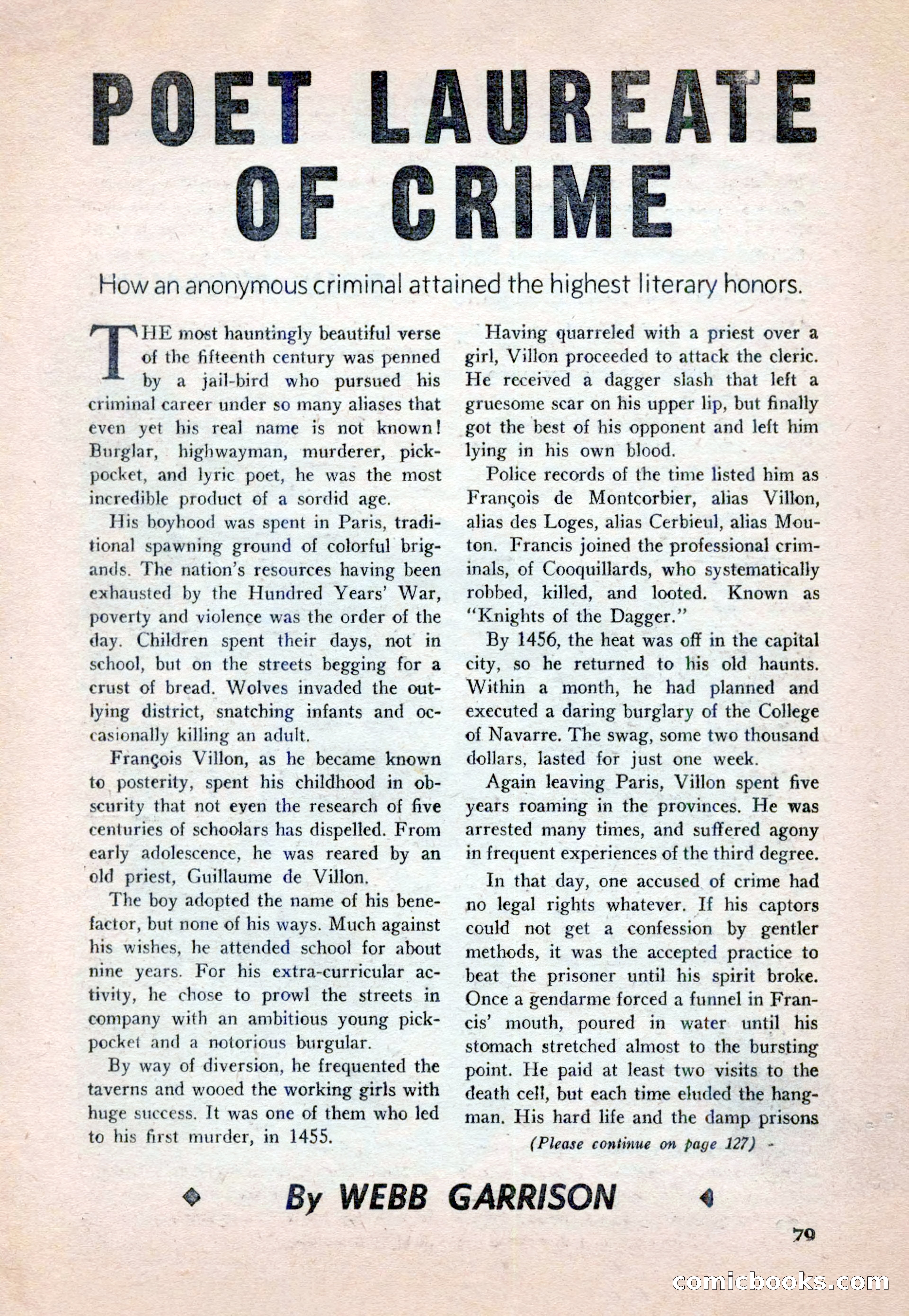
A restored page from Pulp Fiction, 1950. Page through the whole issue in the reader above.
📄 Transcribed text from this page (OCR, searchable)
Machine-transcribed from the original scan — historical spelling and the odd misread are preserved.
POET LAUREATE OF CRIME How an anonymous criminal attained the highest literary honors. of the fifteenth century was penned by a jail-bird who pursued his criminal career under so many aliases that even yet his real name is not known! Burglar, highwayman, murderer, pick- pocket, and lyric poet, he was the most ineredible product of a sordid age. His boyhood was spent in Paris, tradi- tional spawning ground of colorful brig- ands. The nation’s resources having been exhausted by the Hundred Years’ War, poverty and violence was the order of the day. Children spent their days, not in school, but on the streets begging for a erust of bread. Wolves invaded the out- lying district, snatching infants and oc- casionally killing an adult, Francois Villon, as he became known to posterity, spent his childhood in ob- security that not eyen the research of five centuries of schoolars has dispelled. From early adolescence, he was reared by an ‘old priest, Guillaume de Villon, The boy adopted the name of his bene- factor, but none of his ways. Much against his wishes, he attended school for about nine years. For his extra-curricular ac- tivity, he chose to prowl the streets in company with an ambitious young pick- pocket and a notorious burgular. By way of diversion, he frequented the taverns and wooed the working girls with huge success. It was one of them who led to his first murder, in 1455. Ter most hauntingly beautiful verse Having quarreled with a priest over a girl, Villon proceeded to attack the cleric. He received a dagger slash that left a gruesome scar on his upper lip, but finally got the best of his opponent and left him lying in his own blood. Police records of the time listed him as Francois de Montcorbier, alias Villon, alias des Loges, alias Cerbieul, alias Mou- ton. Francis joined the professional crim- inals, of Cooquillards, who systematically robbed, killed, and looted. Known as “Knights of the Dagger.” By 1456, the heat was off in the capital city, so he returned to his old haunts. Within a month, he had planned and executed a daring burglary of the College of Navarre. The swag, some two thousand dollars, lasted for just one week. Again leaving Paris, Villon spent five years roaming in the provinces. He was arrested many times, and suffered agony in frequent experiences of the third degree. In that day, one accused of crime had no legal rights whatever. If his captors could not get a confession by gentler methods, it was the accepted practice to beat the prisoner until his spirit broke. Once a gendarme forced a funnel in Fran- cis’ mouth, poured in water until his stomach stretched almost to the bursting point. He paid at least two visits to the death cell, but each time eluded the hang- man. His hard life and the damp prisons (Please continue on page 127) - © By WEBB GARRISON 4 79 EComichbooks (E@)