
Pulp Fiction, 1950 · page 6 of 132
15 Story Detective, April 1950 — page 6: what you’re looking at
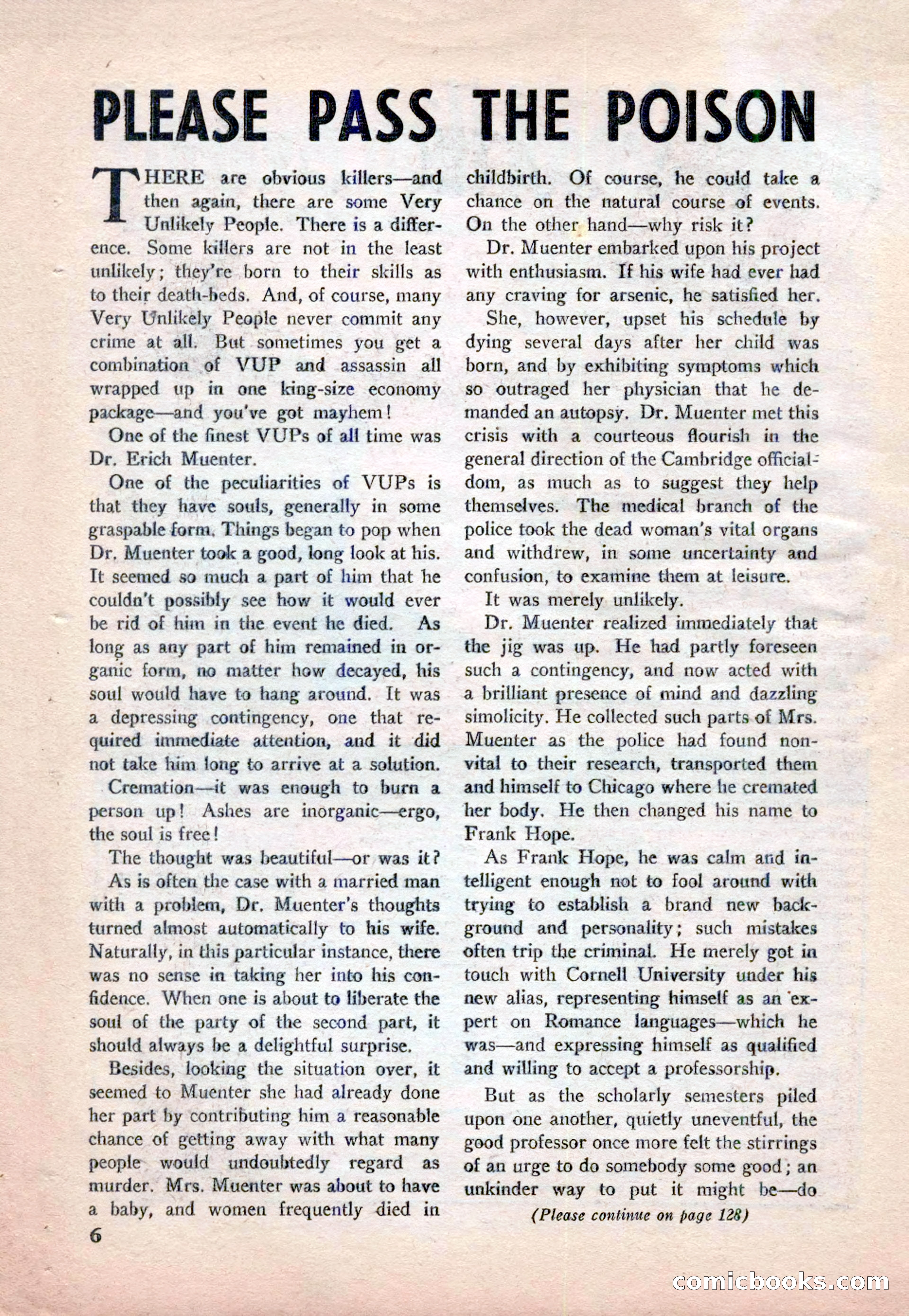
A restored page from Pulp Fiction, 1950. Page through the whole issue in the reader above.
📄 Transcribed text from this page (OCR, searchable)
Machine-transcribed from the original scan — historical spelling and the odd misread are preserved.
PLEASE PASS T tien are obvious killers—and then again, there are some Very Unlikely People. There is a differ- ence. Some killers are not in the least unlikely; they’re born to their skills as to their death-beds. And, of course, many Very Unlikely People never commit any crime at all. But sometimes you get a combination of VUP and assassin all wrapped up in one king-size economy package—and you've got mayhem! One of the finest VUPs of all time was Dr. Erich Muenter. One of the peculiarities of VUPs is that they have souls, generally in some graspable form, Things began to pop when Dr, Muenter took a good, long look at his. It seemed so much a part of him that he couldn’t possibly see how it would ever be rid of him in the event he died. As long as any part of him remained in or- ganic form, no matter how decayed, his soul would have to hang around. It was a depressing contingency, one that re- quired immediate attention, and it did not take him long to arrive at a solution. Cremation—it was enough to burn a person up! Ashes are inorganic—ergo, the soul is free! The thought was beautiful—or was it? As is often the case with a married man with a problem, Dr, Muenter’s thoughts turned almost automatically to his wife. Naturally, in this particular instance, there was no sense in taking her into his con- fidence. When one is about to liberate the soul of the party of the second part, it should always be a delightful surprise. Besides, looking the situation over, it seemed to Muenter she had already done her part by contributing him a reasonable chance of getting away with what many people would undoubtedly regard as murder. Mrs. Muenter was about to have a baby, and women frequently died in 6 THE POISON childbirth. Of course, he could take a chance on the natural course of events. On the other hand—why risk it? Dr. Muenter embarked upon his project with enthusiasm. If his wife had ever had any craving for arsenic, he satisfied her. She, however, upset his schedule by dying several days after her child was born, and by exhibiting symptoms which so outraged her physician that he de- manded an autopsy. Dr. Muenter met this crisis with a courteous flourish in the general direction of the Cambridge official- dom, as much as to suggest they help themselves. The medical branch of the police took the dead woman’s vital organs and withdrew, in some uncertainty and confusion, to examine them at leisure. It was merely unlikely. Dr. Muenter realized immediately that the jig was up. He had partly foreseen such a contingency, and now acted with a brilliant presence of mind and dazzling simolicity. He collected such parts.of Mrs. Muenter as the police had found non- vital to their research, transported them and himself to Chicago where lie cremated her body. He then changed his name to Frank Hope. As Frank Hope, he was calm atid in- telligent enough not to fool around with trying to establish a brand new back- ground and personality; such mistakes often trip the criminal. He merely got ia touch with Cornell University under his new alias, representing himself as an ‘ex- pert on Romance languages—which he was—and expressing himself as qualified and willing to accept a professorship. But as the scholarly semesters piled upon one another, quietly uneventful, the good professor once more felt the stirrings of an urge to do somebody some good; an unkinder way to put it might be—do (Please continue on page 128) COPMICLOOOKS (E(©)