
Pulp Fiction, 1950 · page 26 of 132
15 Story Detective, April 1950 — page 26: what you’re looking at
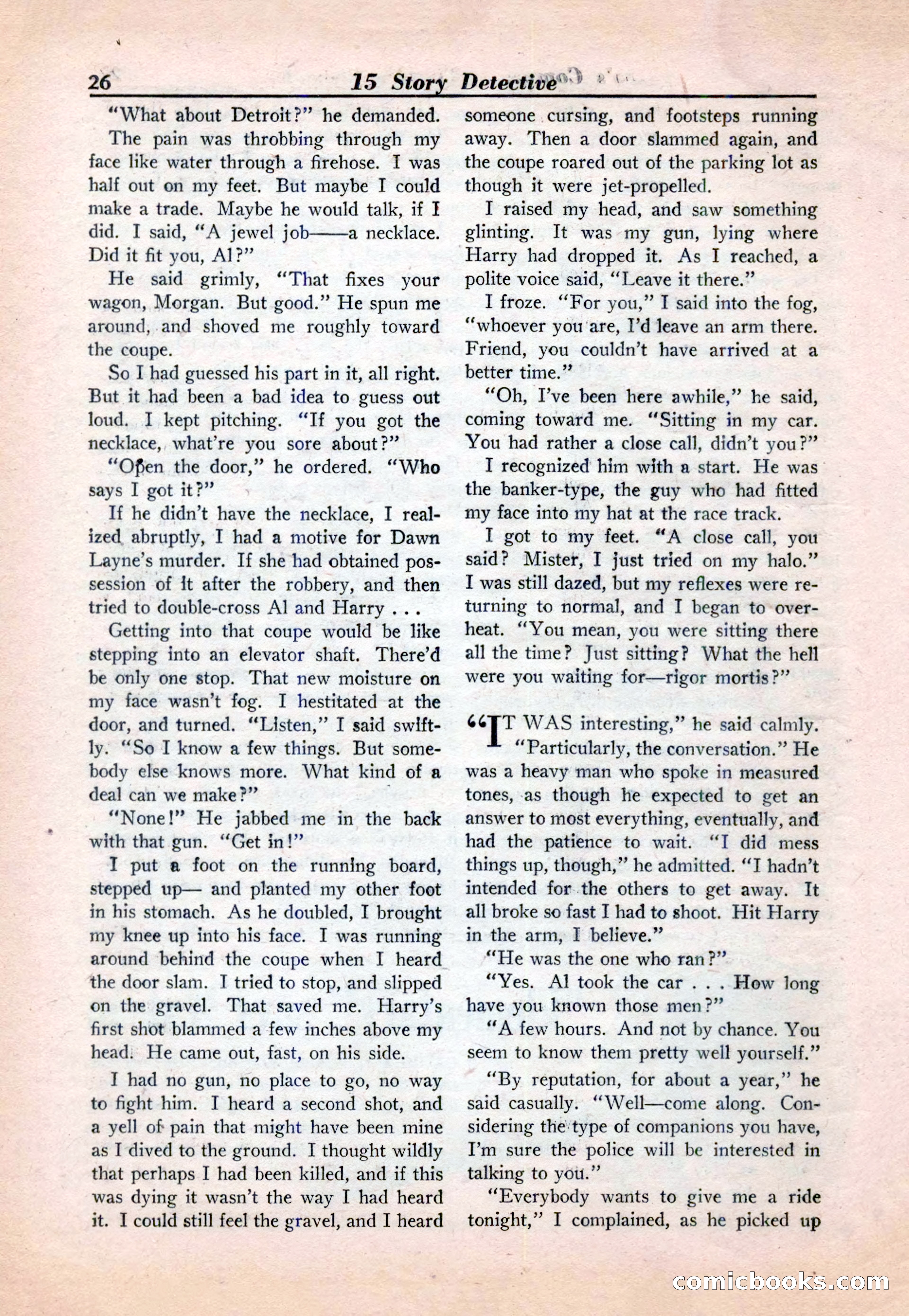
A restored page from Pulp Fiction, 1950. Page through the whole issue in the reader above.
📄 Transcribed text from this page (OCR, searchable)
Machine-transcribed from the original scan — historical spelling and the odd misread are preserved.
x 26 15 Story Detective”) * \: “What about Detroit?” he demanded. The pain was throbbing through my face like water through a firehose. I was half out on my feet. But maybe I could make a trade. Maybe he would talk, if I did. I said, “A jewel job a necklace. Did it fit you, Al?” He said grimly, “That fixes your wagon, Morgan. But good.” He spun me around, and shoved me roughly toward the coupe. So I had guessed his part in it, all right. But it had been a bad idea to guess out loud. I kept pitching. “If you got the necklace,, what’re you sore about?” “Often the door,” he ordered. “Who says I got it?” If he didn’t have the necklace, I real- ized abruptly, I had a motive for Dawn Layne’s murder. If she had obtained pos- session of it after the robbery, and then tried to double-cross Al and Harry... Getting into that coupe would be like stepping into an elevator shaft. There'd be only one stop. That new moisture on my face wasn’t fog. I hestitated at the door, and turned. “Listen,” I said swift- ly. “So I know a few things. But some- body else knows more. What kind of a deal can we make?” . “None!” He jabbed me in the back with that gun. “Get in!” IT put a foot on the running board, stepped up— and planted my other foot in his stomach. As he doubled, I brought my knee up into his face. I was running around behind the coupe when I heard the door slam. I tried to stop, and slipped on the gravel. That saved me. Harry’s first shot blammed a few inches above my head: He came out, fast, on his side. I had no gun, no place to go, no way to fight him. I heard a second shot, and a yell of pain that might have been mine as I dived to the ground. I thought wildly that perhaps I had been killed, and if this was dying it wasn’t the way I had heard it. I could still feel the gravel, and I heard someone cursing, and footsteps running away. Then a door slammed again, and the coupe roared out of the parking lot as though it were jet-propelled. I raised my head, and saw something glinting. It was my gun, lying where Harry had dropped it. As I reached, a polite voice said, “Leave it there.” I froze. “For you,” I said into the fog, “whoever you are, I’d leave an arm there. Friend, you couldn’t have arrived at a better time.” “Oh, I’ve been here awhile,” he said, coming toward me. “Sitting in my car. You had rather a close call, didn’t you?” I recognized him with a start. He was the banker-type, the guy who had fitted my face into my hat at the race track. I got to my feet. “A close call, you said? Mister, I just tried on my halo.” I was still dazed, but my reflexes were re- turning to normal, and I began to over- heat. “You mean, you were sitting there all the time? Just sitting? What the hell were you waiting for—rigor mortis?” va WAS interesting,” he said calmly. “Particularly, the conversation.” He was a heavy man who spoke in measured tones, as though he expected to get an answer to most everything, eventually, and had the patience to wait. “I did mess things up, though,” he admitted. “I hadn’t intended for.the others to get away. It all broke so fast I had to shoot. Hit Harry in the arm, I believe.” “He was the one who ran?” “Yes. Al took the car . . . How long have you known those men?” “A few hours. And not by chance. You seem to know them pretty well yourself.” “By reputation, for about a year,” he said casually. ‘“Well—come along. Con- sidering the’type of companions you have, I’m sure the police will be interested in talking to you.” “Everybody wants to give me a ride tonight,” I complained, as he picked up Eomichbooks (E@