
Pulp Fiction, 1950 · page 24 of 132
15 Story Detective, April 1950 — page 24: what you’re looking at
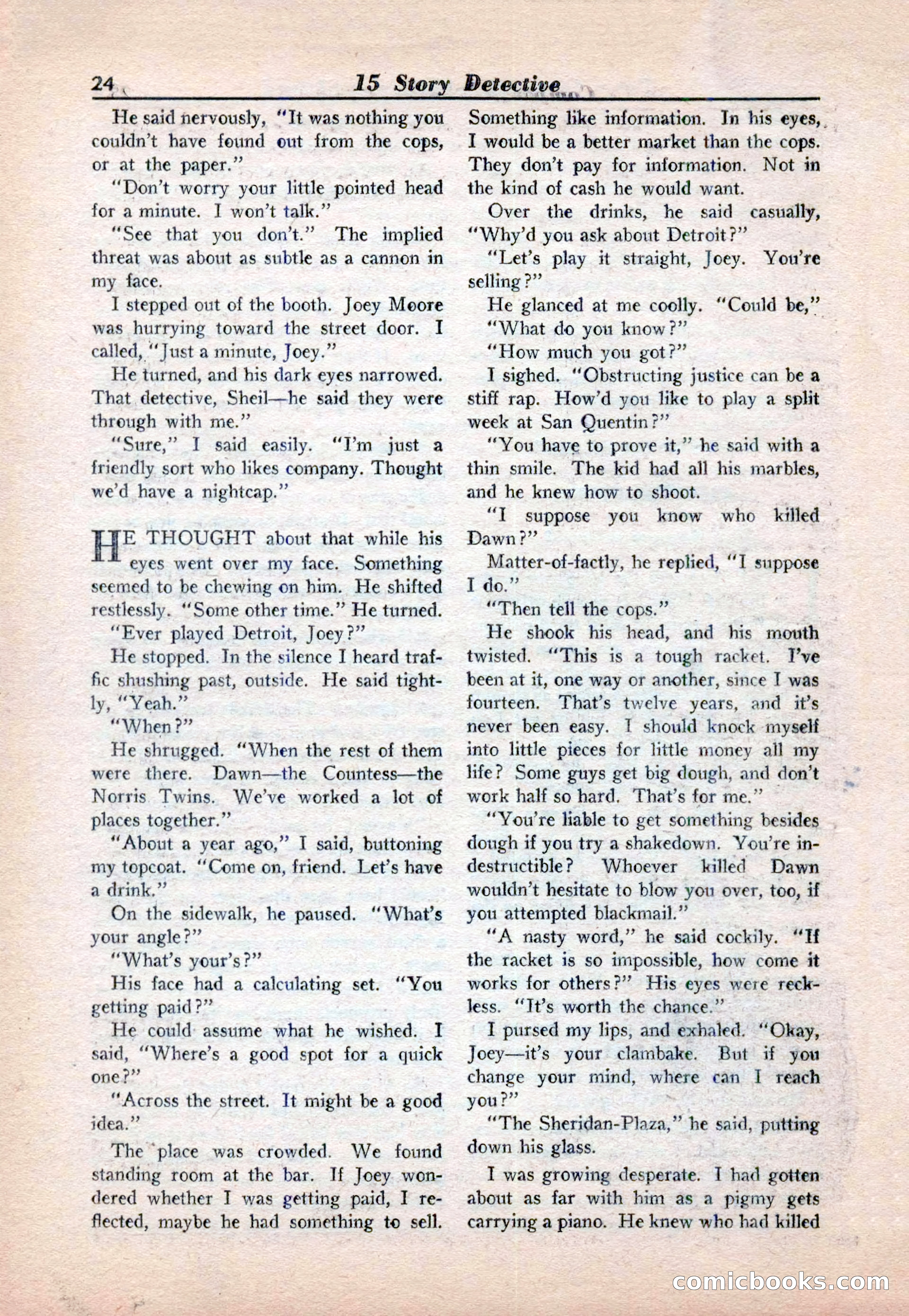
A restored page from Pulp Fiction, 1950. Page through the whole issue in the reader above.
📄 Transcribed text from this page (OCR, searchable)
Machine-transcribed from the original scan — historical spelling and the odd misread are preserved.
24., He said nervously, “It was nothing you couldn’t have feund out from the cops, or at the paper.” “Don’t worry your little pointed head for a minute. I won’t talk.” “See that you don’t.” The implied threat was about as subtle as a cannon in my face. I stepped out of the booth. Joey Meore was hurrying toward the street door. I called, “Just a minute, Joey.” He turned, and his dark eyes narrowed. That detective, Sheil—he said they were through with me.”’ “Sure,” I said easily. “I’m just a friendly sort who likes company. Thought we'd have a nightcap.” E THOUGHT about that while his eyes went over my face. Something seemed to be chewing on him. He shifted restlessly. “Some other time.” He turned. “Ever played Detroit, Joey?” He stopped. In the silence I heard traf- fic shushing past, outside. He said tight- ly, “Yeah.” “When?” He shrugged. “When the rest of them were there. Dawn—the Countess—the Norris Twins. We've worked a lot of places together.”’ “About a year ago,” I said, buttoning my topcoat. “Come on, friend. Let’s have a drink.” On the sidewalk, he paused. ‘What’s your angle?” “What’s your’s?”’ His face had a calculating set. “You getting paid?” He could: assume what he wished. I said, ““Where’s a good spot for a quick one?” “Across the street. It might be a good idea.” The ‘place was crowded. We found standing room at the bar. If Joey won- dered whether I was getting paid, I re- flected, maybe he had something to sell. 15 Story Detective. Something hke information. In his eyes, | I would be a better market than the cops. They don’t pay for information. Not in the kind of cash he would want. Over the drinks, he said casually, “Why’d you ask about Detroit?” “Let’s play it straight, Joey. You're selling ?” | He glanced at me coolly. “Could be,” “What do you know?” “How much you got?” 1 sighed. “Obstructing justice can be a stiff rap. How’d you like to play a split week at San Quentin?” “You have to prove it,” he said with a thin smile. The kid had all his marbles, and he knew how to shoot. af ' Dawn?” 7 Matter-of-factly, he replied, “I suppose I do.” “Then tell the cops.” He shook his head, and his mouth twisted. “This is a tough racket. I’ve been at it, one way or another, since I was fourteen. That’s twelve years, and it’s never been easy. I should knock myself— into little pieces for little money all my life? Some guys get big dough, and don’t work half so hard. That’s for me.” — “You're hable to get something besides dough if you try a shakedown. You're in- destructible? Whoever killed Dawn wouldn’t hesitate to blow you over, too, if you attempted blackmail.” “A nasty word,” he said cockily. “Tf the racket is so impossible, how come it works for others?’ His eyes were reck- less. “It’s worth the chance.” | I pursed my lips, and exhaled. “Okay, Joey—it’s your clambake. But if you change your mind, where can I reach your” “The Sheridan-Plaza,” he said, putting down his glass. I was growing desperate. I had gotten about as far with him as a pigmy gets carrying a piano. He knew who had killed (E(0) DOOKS AIG suppose you knew who killed (E@)