
Pulp Fiction, 1950 · page 109 of 132
15 Story Detective, April 1950 — page 109: what you’re looking at
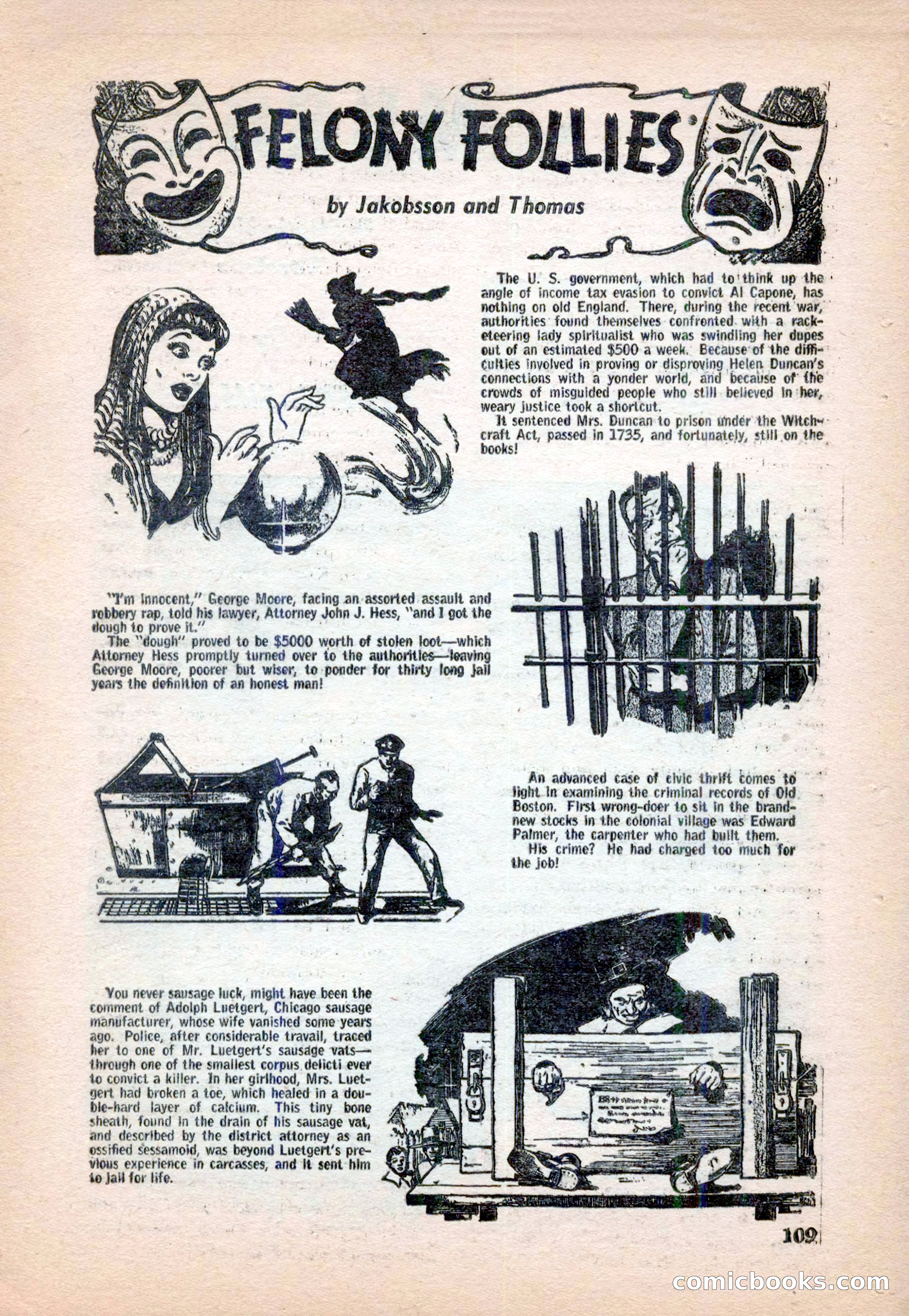
A restored page from Pulp Fiction, 1950. Page through the whole issue in the reader above.
📄 Transcribed text from this page (OCR, searchable)
Machine-transcribed from the original scan — historical spelling and the odd misread are preserved.
~~. 2 nr HM Wile “ym Innocent,” George Moore, facing an assorted assault and robbery rap, told his lawyer, Attorney John J. Hess, “and I got the tough to prove jt.” The “dough” proved to be $5000 worth of stolen loot—which Aitorney Hess promptly turned over to the authoritles—leaving George Moore, poorer but wiser, to ponder for thirty long jail a 7 : years the definition of an honest man! You never sausage luck, might have been the comment of Adolph Luetgert, Chicago sausage manufacturer, whose wife vanished some years ago. Police, after considerable travail, traced her to one of Mr. Luetgert’s sausdge vats— through one of the smallest corpus deticti ever to convict a killer. In her girthood, Mrs. Luet- gert had broken a toe, which healed in a dou- die-hard layer of calcium. This tiny bone sheath, found in the drain of his sausage vat, and described by the district attorney as an ossified sessamoid, was beyond Luetgert’s pre- vious experience in carcasses, and It sent him to jai for life. The U. S. government, which had tei think up the angle of income tax evasion to convict Al Capone, has nothing on old England. There, during the recent war, — authorities found themselves confronted. with a rack- eteering lady spiritualist who was swindling her dupes out of an estimated $500 a week. Because*of the diffi-' culties involved in proving or disproving Helen. Duncan's connections with a yonder world, and because of fhe crowds of misguided people who still. believed In ‘her, weary justice took a shortcut. It sentenced Mrs. Duncan to prison undér the Witch: ae Act, passed in 1735, and fortunately, still.on the ooks! 1 ! An advanced case of elvic thrift tomes to light In examining the criminal records of Old Boston. First wrong-doer to sit in the brand- new stocks in the colonial village was Edward Palmer, the carpenter who had bullt them. tie eas crime? He had charged too much for ob!