
Pulp Fiction, 1946 · page 23 of 84
10-Story Detective Magazine, April 1946 — page 23: what you’re looking at
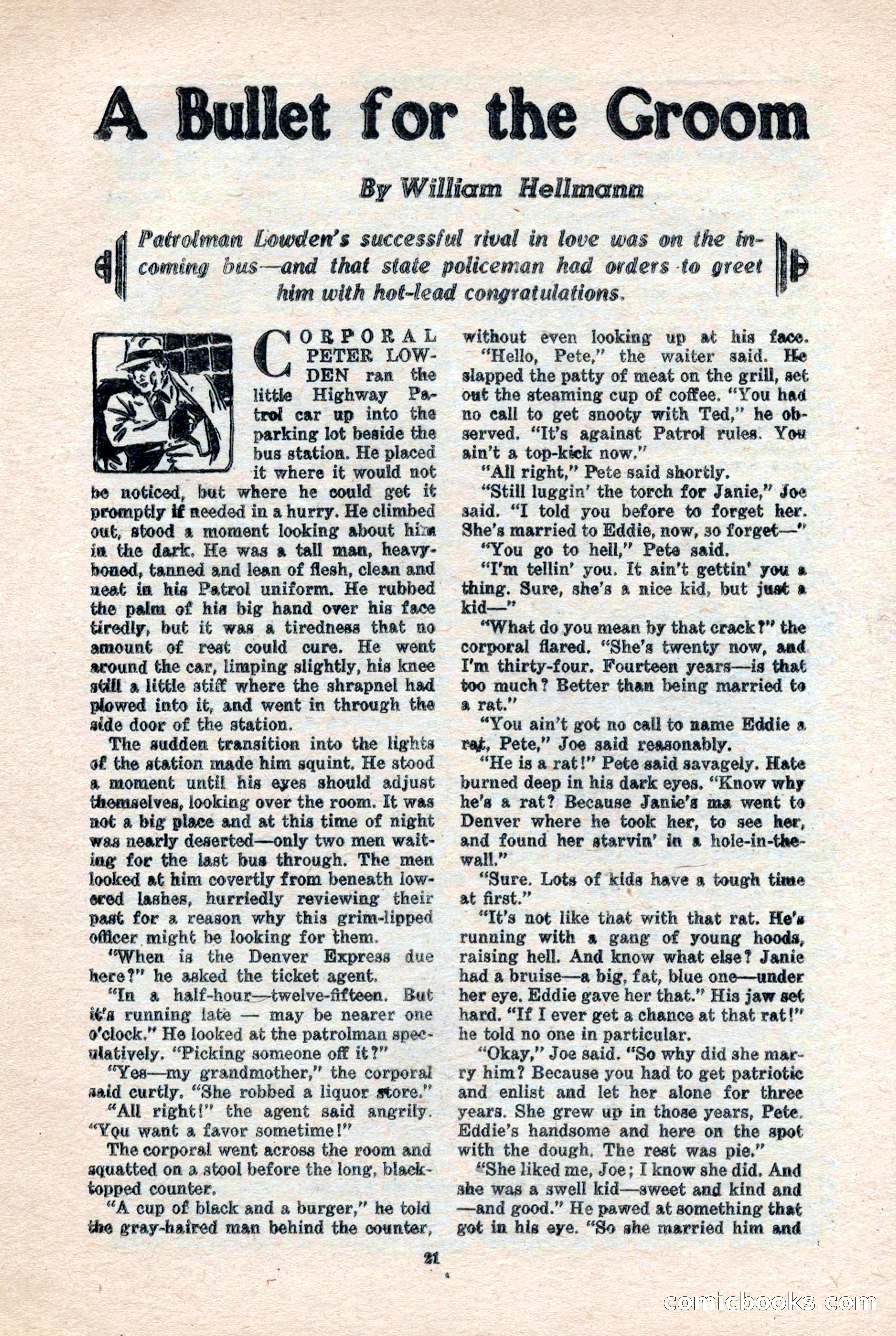
A restored page from Pulp Fiction, 1946. Page through the whole issue in the reader above.
📄 Transcribed text from this page (OCR, searchable)
Machine-transcribed from the original scan — historical spelling and the odd misread are preserved.
A Bullet for the Groom By William Hellmann coming bus—and that state policeman hed ovders ta greet Patrolman Lowden’s successful rival in love was on the in- him with hot-lead congratulations. little Highway Pa- trol car up into the parking lot beside the bus station. He placed it where it would not be noticed, but where he could get it promptly if needed in a hurry. He climbed out, stood a moment looking about hia in the dark. He was a tall man, heavy- honed, tanned and lean of flesh, clean and neat in his Patrol uniform. He rubbed the palm of hia big hand over his face tiredly, but if was a tiredness that no amount of reat could cure. He went around the car, limping slightly, his knee sll a little atiff where the shrapnel had plowed into it, and went in through the side door of the station. The sudden transition into the lights of the atation made him squint, He stood & moment until his eyes should adjust themselves, looking over the room. It was not a big place and at this time of night \_ ORPORAL eat C PETER LOW- SN i DEN ran the was nearly deserted—only two men wait-— ing for the last bus through. The men looked at him covertly from beneath low- ered lashes, hurriedly reviewing their past for a reason why this grim-lipped officer might be looking for them. “When is the Denver Express due here?” he asked the ticket agent. “In a half-hour—twelve-fifteen. But i¢t’'a running late — may be nearer one o'clock.” He looked at the patrolman spec- ulatively. “Picking someone off it?” “Yes—my grandmother,” the corporal aaid eurtly. “She robbed a liquor store.” “All right!" the agent said angrily. “You want a favor sometime!” The corporal went across the room and aguatted on 2 stool before the long, black- topped counter, “A cup of black and a burger,” he told the gray-haired man behind the counter, a without even looking up at his face. “Hello, Pete,” the waiter said. He slapped the patty of meat on the grill, set out the steaming cup of coffee, “You had no call to get snooty with Ted,’ he ob- served, “It’s against Patrol rules. You ain’t a top-kick now,” “All right,” Pete said shortly. “Still luggin’ the torch for Janie,” Joe said. “I told you before to forget her. She’s married to Eddie, now, so forget—” “You go to heil,” Pete said. “I’m tellin’ you. It ain’t wettin’ you « ral Sure, she’s a nice kid, but just « kid— “What do you mean by that crack?” the corporal flared. “She’s twenty now, and I'm thirty-four. Fourteen years—is that $00 much? Better tham being married te a rat.” “You ain’t got no call to name Eddie s. rat, Pete,” Joe said reasonably. “He is a rat!” Pete said savagely. Hate burned deep in his dark eyes. “Know why he’a a rat? Because Janie’s ma went to Denver where he took her, to see her, eee found her atarvin’ in s hole-in-the- wea, ”? “Sure. Lots of kids have . tough time at first.” | “It’s not like that with that rat. He's running with a gang of young hoods, raising hell. And know what else? Janie had a bruise—a big, fat, blue one—under her eye, Eddie gave her that.” His jaw set hard. “If I ever get a chance at that rat!” he told no one in particular. “Okay,” Joe said. “Se why did she mar- ry him? Because you had to get patriotic and enlist and let her alone for three years. She grew up in those years, Pete. Eddie’s handsome and here on the spot with the dough, The reat was pie,” “She liked me, Joe; I know she did. And she was a swell kid—sweet and kind and —and good.” He pawed at something that got in his eye. “So she married him and CoOmiclbool (CO