
Pulp Fiction, 1944 · page 8 of 84
10-Story Detective Magazine Cover — page 8: what you’re looking at
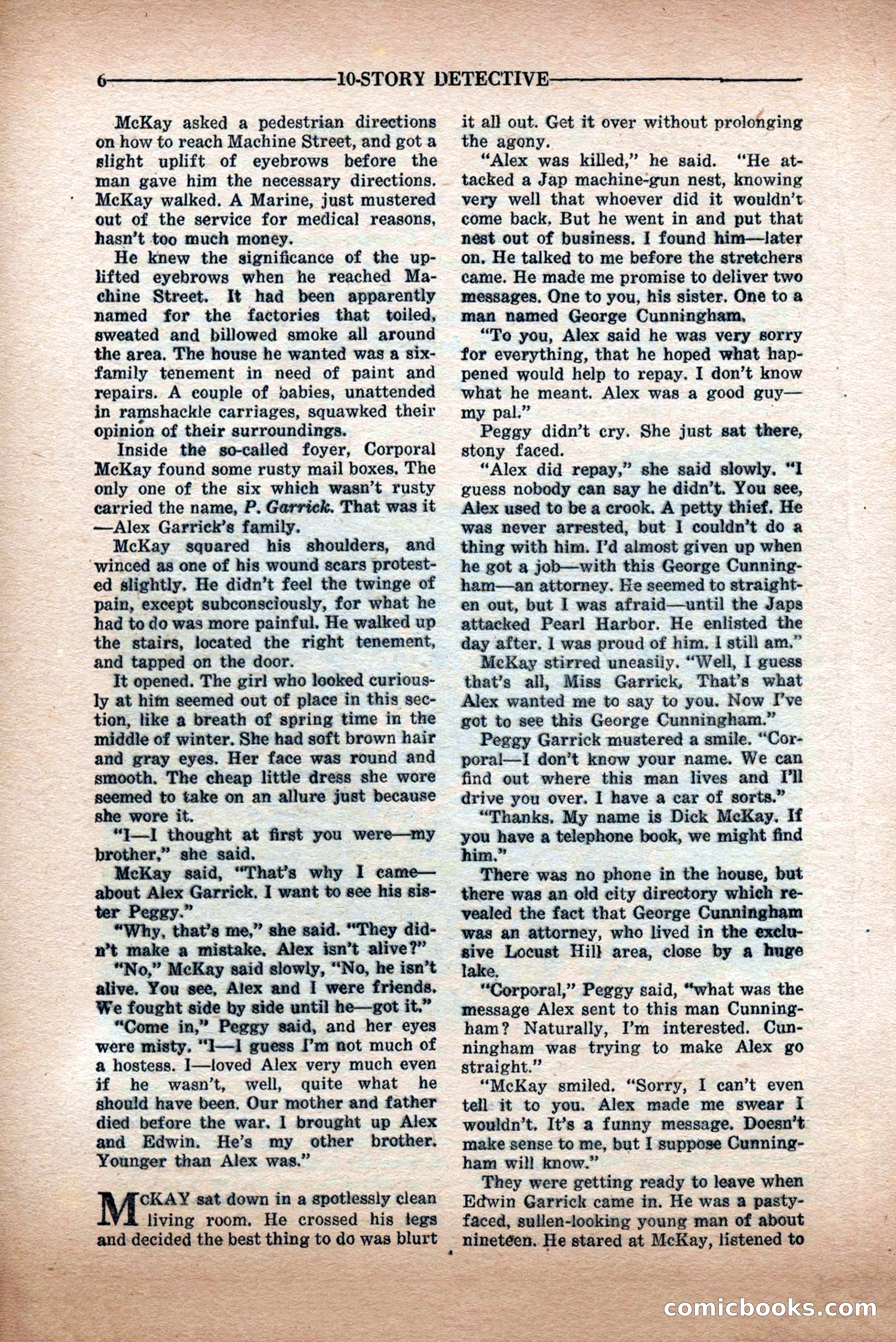
A restored page from Pulp Fiction, 1944. Page through the whole issue in the reader above.
📄 Transcribed text from this page (OCR, searchable)
Machine-transcribed from the original scan — historical spelling and the odd misread are preserved.
McKay asked a pedestrian directions on how fo reach Machine Street, and got a slight uplift of eyebrows before the man gave him the necessary directions. McKay walked. A Marine, just mustered out of the service for medical reasons, hasn’t too much money. He knew the significance of the up- lifted eyebrows when he reached Ma- chine Street. It had been apparently named for the factories that toiled, sweated and billowed smoke all around the area. The house he wanted was a six- family tenement in need of paint and repairs. A eouple of sabies, unattended in ramshackle carriages, squawked their opinion of their surroundings. Inside the so-called foyer, Corporal McKay found some rusty mail boxes, The only one of the six which wasn’t rusty carried the name, P. Garrick. That was it —Alex Garrick’s family. McKay squared his shoulders, and ‘winced as one of his wound scars protest- ed slightly. He didn’t feel the twinge of pain, except subconsciously, for what he had to do was more painful. He walked up the stairs, located the right tenement, and tapped on the door. It opened. The girl who looked curious- ly at him seemed out of place in this sec- tion, like a breath of spring time in the middle of winter. She had soft brown hair and gray eyes. Her face was round and smooth. The cheap little dress she wore seemed to take on an allure just because she wore it. “J—] thought at first you were—my brother,” she said. McKay said, “That’s why I came— about Alex Garrick. 1 want to see his sis- ter Peggy.” “Why, that’s me,” she said. “They did- wt make a mistake, Alex isn’t alive?” “No,” McKay said slowly, “No, he isn’t alive. You see, Alex and I were friends. We fought side by side until he—got it.” “Come in,” Peggy said, and her eyes were misty, “I—1 guess ’'m not much of a hostess. I—loved Alex very much even if he wasn’t, well, quite what he should have been, Our mother and father died before the war. 1 brought up Alex and Edwin. He’s my other brother, Younger than Alex was.” CKAY sat down in a spotlessly clean ‘living room. He crossed his tegs Soe and d bese’: sh beat-shitgs So. ae wae, -blaet 6——_—_—_———_——0-STORY DETECTIVE- a resi He mared , Metened. to it all out. Get it over without prolonging the agony. “Alex was killed,” he said. “He at- tacked a Jap machine-gun nest, knowing very well that whoever did it wouldn’t come back, But he went in and put that nest out of business. I found him—later on, He talked to me before the stretchers came. He made me promise to deliver two messages, One to you, his sister. One to a man named George Cunningham, “Fo you, Alex said he was very sorry for everything, that he hoped what hap- pened would help to repay. I don’t know what he meant. Alex was a good guy— my pal.” Peggy didn’t cry. She just sat there, stony faced. “Alex did repay,” she said slowly, “I guess nobody can say he didn’t. You see, Alex used to be a crook. A petty thief. He was never arrested, but I couldn’t do a thing with him. I’d almost given up when he got a job—with this George Cunning- ham—an attorney. He seemed to straight- en out, but I was afraid—until the Japs attacked Pearl Harbor. He enlisted the day after. | was proud of him, I still am.” McKay stirred uneasily. “Well, I guess that’s all, Miss Garrick, That’s what Alex wanted me to say to you. Now I’ve got to see this George Cunningham.” Peggy Garrick mustered a smile. “Cor- poral—I don’t know your name. We can find out where this man lives and I'll drive you over, I have a car of sorts.” “Thanks. My name is Dick McKay. If tcl cae male There was no phone in the house, but there was an old city directory which re- vealed the fact that George Cunningham was an attorney, who lived in the exclu- wee Locust Hil} area, close by a huge “Corporal,” Peggy said, “what was the message Alex sent to this man Cunning- ham? Naturally, I’m interested. Cun- ningham was trying to make Alex go straight.” | Z “McKay smiled. “Sorry, I can’t even tell. it to you. Alex made me swear i wouldn’t, It’s a funny message. Doesn’t make sense to me, but I suppose Cunning- ham will know.” They were getting ready to leave when Edwin Garrick came in. He was a pasty- faced, sullen-looking young man of satan