
Pulp Fiction, 1944 · page 35 of 84
10-Story Detective Magazine Cover — page 35: what you’re looking at
A restored page from Pulp Fiction, 1944. Page through the whole issue in the reader above.
📄 Transcribed text from this page (OCR, searchable)
Machine-transcribed from the original scan — historical spelling and the odd misread are preserved.
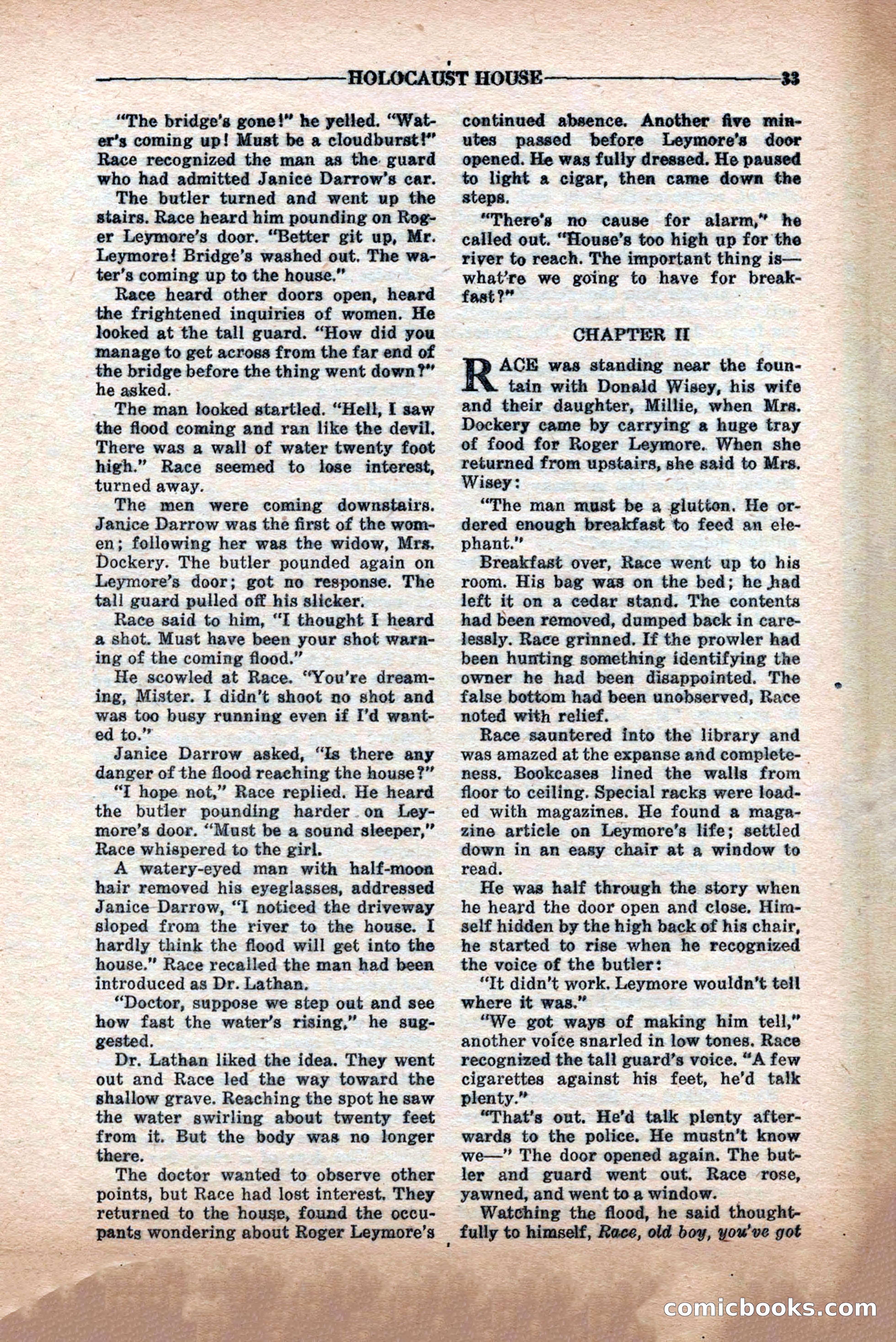
~ Sw! a 1 Se ——— AAS og ee =~ ‘ ie See a J eS a tie. =< - a oe r ; 5 i = aR: < ——— o noe “The bridge’s gone!” he yelled. “Wat- er’s coming up! Must be a cloudburst!” Race recognized the man as the guard who had admitted Janice Darrow’s car. The butler turned and went up the stairs. Race heard him pounding on Rog- er Leymeore’s door. “Better git up, Mr. Leymore! Bridge’s washed out. The wa- ter’s coming up to the house.” Race heard other doors open, heard the frightened inquiries of women. He looked at the tall guard. “How did you manage to get across from the far end of the bridge before the thing went down?” he asked. _ The man looked startled. “Hell, I saw the flood coming and ran like the devil. There was a wall of water twenty foot high.” Race seemed to lose interest, turned away. The men were coming downstairs. Janice Darrow was the first of the wom- en; follewing her was the widow, Mrs. Dockery. The butler pounded again on Leymore’s door; got no response. The tall guard pulled off his slicker. Race said to him, “I thought [I heard a shot. Must have been your shot warn- ing of the coming flood.” He scowled at Race. “You’re dream- ing, Mister. I didn’t shoot no shot and was too busy running even if I’d want- ed to.” Janice Darrow asked, “Is there any danger of the flood reaching the house?” “T hope not,” Race replied. He heard the butler pounding harder.on Ley- more’s door. “Must be a sound sleeper,” Race whispered to the girl. A watery-cyed man with half-moon hair removed his eyeglasses, addressed Janice Darrow, “I noticed the driveway sloped from the river to the house. I hardly think the flood will get into the house.” Race recalled the man had been introduced as Dr. Lathan. “Doctor, suppose we step out and see how fast the water’s rising,” he sug- gested. . Dr. Lathan liked the idea. They went out and Race led the way toward the shallow grave. Reaching the spot he saw the water swirling about twenty feet from it. But the body was no longer there. The doctor wanted to observe other points, but Race had lost interest. They returned to the house, found the occu- _ _ Pants wondering about Roger Leymore’s == See “ar SB: == ie ere = es ; a Sis ; “Se os oer i. ‘ HOLOCAUST HOUSE Se <; = . et — Ss J continued absence. Another five min- utes passed before Leymore’s door opened. He was fully dressed. He paused to light a cigar, then came down the steps. “There's no cause for alarm,” he called out. “House’s too high up for the river to reach. The important thing is— what’re we going to have for break- fast?” CHAPTER HI ACE was standing near the foun- tain with Donald Wisey, his wife and their daughter, Millie, when Mrs. Dockery came by carrying a huge tray of food for Roger Leymore. When she returned from upstairs, she said to Mrs. Wisey: “The man must be a glutton. He or- dered enough breakfast to feed an ele- phant.” Breakfast over, Race went up to his room. His bag was on the bed; he had left it on a cedar stand. The contents had been removed, dumped back in care- lessly. Race grinned. If the prowler had been hunting something identifying the owner he had been disappointed. The false bottom had been unobserved, Race noted with relief. Race sauntered into the library and was amazed at the expanse and complete-_ ness, Bookcases lined the walls from floor to ceiling. Special racks were load- ed with magazines. He found a maga- zine article on Leymore’s life; settled down in an easy chair at a window to read. He was half through the story when he heard the door open and close, Him- self hidden by the high back of his chair, he started to rise when he recognized the voice of the butier: “It didn’t work. Leymore wouldn't tell where it was.” “We got ways of making him tell,” another voice snarled in low tones. Race recognized the tall guard’s voice. “A few cigarettes against his feet, he’d talk plenty.” “That's out. He’d talk plenty after- wards to the police. He mustn’t know we—” The door opened again. The but- ler and guard went out. Race rose, yawned, and went to a window. avis es- ae a — Neti rte 5 < : —s SS we ae aS =e SS =) ; — : = < eRe = re So ae “fee tie eae Se] : eee “ . o ao = ee. Watching the flood, he said ers a E: x , fully to himself, . Race, Sp hs :