
Pulp Fiction, 1944 · page 32 of 84
10-Story Detective Magazine Cover — page 32: what you’re looking at
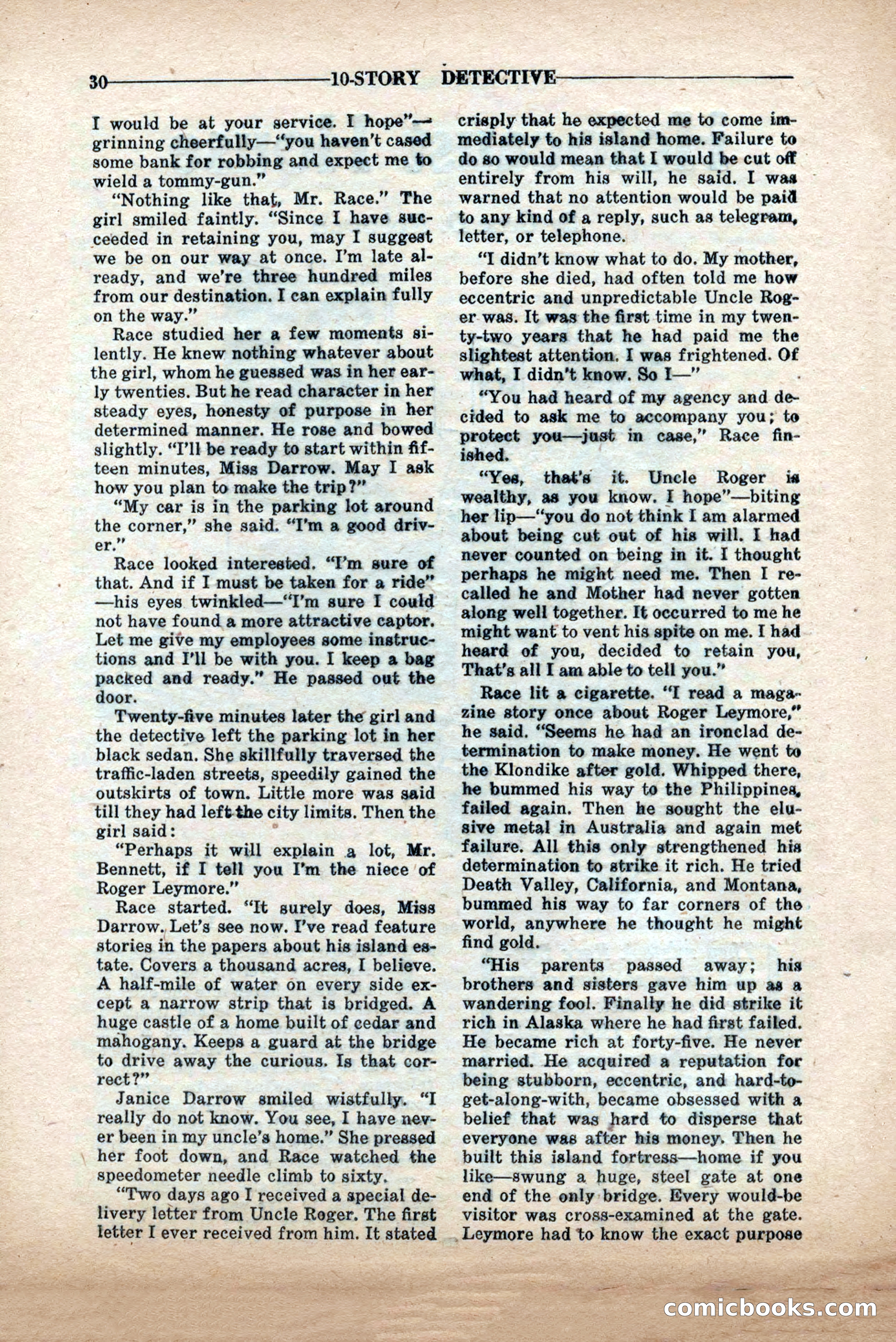
A restored page from Pulp Fiction, 1944. Page through the whole issue in the reader above.
📄 Transcribed text from this page (OCR, searchable)
Machine-transcribed from the original scan — historical spelling and the odd misread are preserved.
a 39 —_________—10-STORY DETECTIVE I would be at your service. I hope”— grinning cheerfully—“you haven’t cased some bank for robbing and expect me to wield a tommy-gun.” “Nothing like that, Mr. Race.” The girl smiled faintly. “Since I have suc- ceeded in retaining you, may I suggest we be on our way at once. I’m late al- ready, and we're three hundred miles from our destination. I can explain fully on the way.” Race studied her a few moments si- lently. He knew nothing whatever about the girl, whom he guessed was in her ear- ly twenties. But he read character in her steady eyes, honesty of purpose in her determined manner. He rose and bowed slightly. “I’lk be ready to start within fif- teen minutes, Miss Darrow. May I ask how you plan to make the trip?” “My car is in the parking lot around the corner,” she said. “I’m a good driv- er,” Race looked interested. “I’m sure of that. And if I must be taken for a ride” —his eyes twinkled—“I’m sure I could not have found a more attractive captor. Let me give my employees some instruc- tions and I’ll be with you. I keep a bag packed and ready.” He passed out the door. Twenty-five minutes later the girl and the detective left the parking lot in her black sedan. She skillfully traversed the traffic-laden streets, speedily gained the outskirts of town. Little more was said till they had left-the city limits. Then the girl said: “Perhaps it will explain g lot, Mr. Bennett, if I tell you I’m the niece of Roger Leymore.” Race started. “It surely does, Miss Darrow. Let’s see now. I’ve read feature stories in the papers about his island es- tate. Covers a thousand acres, I believe. A half-mile of water on every side ex- cept a narrow strip that is bridged. A huge castle of a home built of eedar and mahogany. Keeps a guard at the bridge to drive away the curious. Is that cor- rect?” Janice Darrow smiled wistfully. “I really do not know. You see, I have nev- er been in my uncle’s home.” She preased her foot down, and Race watched the speedometer needle climb to sixty. “Two days ago I received a special de- livery letter from Uncle Reger. The first letter I ever received from him. It stated. crisply that he expected me to come im- mediately to his island home. Failure te do so would mean that I would be cut off entirely from his will, he said. I waa ~ warned that no attention would be paid to any kind of a reply, such as telegram, letter, or telephone. “TY didn’t know what to do. My mother, before she died, had often told me how eccentric and unpredictable Uncle Rog- er. was. It was the first time in my twen- ty-two years that he had paid me the slightest attention. I was frightened. Of what, I didn’t know. So I—” “You had heard of my agency and ie: cided to ask me to accompany you; to protect you—just im case,” Race fin- ished. “Yes, that’s it. Uncle Roger ia wealthy, as you know. I hope’—biting her lip—“you do not think I am alarmed about being cut out of his will. I had never counted on being in it. I thought perhaps he might need me. Then I re- called he and Mother had never gotten along well together. It occurred to me he might want to vent his spite on me. I had heard of you, decided to retain you, That's all I am able to tell you.” Race lit a cigarette. “I read a maga- zine story once about Roger Leymore,” he said. “Seems he had an ironclad de- termination to make money. He went to the Klondike after gold. Whipped there, he bummed his way to the Philippines, failed again. Then he sought the elu- sive metal in Australia and again met failure. All this only strengthened hia determination to strike it rich. He tried Death Valley, California, and Montana, bummed his way to far corners of the world, anywhere he thought he —— find gold. “His parents passed away; his brothers and sisters gave him up as a wandering fool. Finally he did strike it rich in Alaska where he had first failed. He became rich at forty-five. He never married. He acquired a reputation for | being stubborn, eccentric, and hard-to- get-along-with, became obsessed with a belief that was hard to disperse that everyone was after his money. Then he built this island fortress—home if you like—swung a huge, steel gate at one end of the only bridge. Every would-be visitor was cross-examined at the gate. s. Lepore had seen the exact purpose |