
Pulp Fiction, 1944 · page 21 of 84
10-Story Detective Magazine Cover — page 21: what you’re looking at
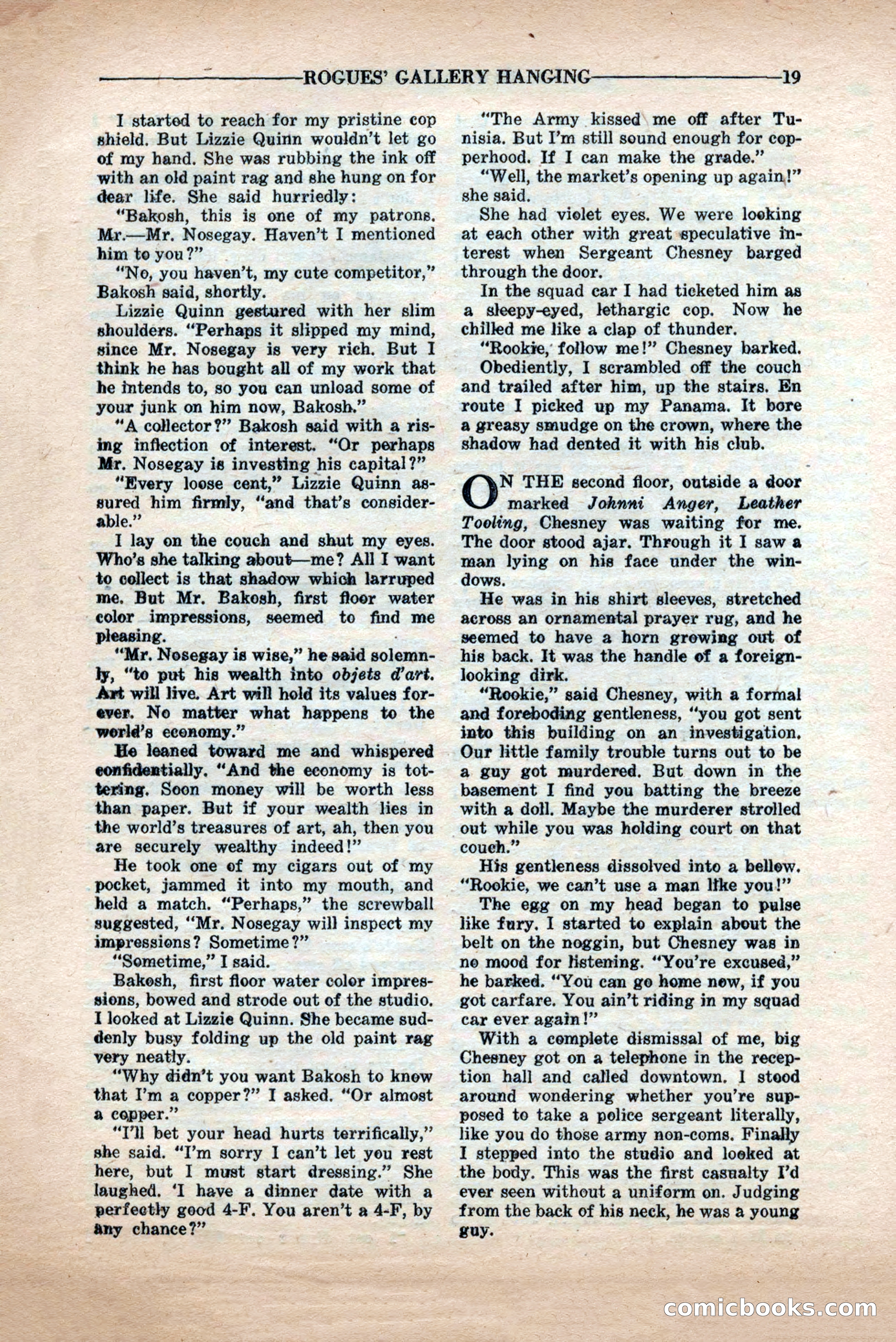
A restored page from Pulp Fiction, 1944. Page through the whole issue in the reader above.
📄 Transcribed text from this page (OCR, searchable)
Machine-transcribed from the original scan — historical spelling and the odd misread are preserved.
- ROGUES’ GALLERY HANGING I started to reach for my pristine cop shield. But Lizzie Quinn wouldn’t let go of my hand. She was rubbing the ink off with an old paint rag and she hung on for dear life. She said hurriedly: “Bakosh, this is one of my patrons, Mr.—Mr. Nosegay. Haven’t I mentioned him to you?” “No, you haven’t, my cute competitor,” Bakosh said, shortly. Lizzie Quinn gestured with her slim shoulders. “Perhaps it slipped my mind, since Mr. Nosegay is very rich. But I think he has bought all of my work that he mtends to, so you can unload some of your junk on him now, Bakosh.” “A collector?” Bakosh said with a ris- ing inflection of interest. “Or perhaps Mr. Nosegay is investing his capital?” “Every loose cent,” Lizzie Quinn as- sured him firmly, “and that’s consider- able.” I lay on the couch and shut my eyes. Who’s she talking about—me? All I want . to collect is that shadow which larruped me, But Mr. Bakosh, first floor water color impressions, seemed to find me pleasing. “Mr. Nosegay is wise,” he said sclaamit ly, “to put his wealth into objets d'art. Art will live. Art will hold its values for- ever. No matter what happens to the world’s economy.” He leaned toward me and whispered eonfidentially. ““And the economy is tot- tering. Seon money will be worth less than paper. But if your wealth lies in the world’s treasures of art, ah, then you are securely wealthy indeed!” He took one of my cigars out of my pocket, jammed it into my mouth, and held a match. “Perhaps,” the screwball suggested, ‘““Mr. Nosegay will inspect my impressions? Sometime?” “Sometime,” I said. Bakesh, first floor water color impres- sions, bowed and strode out of the studio. I looked at Lizzie Quinn. She became sud- denly busy folding up the old paint rag very neatly. “Why didn’t you want Bakosh to knew that I’m a copper?” I asked. “Or almost & copper.” “Tl bet your head hurts terrifically,” she said. “I’m sorry I can’t let you rest here, but I must start dressing.” She laughed. ‘I have a dinner date with a perfectly good 4-F. You aren’t a 4-F, ss any chance?” Ms 19 “The Army kissed\ me off after Tu- nisia. But I’m still sound enough for cop- perhood. If I can make the grade.” “Well, the market’s opening up again!” she said. She had violet eyes. We were loeking at each other with great speculative in- terest when Sergeant Chesney barged through the door. In the squad ear I had tieketed him as a sleepy-eyed, lethargic cop. Now he chilled me like a clap of thunder. “Rookie, follow me!” Chesney barked. Obediently, I scrambled off the couch and trailed after him, up the stairs, En route I picked up my Panama. It bore a greasy smudge on the crown, where the shadow had dented it with his club. N THE second floor, outside a door marked Johnni Anger, Leather Tooling, Chesney was waiting for me. The door stood ajar. Through it I saw a man lying on his face under the win- dows. He was in his shirt sleeves, stretched across an ornamental prayer rug, and he seemed to have a horn grewing out of his back. It was the handle of a foreign- looking dirk. “Rookie,” said Chesney, with a formal and foreboding gentleness, “you got sent into this building on an investigation, Our little family trouble turns out to be a guy got murdered. But down in the basement I find you batting the breeze with a doll. Maybe the murderer strolled out while you was holding court on that coueh.” His gentleness dissolved into a bellew. “Rookie, we can’t use a man ltke you!” The egg on my head began to pulse like fury. I started to explain about the belt on the noggin, but Chesney was in no mood for listening. ““You’re excused,” he barked. “You can go home new, if you got carfare. You ain’t riding in my squad car ever again!” With a complete dismissal of me, big Chesney got on a telephone in the recep- tion hall and called downtown. I steod around wondering whether you’re sup- posed to take a police sergeant literally, like you do those army non-coms. Finally I stepped into the studio and loeked at the body. This was the first casualty I’d ever seen without a uniform on. Judging from the back of his neck, he was a young guy. =comicbook (E(@) im