
Pulp Fiction, 1942 · page 86 of 116
10-Story Detective, November 1942 — page 86: what you’re looking at
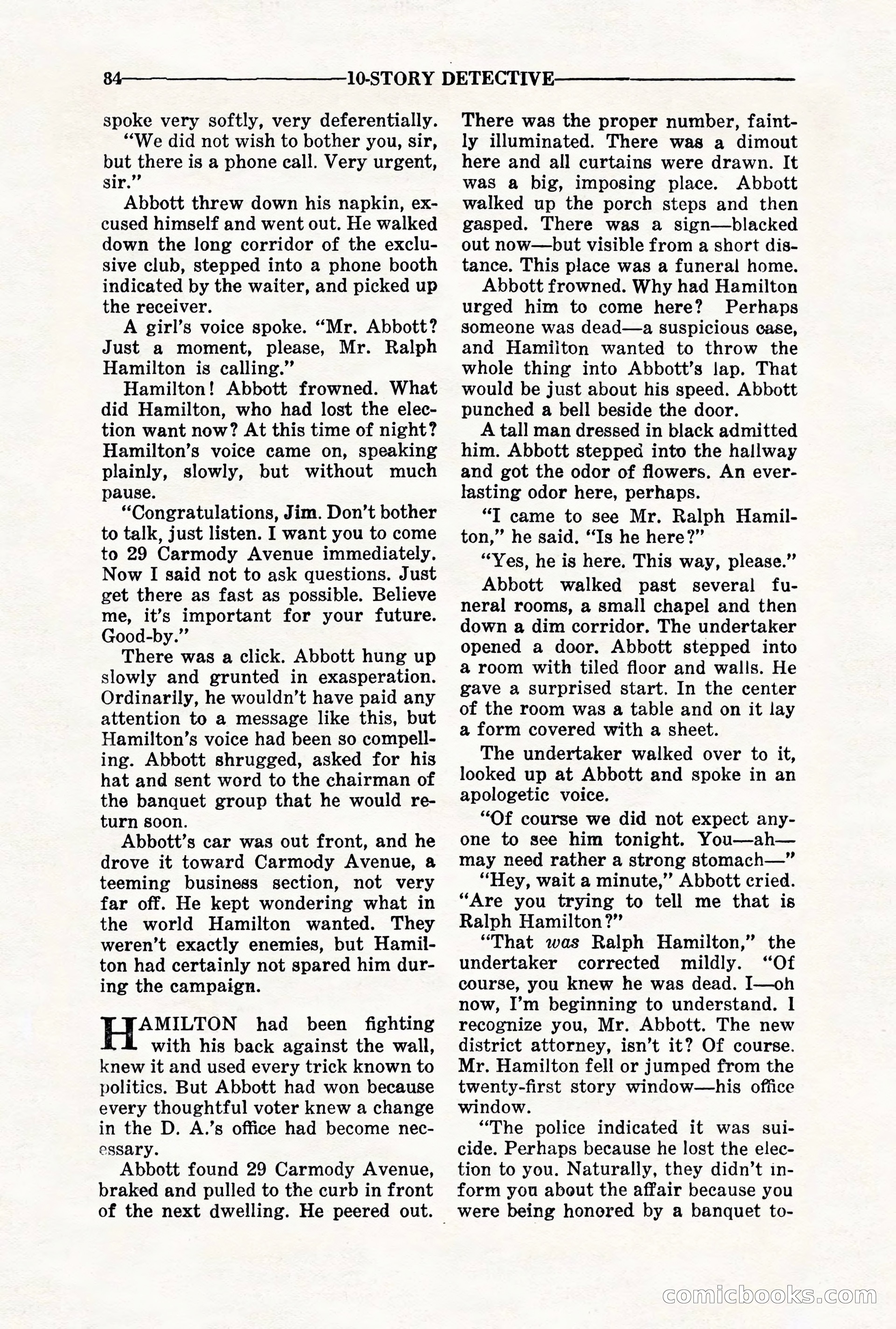
A restored page from Pulp Fiction, 1942. Page through the whole issue in the reader above.
📄 Transcribed text from this page (OCR, searchable)
Machine-transcribed from the original scan — historical spelling and the odd misread are preserved.
84 0.STORY DETECTIVE spoke very softly, very deferentially. “We did not wish to bother you, sir, but there is a phone call. Very urgent, sir.” Abbott threw down his napkin, ex- cused himself and went out. He walked down the long corridor of the exclu- sive club, stepped into a phone booth indicated by the waiter, and picked up the receiver. A girl’s voice spoke. “Mr. Abbott? Just a moment, please, Mr. Ralph Hamilton is calling.” Hamilton! Abbott frowned. What did Hamilton, who had lost the elec- tion want now? At this time of night? Hamilton’s voice came on, speaking plainly, slowly, but without much pause. “Congratulations, Jim. Don’t bother to talk, just listen. I want you to come to 29 Carmody Avenue immediately. Now I said not to ask questions. Just get there as fast as possible. Believe me, it’s important for your future. Good-by.”’ There was a click. Abbott hung up slowly and grunted in exasperation. Ordinarily, he wouldn’t have paid any attention to a message like this, but Hamilton’s voice had been so compell- ing. Abbott shrugged, asked for his hat and sent word to the chairman of the banquet group that he would re- turn soon. Abbott’s car was out front, and he drove it toward Carmody Avenue, a teeming business section, not very far off. He kept wondering what in the world Hamilton wanted. They weren’t exactly enemies, but Hamil- ton had certainly not spared him dur- ing the campaign. AMILTON had been fighting with his back against the wall, knew it and used every trick known to politics. But Abbott had won because every thoughtful voter knew a change in the D. A.’s office had become nec- essary. Abbott found 29 Carmody Avenue, braked and pulled to the curb in front b of the next dwelling. He peered out. There was the proper number, faint- ly illuminated. There was a dimout here and all curtains were drawn. It was a big, imposing place. Abbott walked up the porch steps and then gasped. There was a sign—blacked out now—but visible from a short dis- tance. This place was a funeral home. Abbott frowned. Why had Hamilton urged him to come here? Perhaps someone was dead—a suspicious case, and Hamiiton wanted to throw the whole thing into Abbott’s lap. That would be just about his speed. Abbott punched a bell beside the door. A tall man dressed in black admitted him. Abbott stepped into the hallway and got the odor of flowers. An ever- lasting odor here, perhaps. “I came to see Mr. Ralph Hamil- ton,” he said. “Is he here?” “Yes, he is here. This way, please.” Abbott walked past several fu- neral rooms, a small chapel and then down a dim corridor. The undertaker opened a door. Abbott stepped into a room with tiled floor and walls. He gave a surprised start. In the center of the room was a table and on it lay a form covered with a sheet. The undertaker walked over to it, looked up at Abbott and spoke in an apologetic voice. “Of course we did not expect any- one to see him tonight. You—ah— may need rather a strong stomach—” “Hey, wait a minute,” Abbott cried. “Are you trying to tell me that is Ralph Hamilton?” “That was Ralph Hamilton,” the undertaker corrected mildly. “Of course, you knew he was dead. I—oh now, I’m beginning to understand. I recognize you, Mr. Abbott. The new district attorney, isn’t it? Of course. Mr. Hamilton fell or jumped from the twenty-first story window—his office window. “The police indicated it was sui- cide. Perhaps because he lost the elec- tion to you. Naturally, they didn’t in- form you about the affair because you were being honored by a banquet to- DOOK C©