
Pulp Fiction, 1942 · page 79 of 116
10-Story Detective, November 1942 — page 79: what you’re looking at
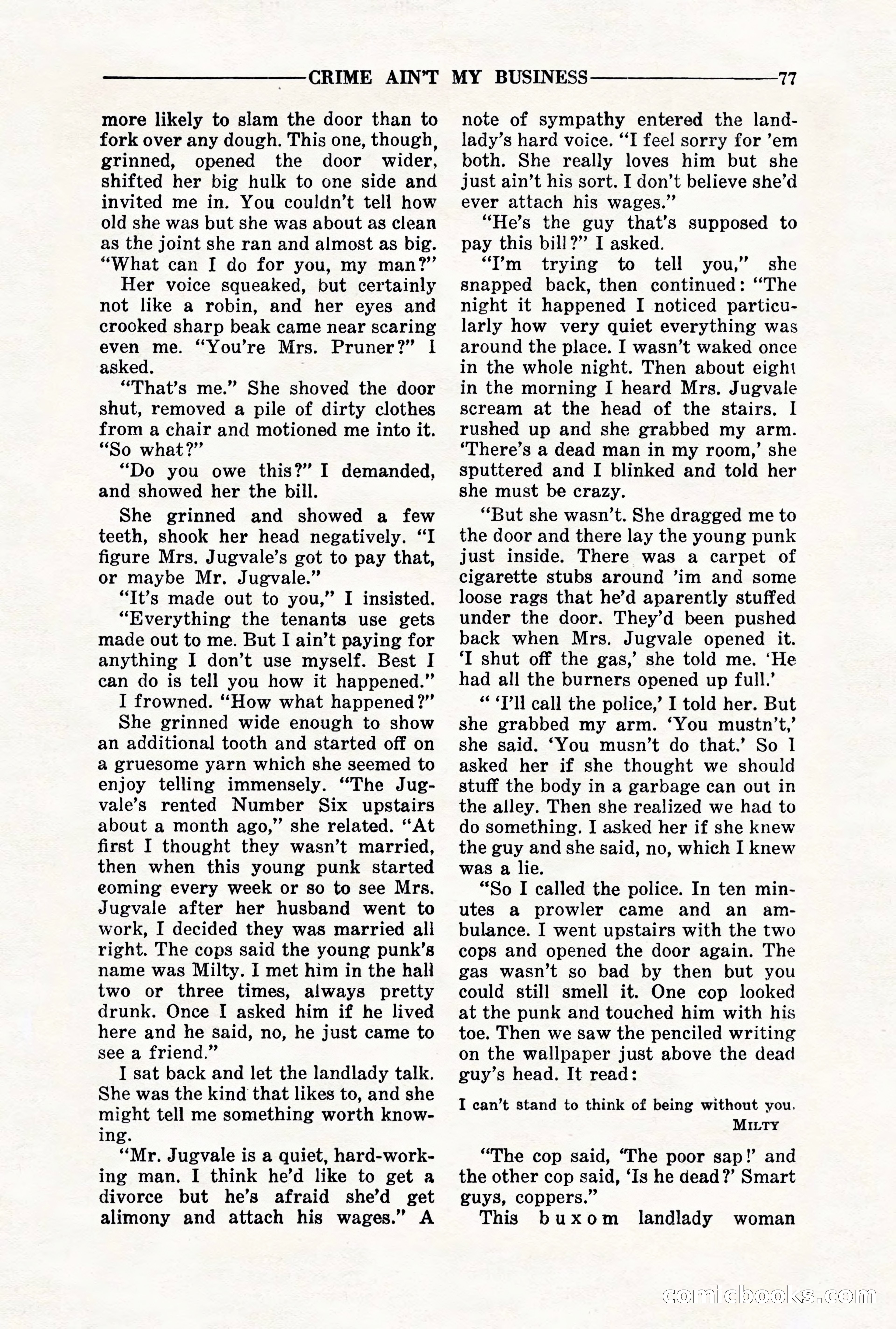
A restored page from Pulp Fiction, 1942. Page through the whole issue in the reader above.
📄 Transcribed text from this page (OCR, searchable)
Machine-transcribed from the original scan — historical spelling and the odd misread are preserved.
—CRIME AIN’T MY BUSINESS—————_——77 more likely to slam the door than to fork over any dough. This one, though, grinned, opened the door wider, shifted her big hulk to one side and invited me in. You couldn’t tell how old she was but she was about as clean as the joint she ran and almost as big. “What can I do for you, my man?” Her voice squeaked, but certainly not like a robin, and her eyes and crooked sharp beak came near scaring even me. “You’re Mrs. Pruner?” I asked. “That’s me.” She shoved the door shut, removed a pile of dirty clothes from a chair and motioned me into it. “So what?” “Do you owe this?’ I demanded, and showed her the bill. She grinned and showed a few teeth, shook her head negatively. “I figure Mrs. Jugvale’s got to pay that, or maybe Mr. Jugvale.” “It’s made out to you,” I insisted. “Everything the tenants use gets made out to me. But I ain’t paying for anything I don’t use myself. Best I can do is tell you how it happened.” I frowned. “How what happened?” She grinned wide enough to show an additional tooth and started off on a gruesome yarn which she seemed to enjoy telling immensely. “The Jug- vale’s rented Number Six upstairs about a month ago,” she related. ‘At first I thought they wasn’t married, then when this young punk started eoming every week or so to see Mrs. Jugvale after her husband went to work, I decided they was married all right. The cops said the young punk’s name was Milty. I met him in the hall two or three times, always pretty drunk. Once I asked him if he lived here and he said, no, he just came to see a friend.” I sat back and let the landlady talk. She was the kind that likes to, and she might tell me something worth know- ing. “Mr. Jugvale is a quiet, hard-work- ing man. I think he’d like to get a divorce but he’s afraid she’d get alimony and attach his wages.” A note of sympathy entered the land- lady’s hard voice. “I feel sorry for ’em both. She really loves him but she just ain’t his sort. I don’t believe she’d ever attach his wages.” “He’s the guy that’s supposed to pay this bill?” I asked. “I’m trying to tell you,’ she snapped back, then continued: ‘‘The night it happened I noticed particu- larly how very quiet everything was around the place. I wasn’t waked once in the whole night. Then about eight in the morning I heard Mrs. Jugvale scream at the head of the stairs. I rushed up and she grabbed my arm. “‘There’s a dead man in my room,’ she sputtered and I blinked and told her she must be crazy. “But she wasn’t. She dragged me to the door and there lay the young punk just inside. There was a carpet of cigarette stubs around ’im and some loose rags that he’d aparently stuffed under the door. They’d been pushed back when Mrs. Jugvale opened it. ‘I shut off the gas,’ she told me. ‘He had all the burners opened up full.’ ‘* *T’ll call the police,’ I told her. But she grabbed my arm. ‘You mustn’t,’ she said. ‘You musn’t do that.’ So 1 asked her if she thought we should stuff the body in a garbage can out in the alley. Then she realized we had to do something. I asked her if she knew the guy and she said, no, which I knew was a lie. “So I called the police. In ten min- utes a prowler came and an am- bulance. I went upstairs with the two cops and opened the door again. The gas wasn’t so bad by then but you could still smell it. One cop looked at the punk and touched him with his toe. Then we saw the penciled writing on the wallpaper just above the dead guy’s head. It read: I can’t stand to think of being without you. MILTY “The cop said, “The poor sap!’ and the other cop said, ‘Is he dead?’ Smart guys, coppers.” This buxom landlady woman cCoOmiclbool (C©