
Pulp Fiction, 1942 · page 63 of 116
10-Story Detective, November 1942 — page 63: what you’re looking at
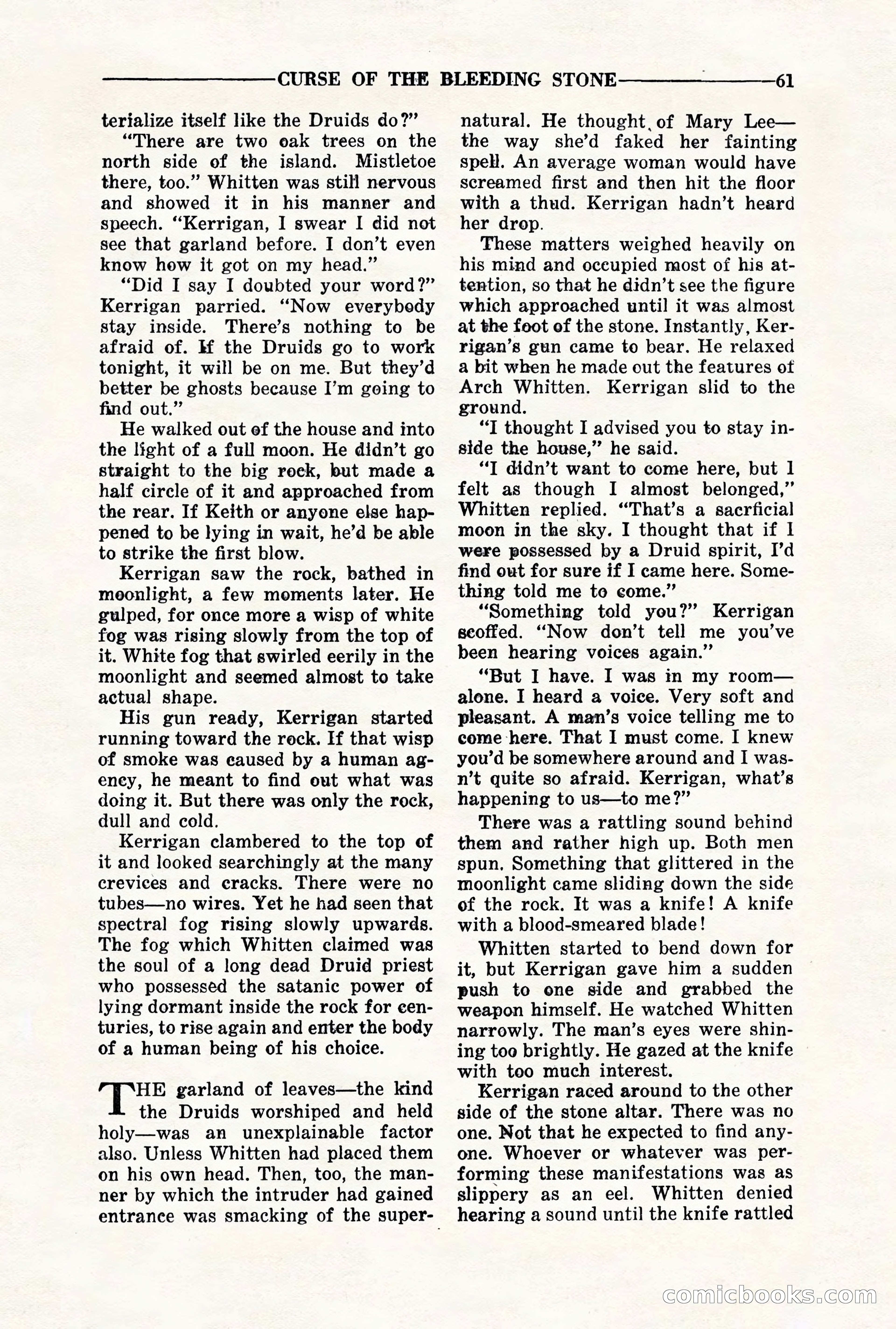
A restored page from Pulp Fiction, 1942. Page through the whole issue in the reader above.
📄 Transcribed text from this page (OCR, searchable)
Machine-transcribed from the original scan — historical spelling and the odd misread are preserved.
CURSE OF THE BLEEDING STONE terialize itself like the Druids do?” “There are two oak trees on the north side of the island. Mistletoe there, too.”’ Whitten was still nervous and showed it in his manner and speech. ‘‘Kerrigan, I swear I did not see that garland before. I don’t even know how it got on my head.” “Did I say I doubted your word?” Kerrigan parried. “Now everybedy stay inside. There’s nothing to be afraid of. H the Druids go to work tonight, it will be on me. But they’d better be ghosts because I’m going to find out.” He walked out ef the house and into the light of a full moon. He didn’t go straight to the big rock, but made a half circle of it and approached from the rear. If Keith or anyone else hap- pened to be lying in wait, he’d be able to strike the first blow. Kerrigan saw the rock, bathed in moonlight, a few moments later. He gulped, for once more a wisp of white fog was rising slowly from the top of it. White fog that swirled eerily in the moonlight and seemed almost to take actual shape. His gun ready, Kerrigan started running toward the reck. If that wisp of smoke was caused by a human ag- ency, he meant to find out what was doing it. But there was only the rock, dull and cold. Kerrigan clambered to the top of it and looked searchingly at the many crevices and cracks. There were no tubes—no wires. Yet he had seen that spectral fog rising slowly upwards. The fog which Whitten claimed was the soul of a long dead Druid priest who possessed the satanic power of lying dormant inside the rock for een- turies, to rise again and enter the body of a human being of his choice. HE garland of leaves—the kind the Druids worshiped and held holy—was an unexplainable factor also. Unless Whitten had placed them on his own head. Then, too, the man- ner by which the intruder had gained entrance was smacking of the super- 61 natural. He thought.of Mary Lee— the way she’d faked her fainting spell. An average woman would have screamed first and then hit the floor with a thud. Kerrigan hadn’t heard her drop. These matters weighed heavily on his mind and oceupied most of his at- tention, so that he didn’t see the figure which approached until it was almost at the feot of the stone. Instantly, Ker- rigan’s gun came to bear. He relaxed a bit when he made out the features ot Arch Whitten. Kerrigan slid to the ground. “TI thought I advised you to stay in- side the house,” he said. “TI didn’t want to come here, but 1 felt as though I almost belonged,”’ Whitten replied. “That’s a sacrficial moon in the sky. I thought that if I were possessed by a Druid spirit, I’d find out for sure if I came here. Some- thing told me to come.” “Something told you?” Kerrigan seoffed. “Now don’t tell me you’ve been hearing voices again.” “But I have. I was in my room— alone. I heard a voice. Very soft and pleasant. A man’s voice telling me to come here. That I must come. I knew you'd be somewhere around and I was- n’t quite so afraid. Kerrigan, what’s happening to us—to me?” There was a rattling sound behind them and rather high up. Both men spun, Something that glittered in the moonlight came sliding down the side of the rock. It was a knife! A knife with a blood-smeared blade! Whitten started to bend down for it, but Kerrigan gave him a sudden push to one side and grabbed the weapon himself. He watched Whitten narrowly. The man’s eyes were shin- ing too brightly. He gazed at the knife with too much interest. Kerrigan raced around to the other side of the stone altar. There was no one. Not that he expected to find any- one. Whoever or whatever was per- forming these manifestations was as slippery as an eel. Whitten denied hearing a sound until the knife rattled DOOK C©