
Pulp Fiction, 1942 · page 58 of 116
10-Story Detective, November 1942 — page 58: what you’re looking at
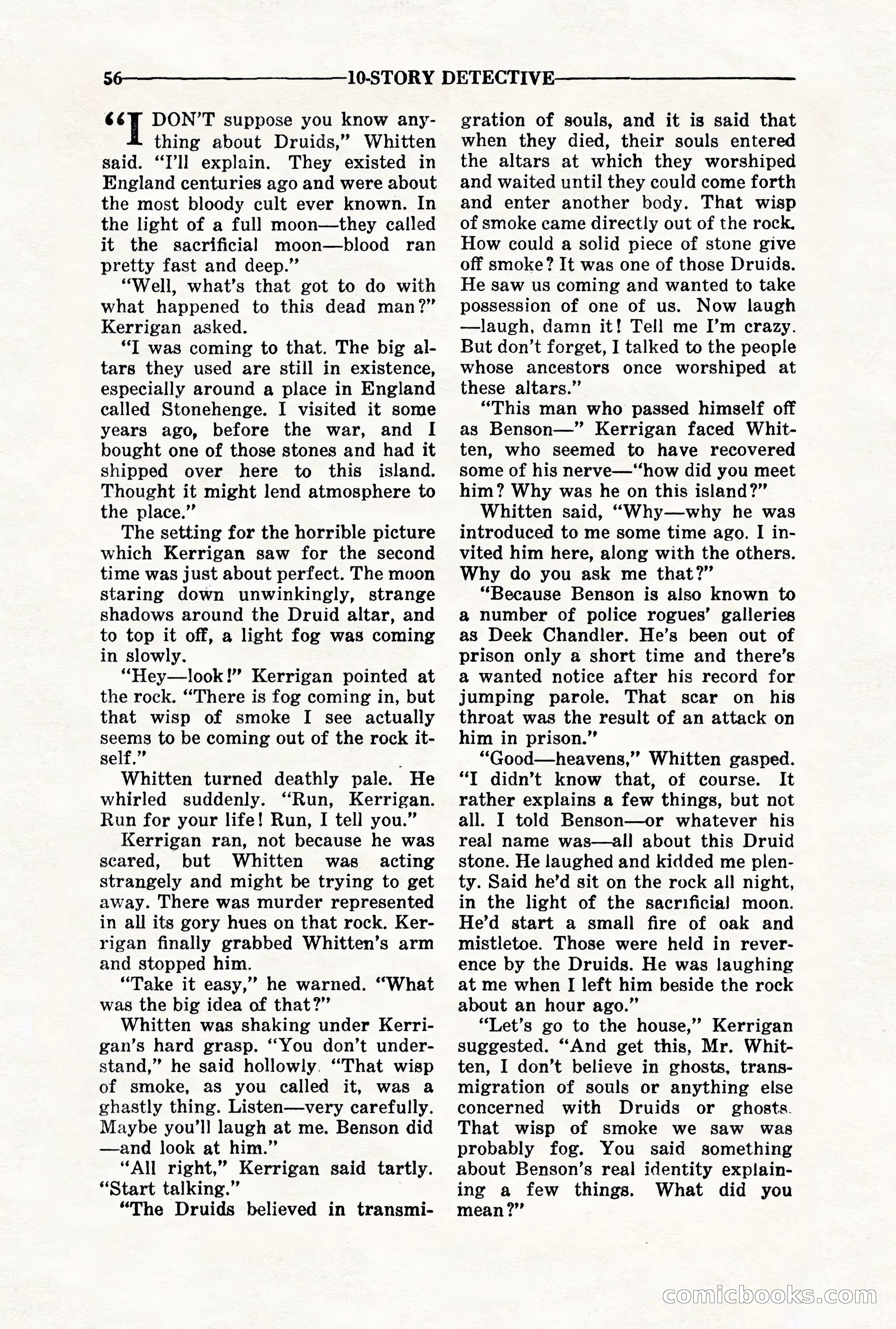
A restored page from Pulp Fiction, 1942. Page through the whole issue in the reader above.
📄 Transcribed text from this page (OCR, searchable)
Machine-transcribed from the original scan — historical spelling and the odd misread are preserved.
§6—______—_—_——_——_10-STORY DETECTIVE——_—_—_—_—______—_- 6¢BH DON’T suppose you know any- thing about Druids,” Whitten said. “I'll explain. They existed in England centuries ago and were about the most bloody cult ever known. In the light of a full moon—they called it the sacrificial moon—blood ran pretty fast and deep.” “Well, what’s that got to do with what happened to this dead man?” Kerrigan asked. “I was coming to that. The big al- tars they used are still in existence, especially around a place in England called Stonehenge. I visited it some years ago, before the war, and I bought one of those stones and had it shipped over here to this island. Thought it might lend atmosphere to the place.” The setting for the horrible picture which Kerrigan saw for the second time was just about perfect. The moon staring down unwinkingly, strange shadows around the Druid altar, and to top it off, a light fog was coming in slowly. ““Hey—look!” Kerrigan pointed at the rock. “There is fog coming in, but that wisp of smoke I see actually seems to be coming out of the rock it- self.” Whitten turned deathly pale. He whirled suddenly. “Run, Kerrigan. Run for your life! Run, I tell you.” Kerrigan ran, not because he was scared, but Whitten was acting strangely and might be trying to get away. There was murder represented in all its gory hues on that rock. Ker- rigan finally grabbed Whitten’s arm and stopped him. “Take it easy,” he warned. “What was the big idea of that?” Whitten was shaking under Kerri- gan’s hard grasp. “You don’t under- stand,” he said hollowly. “That wisp of smoke, as you called it, was a ghastly thing. Listen—very carefully. Maybe you’ll laugh at me. Benson did —and look at him.” “All right,” Kerrigan said tartly. “Start talking.” “The Druids believed in transmi- gration of souls, and it is said that when they died, their souls entered the altars at which they worshiped and waited until they could come forth and enter another body. That wisp of smoke came directly out of the rock. How could a solid piece of stone give off smoke? It was one of those Druids. He saw us coming and wanted to take possession of one of us. Now laugh —laugh, damn it! Tell me I’m crazy. But don’t forget, I talked to the people whose ancestors once worshiped at these altars.” “This man who passed himself off as Benson—” Kerrigan faced Whit- ten, who seemed to have recovered some of his nerve—‘“‘how did you meet him? Why was he on this island?” Whitten said, “Why—why he was introduced to me some time ago. I in- vited him here, along with the others. Why do you ask me that?” “Because Benson is also known to a number of police rogues’ galleries as Deek Chandler. He’s been out of prison only a short time and there’s a wanted notice after his record for jumping parole. That scar on his throat was the result of an attack on him in prison.” “‘Good—heavens,”’ Whitten gasped. “I didn’t know that, of course. It rather explains a few things, but not all. I told Benson—or whatever his real name was—all about this Druid stone. He laughed and kidded me plen- ty. Said he’d sit on the rock all night, in the light of the sacrificial! moon. He’d start a small fire of oak and mistletoe. Those were held in rever- ence by the Druids. He was laughing at me when I left him beside the rock about an hour ago.” *“Let’s go to the house,” Kerrigan suggested. “‘And get this, Mr. Whit- ten, I don’t believe in ghosts, trans- migration of souls or anything else concerned with Druids or ghosts. That wisp of smoke we saw was probably fog. You said something about Benson’s real identity explain- ing a few things. What did you mean?” NOOK C©@