
Pulp Fiction, 1942 · page 50 of 116
10-Story Detective, November 1942 — page 50: what you’re looking at
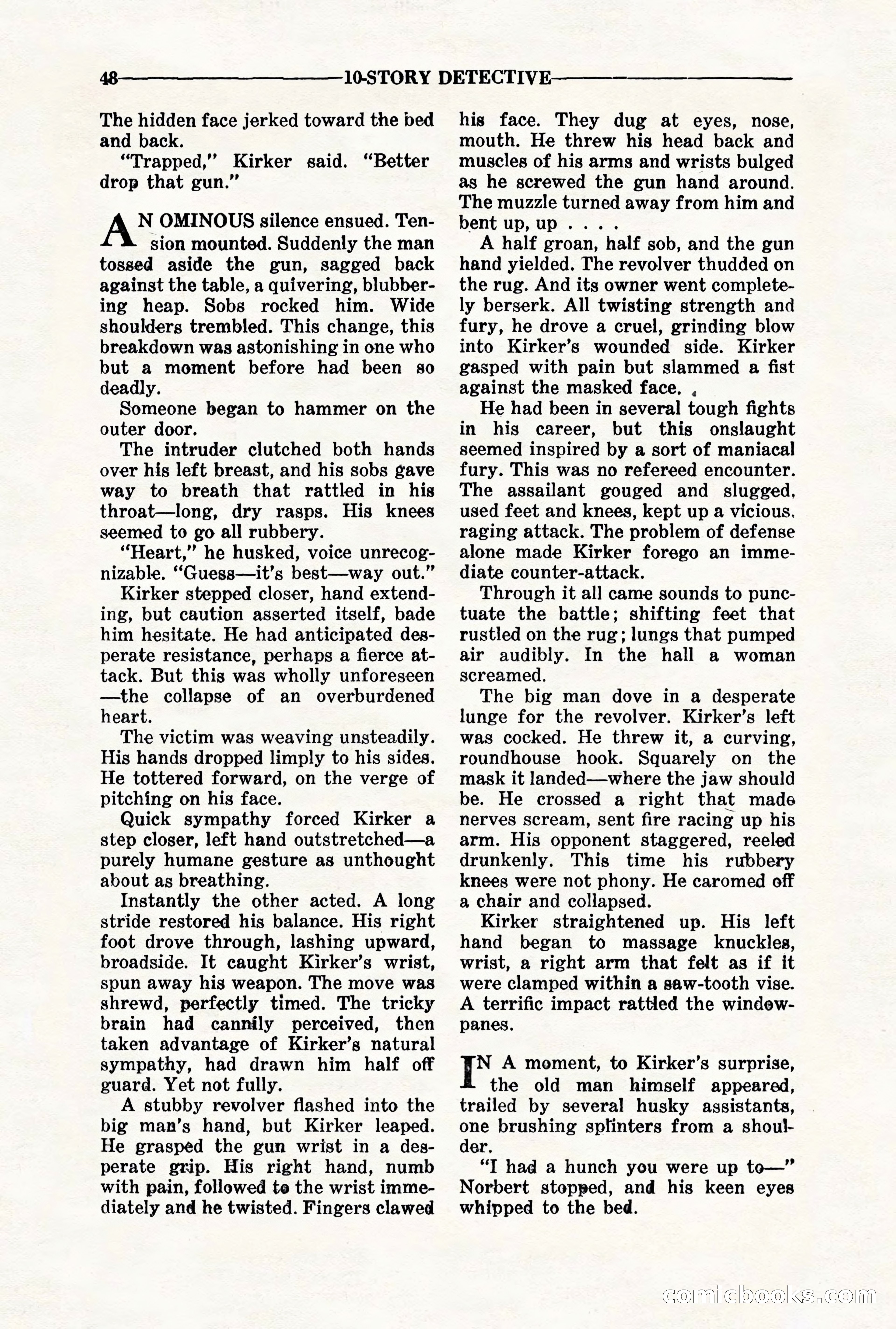
A restored page from Pulp Fiction, 1942. Page through the whole issue in the reader above.
📄 Transcribed text from this page (OCR, searchable)
Machine-transcribed from the original scan — historical spelling and the odd misread are preserved.
48——_———_——_—_—_—_—_————_10-STORY DETECTIVE————— The hidden face jerked toward the bed and back. “Trapped,” Kirker said. “Better drop that gun.” N OMINOUS silence ensued. Ten- sion mounted. Suddenly the man tossed aside the gun, sagged back against the table, a quivering, blubber- ing heap. Sobs rocked him. Wide shoulders trembled. This change, this breakdown was astonishing in one who but a moment before had been so deadly. Someone began to hammer on the outer door. The intruder clutched both hands over his left breast, and his sobs gave way to breath that rattled in his throat—long, dry rasps. His knees seemed to go all rubbery. “Heart,” he husked, voice unrecog- nizable. ‘“Guess—it’s best—way out.” Kirker stepped closer, hand extend- ing, but caution asserted itself, bade him hesitate. He had anticipated des- perate resistance, perhaps a fierce at- tack. But this was wholly unforeseen —the collapse of an overburdened heart. The victim was weaving unsteadily. His hands dropped limply to his sides. He tottered forward, on the verge of pitching on his face. Quick sympathy forced Kirker a step closer, left hand outstretched—a purely humane gesture as unthought about as breathing. Instantly the other acted. A long stride restored his balance. His right foot drove through, lashing upward, broadside. It caught Kirker’s wrist, spun away his weapon. The move was shrewd, perfectly timed. The tricky brain had cannily perceived, then taken advantage of Kirker’s natural sympathy, had drawn him half off guard. Yet not fully. A stubby revolver flashed into the big man’s hand, but Kirker leaped. He grasped the gun wrist in a des- perate grip. His right hand, numb with pain, followed te the wrist imme- diately and he twisted. Fingers clawed his face. They dug at eyes, nose, mouth. He threw his head back and muscles of his arms and wrists bulged as he screwed the gun hand around. The muzzle turned away from him and bent up,up.... A half groan, half sob, and the gun hand yielded. The revolver thudded on the rug. And its owner went complete- ly berserk. All twisting strength and fury, he drove a cruel, grinding blow into Kirker’s wounded side. Kirker gasped with pain but slammed a fist against the masked face. , He had been in several tough fights in his career, but this onslaught seemed inspired by a sort of maniacal fury. This was no refereed encounter. The assailant gouged and slugged, used feet and knees, kept up a vicious. raging attack. The problem of defense alone made Kirker forego an imme- diate counter-attack. Through it all came sounds to punc- tuate the battle; shifting feet that rustled on the rug; lungs that pumped air audibly. In the hall a woman screamed. The big man dove in a desperate lunge for the revolver. Kirker’s left was cocked. He threw it, a curving, roundhouse hook. Squarely on the mask it landed—where the jaw should be. He crossed a right that made nerves scream, sent fire racing up his arm. His opponent staggered, reeled drunkenly. This time his rubbery knees were not phony. He caromed off a chair and collapsed. Kirker straightened up. His left hand began to massage knuckles, wrist, a right arm that felt as if it were clamped within a saw-tooth vise. A terrific impact rattled the windew- panes. N A moment, to Kirker’s surprise, the old man himself appeared, trailed by several husky assistants, one brushing splinters from a shoul- der, “T had a hunch you were up te—” Norbert stopped, and his keen eyes whipped to the bed. cComiclool (C@ 5}