
Pulp Fiction, 1942 · page 45 of 116
10-Story Detective, November 1942 — page 45: what you’re looking at
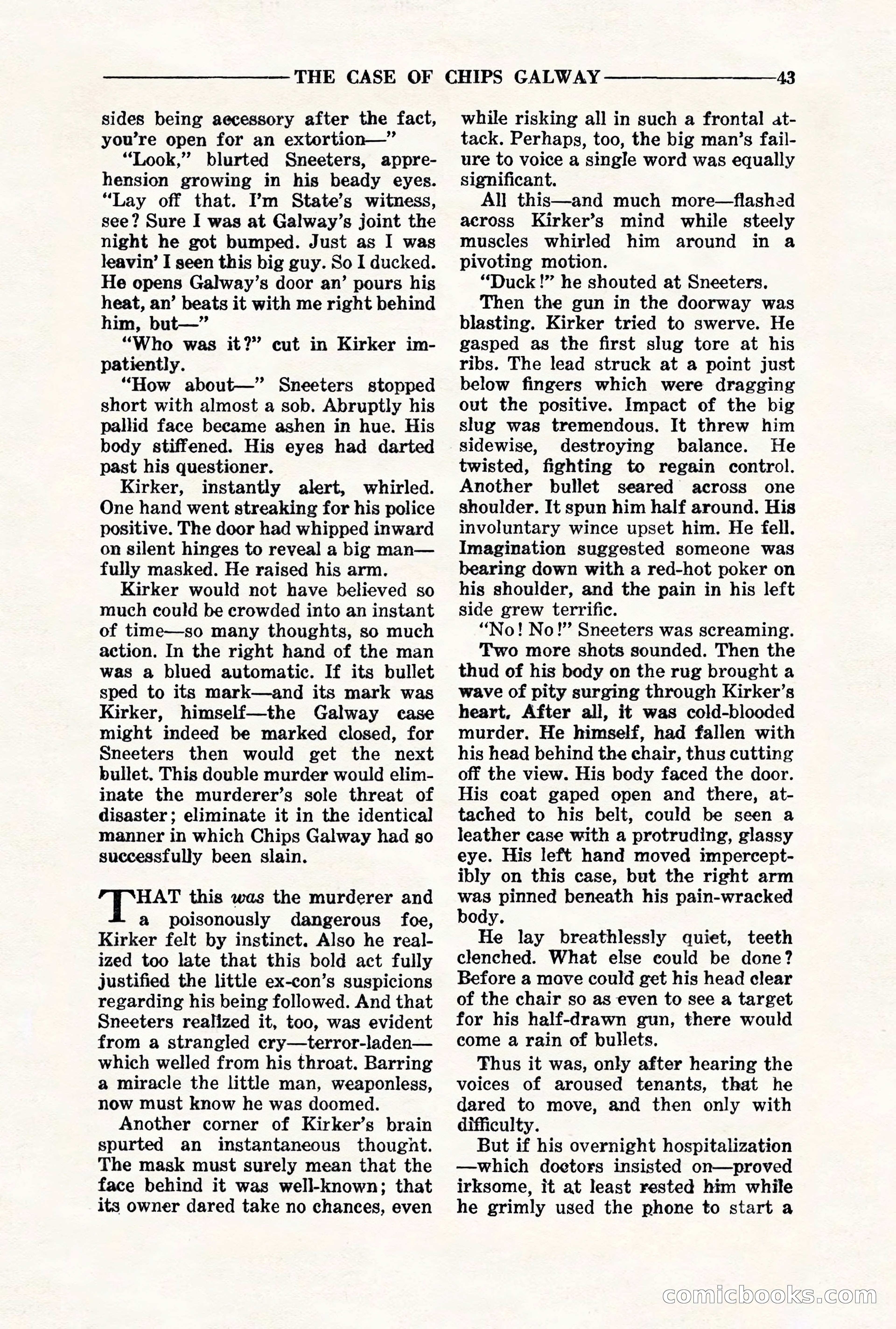
A restored page from Pulp Fiction, 1942. Page through the whole issue in the reader above.
📄 Transcribed text from this page (OCR, searchable)
Machine-transcribed from the original scan — historical spelling and the odd misread are preserved.
THE CASE OF CHIPS GALWAY sides being aecessory after the fact, you’re open for an extortion—” “Look,” blurted Sneeters, appre- hension growing in his beady eyes. “Lay off that. ’m State’s witness, see? Sure I was at Galway’s joint the night he got bumped. Just as I was leavin’ I seen this big guy. So I ducked. He opens Galway’s door an’ pours his heat, an’ beats it with me right behind him, but—” “Who was it?” cut in Kirker im- patiently. “How about—” Sneeters stopped short with almost a sob. Abruptly his pallid face became ashen in hue. His body stiffened. His eyes had darted past his questioner. Kirker, instantly alert, whirled. One hand went streaking for his police positive. The door had whipped inward on silent hinges to reveal a big man— fully masked. He raised his arm. Kirker would not have believed so much could be crowded into an instant of time—so many thoughts, so much action. In the right hand of the man was a blued automatic. If its bullet sped to its mark—and its mark was Kirker, himself—the Galway ease might indeed be marked closed, for Sneeters then would get the next bullet. This double murder would elim- inate the murderer’s sole threat of disaster; eliminate it in the identical manner in which Chips Galway had so successfully been slain. HAT this was the murderer and a poisonously dangerous foe, Kirker felt by instinct. Also he real- ized too late that this bold act fully justified the little ex-con’s suspicions regarding his being followed. And that Sneeters realized it, too, was evident from a strangled cry—terror-laden— which welled from his throat. Barring a miracle the little man, weaponless, now must know he was doomed. Another corner of Kirker’s brain spurted an instantaneous thought. The mask must surely mean that the face behind it was well-known; that its owner dared take no chances, even 43 while risking all in such a frontal at- tack. Perhaps, too, the big man’s fail- ure to voice a single word was equally significant. All this—and much more—flashed across Kirker’s mind while steely muscles whirled him around in a pivoting motion. “Duck!” he shouted at Sneeters. Then the gun in the doorway was blasting. Kirker tried to swerve. He gasped as the first slug tore at his ribs. The lead struck at a point just below fingers which were dragging out the positive. Impact of the big slug was tremendous. It threw him sidewise, destroying balance. He twisted, fighting to regain control. Another bullet seared across one shoulder. It spun him half around. His involuntary wince upset him. He fell. Imagination suggested someone was bearing down with a red-hot poker on his shoulder, and the pain in his left side grew terrific. “No! No!” Sneeters was screaming. Two more shots sounded. Then the thud of his body on the rug brought a wave of pity surging through Kirker’s heart, After all, it was cold-blooded murder. He himself, had fallen with his head behind the chair, thus cutting off the view. His body faced the door. His coat gaped open and there, at- tached to his belt, could be seen a leather case with a protruding, glassy eye. His left hand moved impercept- ibly on this case, but the right arm was pinned beneath his pain-wracked body. He lay breathlessly quiet, teeth clenched. What else could be done? Before a mave could get his head clear of the chair so as even to see a target for his half-drawn gun, there would come a rain of bullets. Fhus it was, only after hearing the voices of aroused tenants, that he dared to move, and then only with difficulty. But if his overnight hospitalization —which doetors insisted on—proved irksome, it at least rested him while he grimly used the phone to start a CO IOOOLK C@