
Pulp Fiction, 1942 · page 40 of 116
10-Story Detective, November 1942 — page 40: what you’re looking at
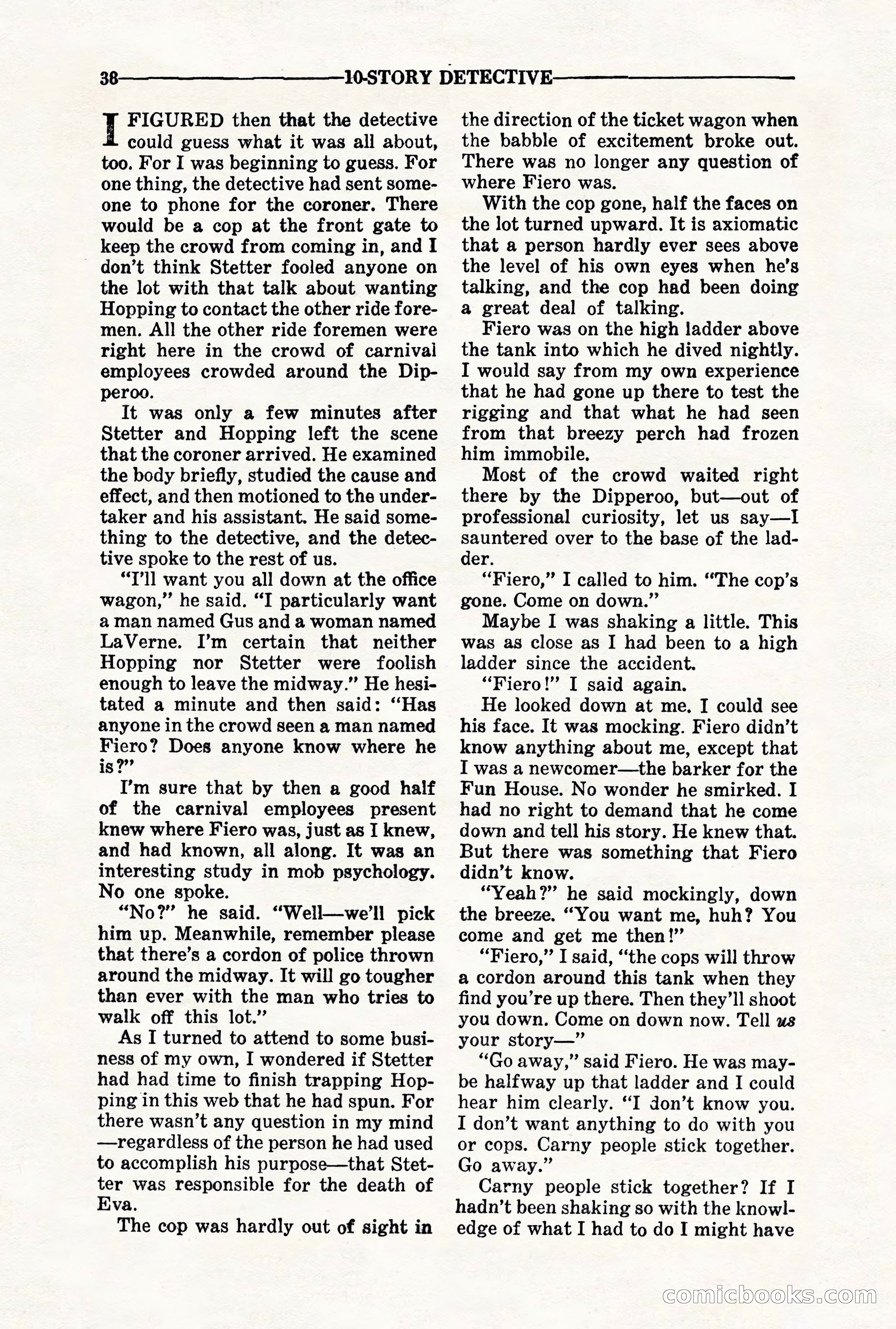
A restored page from Pulp Fiction, 1942. Page through the whole issue in the reader above.
📄 Transcribed text from this page (OCR, searchable)
Machine-transcribed from the original scan — historical spelling and the odd misread are preserved.
38 FIGURED then that the detective could guess what it was all about, too. For I was beginning to guess. For one thing, the detective had sent some- one to phone for the coroner. There would be a cop at the front gate to keep the crowd from coming in, and I don’t think Stetter fooled anyone on the lot with that talk about wanting Hopping to contact the other ride fore- men. All the other ride foremen were right here in the crowd of carnival employees crowded around the Dip- peroo. It was only a few minutes after Stetter and Hopping left the scene that the coroner arrived. He examined the body briefly, studied the cause and effect, and then motioned to the under- taker and his assistant. He said some- thing to the detective, and the detec- tive spoke to the rest of us. “T’ll want you all down at the office wagon,” he said. “I particularly want aman named Gus and a woman named LaVerne. I’m certain that neither Hopping nor Stetter were foolish enough to leave the midway.” He hesi- tated a minute and then said: ‘‘Has anyone in the crowd seen a man named Fiero? Does anyone know where he is ?”’ I’m sure that by then a good half of the carnival employees present knew where Fiero was, just as I knew, and had known, all along. It was an interesting study in mob psychology. No one spoke. “No?” he said. “Well—we’ll pick him up. Meanwhile, remember please that there’s a cordon of police thrown around the midway. It will go tougher than ever with the man who tries to walk off this lot.’ As I turned to attend to some busi- ness of my own, I wondered if Stetter had had time to finish trapping Hop- ping in this web that he had spun. For there wasn’t any question in my mind —regardless of the person he had used to accomplish his purpose—that Stet- ter was responsible for the death of Eva. The cop was hardly out of sight in 10-STORY DETECTIVE the direction of the ticket wagon when the babble of excitement broke out. There was no longer any question of where Fiero was. With the cop gone, half the faces on the lot turned upward. It is axiomatic that a person hardly ever sees above the level of his own eyes when he’s talking, and the cop had been doing a great deal of talking. Fiero was on the high ladder above the tank into which he dived nightly. I would say from my own experience that he had gone up there to test the rigging and that what he had seen from that breezy perch had frozen him immobile. Most of the crowd waited right there by the Dipperoo, but—out of professional curiosity, let us say—lI sauntered over to the base of the lad- der. “Fiero,” I called to him. “The cop’s gone. Come on down.” Maybe I was shaking a little. This was as close as I had been to a high ladder since the accident. “Fiero!” I said again. He looked down at me. I could see his face. It was mocking. Fiero didn’t know anything about me, except that I was a newcomer—the barker for the Fun House. No wonder he smirked. I had no right to demand that he come down and tell his story. He knew that. But there was something that Fiero didn’t know. “Yeah?” he said mockingly, down the breeze. “You want me, huh? You come and get me then!’’ “Fiero,” I said, “the cops will throw a cordon around this tank when they find you’re up there. Then they’1] shoot you down. Come on down now. Tell us your story—” “Go away,” said Fiero. He was may- be halfway up that ladder and I could hear him clearly. “I don’t know you. I don’t want anything to do with you or cops. Carny people stick together. Go away.” Carny people stick together? If I hadn’t been shaking so with the knowl- edge of what I had to do I might have GOMIIGIOO SS (C@ 5}