
Pulp Fiction, 1942 · page 27 of 116
10-Story Detective, November 1942 — page 27: what you’re looking at
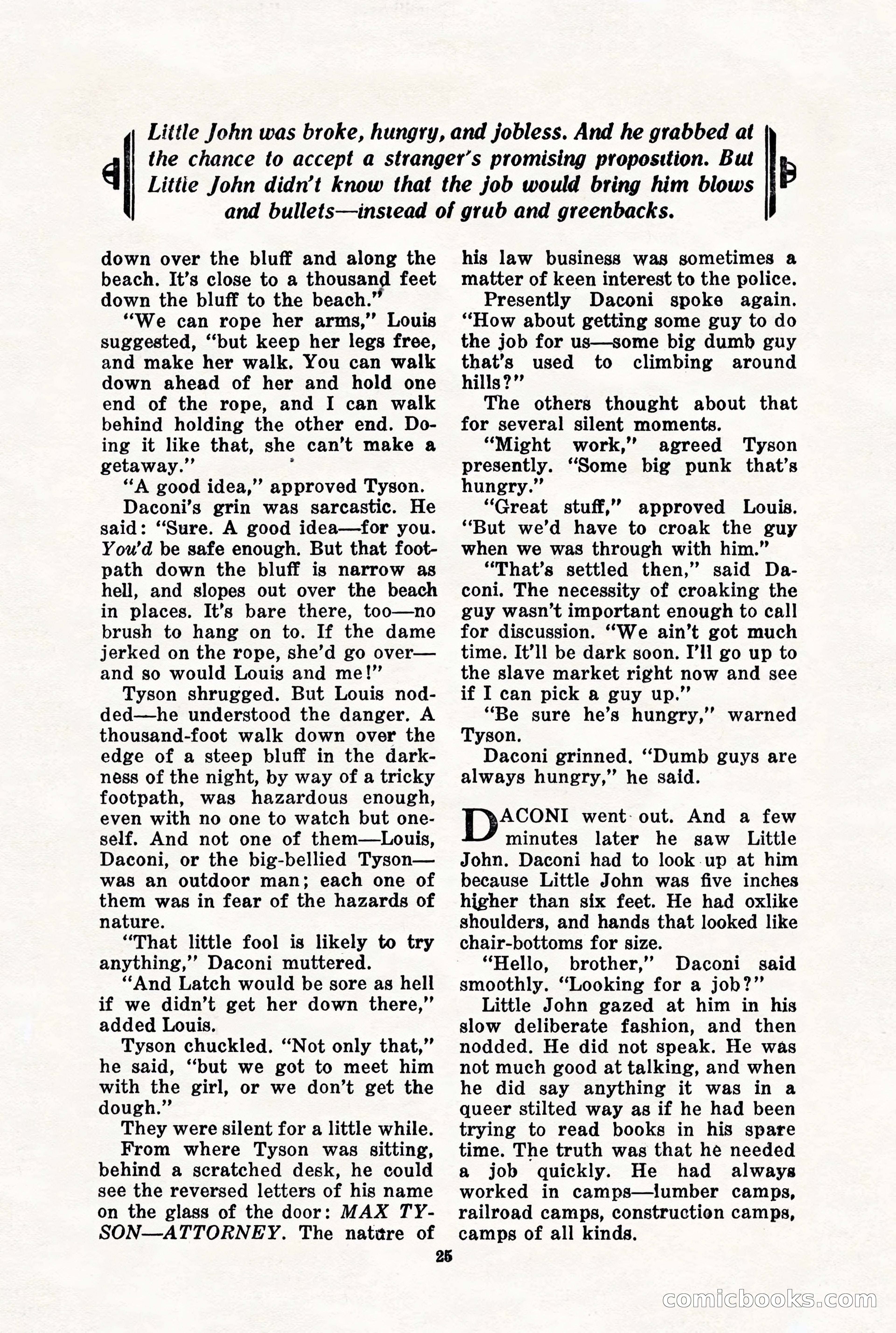
A restored page from Pulp Fiction, 1942. Page through the whole issue in the reader above.
📄 Transcribed text from this page (OCR, searchable)
Machine-transcribed from the original scan — historical spelling and the odd misread are preserved.
Little John was broke, hungry, and jobless. And he grabbed at q the chance to accept a stranger’s promising proposition. But Littie John didn’t know that the job would bring him blows P and bullets—insiead of grub and greenbacks. down over the bluff and along the beach. It’s close to a thousand feet down the bluff to the beach.” ‘We can rope her arms,” Louis suggested, “but keep her legs free, and make her walk. You can walk down ahead of her and hold one end of the rope, and I can walk behind holding the other end. Do- ing it like that, she can’t make a getaway.” : | “A good idea,” approved Tyson. Daconi’s grin was sarcastic. He said: “Sure. A good idea—for you. You'd be safe enough. But that foot- path down the bluff is narrow as hell, and slopes out over the beach in places. It’s bare there, too—no brush to hang on to. If the dame jerked on the rope, she’d go over— and so would Louis and me!”’ Tyson shrugged. But Louis nod- ded—he understood the danger. A thousand-foot walk down over the edge of a steep bluff in the dark- ness of the night, by way of a tricky footpath, was hazardous enough, even with no one to watch but one- self. And not one of them—Louis, Daconi, or the big-bellied Tyson— was an outdoor man; each one of them was in fear of the hazards of nature. “That little fool is likely to try anything,’ Daconi muttered. ‘“‘And Latch would be sore as hell if we didn’t get her down there,” added Louis. Tyson chuckled. “Not only that,” he said, “but we got to meet him with the girl, or we don’t get the dough.” They were silent for a little while. From where Tyson was sitting, behind a scratched desk, he could see the reversed letters of his name on the glass of the door: MAX TY- SON—ATTORNEY. The natetre of 25 his law business was sometimes a matter of keen interest to the police. Presently Daconi spoke again. “How about getting some guy to do the job for us—some big dumb guy that’s used to climbing around hills?” The others thought about that for several silent moments. “Might work,’ agreed Tyson presently. “Some big punk that’s hungry.” “Great stuff,” approved Louis. ‘But we’d have to croak the guy when we was through with him.” “That’s settled then,” said Da- coni, The necessity of croaking the guy wasn’t important enough to call for discussion. “We ain’t got much time. It’ll be dark soon. I'll go up to the slave market right now and see if I can pick a guy up.” “Be sure he’s hungry,’ warned Tyson. Daconi grinned, ‘“‘Dumb guys are always hungry,” he said. ACONI went: out. And a few minutes later he saw Little John. Daconi had to look up at him because Little John was five inches higher than six feet. He had oxlike shoulders, and hands that looked like chair-bottoms for size. ‘Hello, brother,” Daconi said smoothly. “Looking for a job?” Little John gazed at him in his slow deliberate fashion, and then nodded. He did not speak. He was not much good at talking, and when he did say anything it was in a queer stilted way as if he had been trying to read books in his spare time. The truth was that he needed a job quickly. He had always worked in camps—lumber camps, railroad camps, construction camps, camps of all kinds. CO lOOOLK (C©@