
Pulp Fiction, 1942 · page 93 of 116
10-Story Detective Magazine Cover — page 93: what you’re looking at
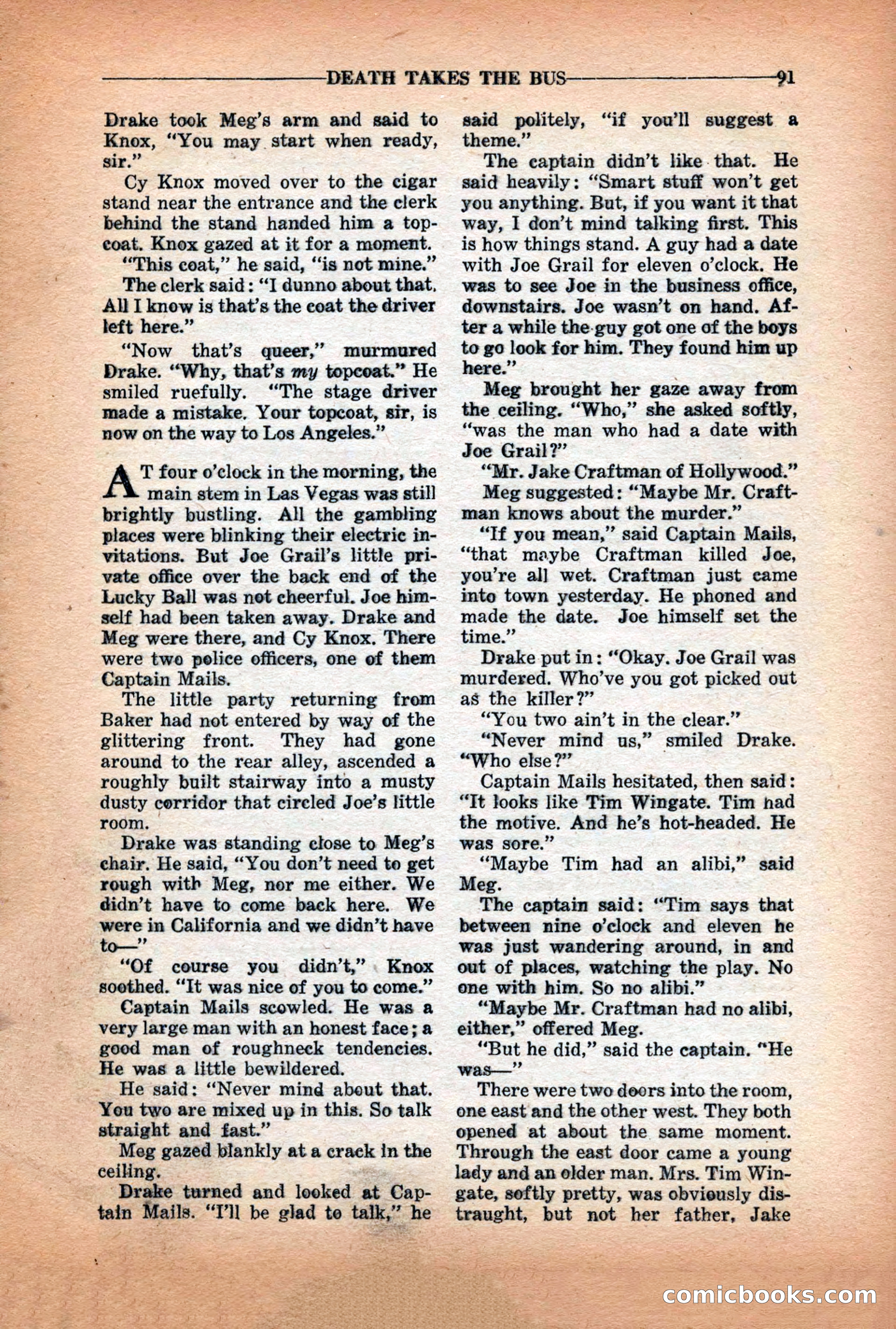
A restored page from Pulp Fiction, 1942. Page through the whole issue in the reader above.
📄 Transcribed text from this page (OCR, searchable)
Machine-transcribed from the original scan — historical spelling and the odd misread are preserved.
DEATH TAKES THE BUS—-————————————_4 Drake took Meg’s arm and said to Knox, “You may start when ready, sir.” Cy Knox moved over to the cigar stand near the entrance and the clerk - behind the stand handed him a top- coat. Knox gazed at it for a moment. “This coat,” he said, “is not mine.” The clerk said: “I dunno about that, All I know is that’s the eoat the driver left here.” “Now that’s queer,” murmured Drake. “Why, that’s my topcoat.” He smiled ruefully. “The stage driver made a mistake, Your topcoat, sir, is now on the way to Los Angeles.” T four o’clock in the morning, the main stem in Las Vegas was still brightly bustling. All the gambling places were blinking their electric in- vitations. But Joe Grail’s little pri- vate office over the back end of the Lucky Ball was not cheerful. Joe him- self had been taken away. Drake and Meg were there, and Cy Knox. There were two police officers, one of them Captain Mails. The little party returning from Baker had not entered by way of the glittering front. They had gone around to the rear alley, ascended a roughly built stairway into a musty dusty corridor that circled Joe’s little room. Drake was standing close to Meg’s chair. He said, “You don’t need to get rough with Meg, nor me either. We didn’t have to come back here. We were in California and we didn’t have ae, = “Of course you didn’t,” Knox soothed. “It was nice of you to come.” Captain Mails scowled. He was a very large man with an honest face; a good man of roughneck tendencies. He was a little bewildered. He said: “Never mind about that. You two are mixed up in this. So talk straight and fast.” Meg gazed blankly at a crack in the ceiling. Drake turned and looked at Cap- tain Mails. “Ill be glad to talk,’ he said politely, “if you'll suggest a theme.” The captain didn’t like that. He said heavily: “Smart stuff won’t get you anything. But, if you want it that way, 1 don’t mind talking first. This is how things stand. A guy had a date with Joe Grail for eleven o’clock. He was to see Joe in the business office, downstairs. Joe wasn’t on hand. Af- ter a while the-.guy got one of the boys to go look for him. They found him up here.”’ Meg brought her gaze away from the ceiling. “Who,” she asked softly, “was the man who had a date with Joe Grail?” | “Mr. Jake Craftman of Hollywood.” Meg suggested: “Maybe Mr. Craft- man knows about the murder.” “Tf you mean,” said Captain Mails, “that maybe Craftman killed Joe, you’re al] wet. Craftman just came ito town yesterday. He phoned and made the date. Joe himself set the time.” Drake put in: “Okay. Joe Grail was murdered. Who’ve you got picked out as the killer?” “You two ain’t in the clear.” “Never mind us,” smiled Drake. “Who else?” Captain Mails hesitated, then said: “Tt looks like Tim Wingate. Tim had the motive. And he’s hot-headed. He was sore.” “Maybe Tim had an alibi,” said Meg. The captain said: “Tim says that between nine o'clock and eleven he was just wandering around, in and out of places, watching the play. No one with him. So no alibi.” “Maybe Mr. Craftman had no alibi, either,” offered Meg. “But he did,” said the captain. “He was—’”’ There were two deors into the room, one east and the other west. They both opened at about the same moment. Through the east door came a young lady and an elder man. Mrs. Tim Win- gate, seftly pretty, was obvieusly dis- traught, but not her father, Jake comichbook .cO