
Pulp Fiction, 1942 · page 78 of 116
10-Story Detective Magazine Cover — page 78: what you’re looking at
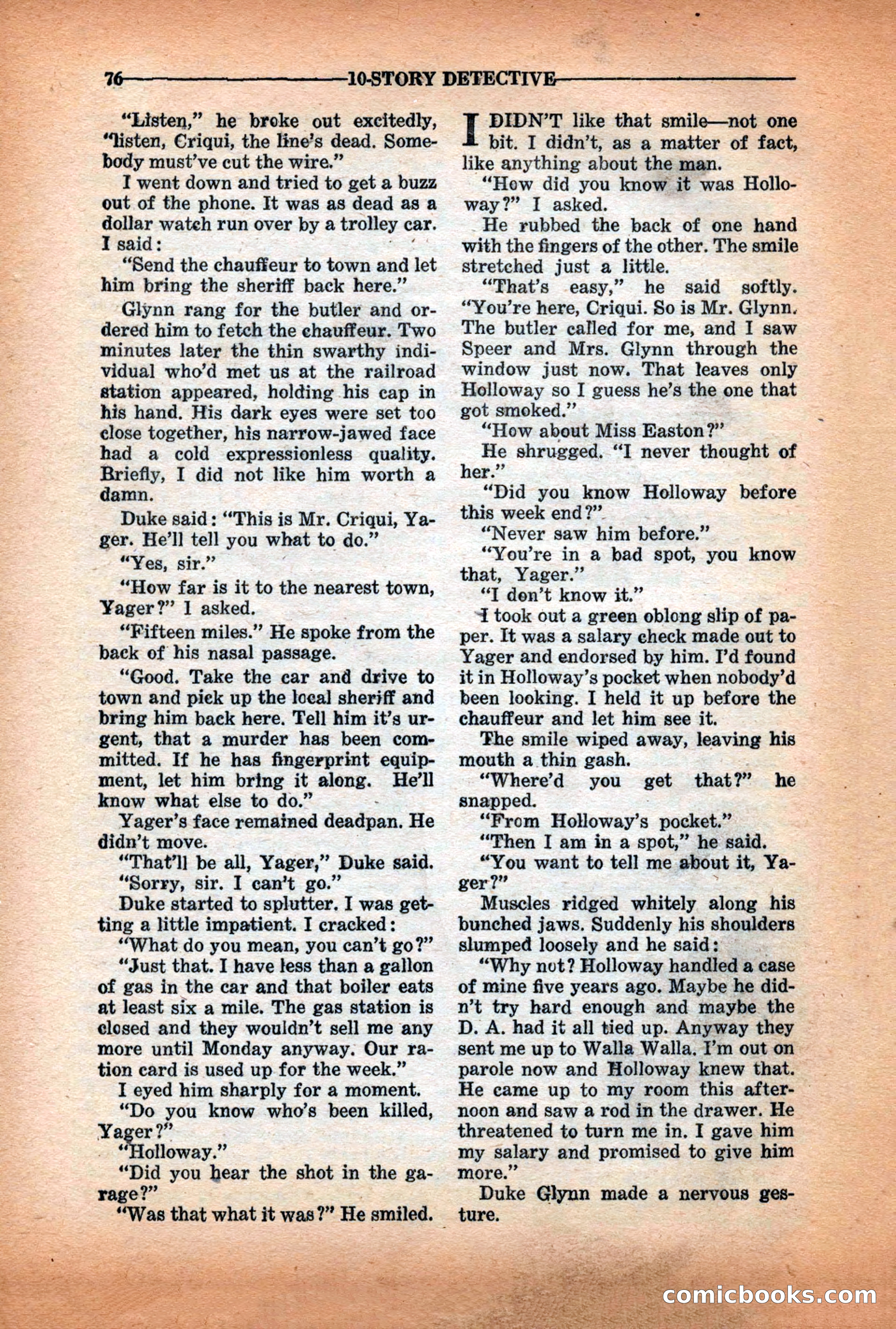
A restored page from Pulp Fiction, 1942. Page through the whole issue in the reader above.
📄 Transcribed text from this page (OCR, searchable)
Machine-transcribed from the original scan — historical spelling and the odd misread are preserved.
146—___———__—_——__10-STORY DEFECTIVE———___———_ “Listen,” he broke out excitedly, “listen, Criqui, the line’s dead. Some- body must’ve cut the wire.” I went down and tried to get a buzz out of the phone. It was as dead as a dollar watch run over by a trolley car. I said: “Send the chauffeur to town and let him bring the sheriff back here.” Glynn rang for the butler and or- dered him to fetch the chauffeur. Two minutes later the thin swarthy indi- vidual who’d met us at the railroad station appeared, holding his cap in his hand. His dark eyes were set too close together, his narrow-jawed face had a cold expressionless quality. Briefly, I did not like him worth a damn. Duke said: “This is Mr. Criqui, Ya- ger. He’ll tell you what to do.” “Yes, sir.” “How far is it to the nearest town, ¥ager?” I asked. “Fifteen miles.” He spoke from the back of his nasal passage. “Good. Take the car and drive to town and piek up the loca] sheriff and bring him back here. Tell him it’s ur- gent, that a murder has been com- mitted. If he has fingerprint equip- ment, let him bring it along. He'll know what else to do.” Yager’s face remained icaican. He didn’t move. “That'll be all, Yager,” Duke said. “Sorry, sir. I can’t go.” Duke started to splutter. I was get- ting a little impatient. I cracked: “What do you mean, you can’t go?” “Just that. I have less than a gallon of gas in the car and that boiler eats at least six a mile. The gas station is closed and they wouldn’t sell me any more until Monday anyway. Our ra- tion card is used up for the week.” I eyed him sharply for a moment. “Do you know who’s been killed, Yager?” ‘Holloway.” “Did you hear the shot in the ga- rage?” “Was that what it was?” He smiled. DIDN’T like that smile—not one bit. I didn’t, as a matter of fact, like anything about the man. “Hew did you know it was Hollo- way?” I asked. He rubbed the back of one hand with the fingers of the other. The smile stretched just a little. “That's easy,” he said _ softly. “You’re here, Criqui. So is Mr. Glynn. The butler called for me, and I saw Speer and Mrs. Glynn through the window just now. That leaves only Holloway so I guess he’s the one that got smoked.” “How about Miss Easton?” He shrugged. “I never thought of her.”’ “Did you know Holloway before this week end?” “Never saw him before.” “You’re in a bad spot, you know that, Yager.” “T den’t know it.” i took out a green oblong slip of pa- per. It was a salary eheck made out to Yager and endorsed by him. I’d found it in Holloway’s pocket when nobody’d been looking. I held it up before the chauffeur and let him see it. ‘Fhe smile wiped away, leaving his mouth a thin gash. “Where'd you get that?” he snapped. “From Holloway’ s pocket.” “Then I am in a spot,” he said. “You want to tell me about it, Ya- ger?” Muscles ridged whitely along his bunched jaws. Suddenly his shoulders slumped loosely and he said: — “Why not? Holloway handled a case of mine five years ago. Maybe he did- n’t try hard enough and maybe the D. A. had it all tied up. Anyway they sent me up to Walla Walla. I’m out on parole now and Holloway knew that. He came up to my room this after- noon and saw a rod in the drawer. He threatened to turn me in. I gave him my salary and promised to give him more.” Duke Glynn made a nervous ges- _ ture.