
Pulp Fiction, 1941 · page 70 of 114
10-Story Detective, September 1941 — page 70: what you’re looking at
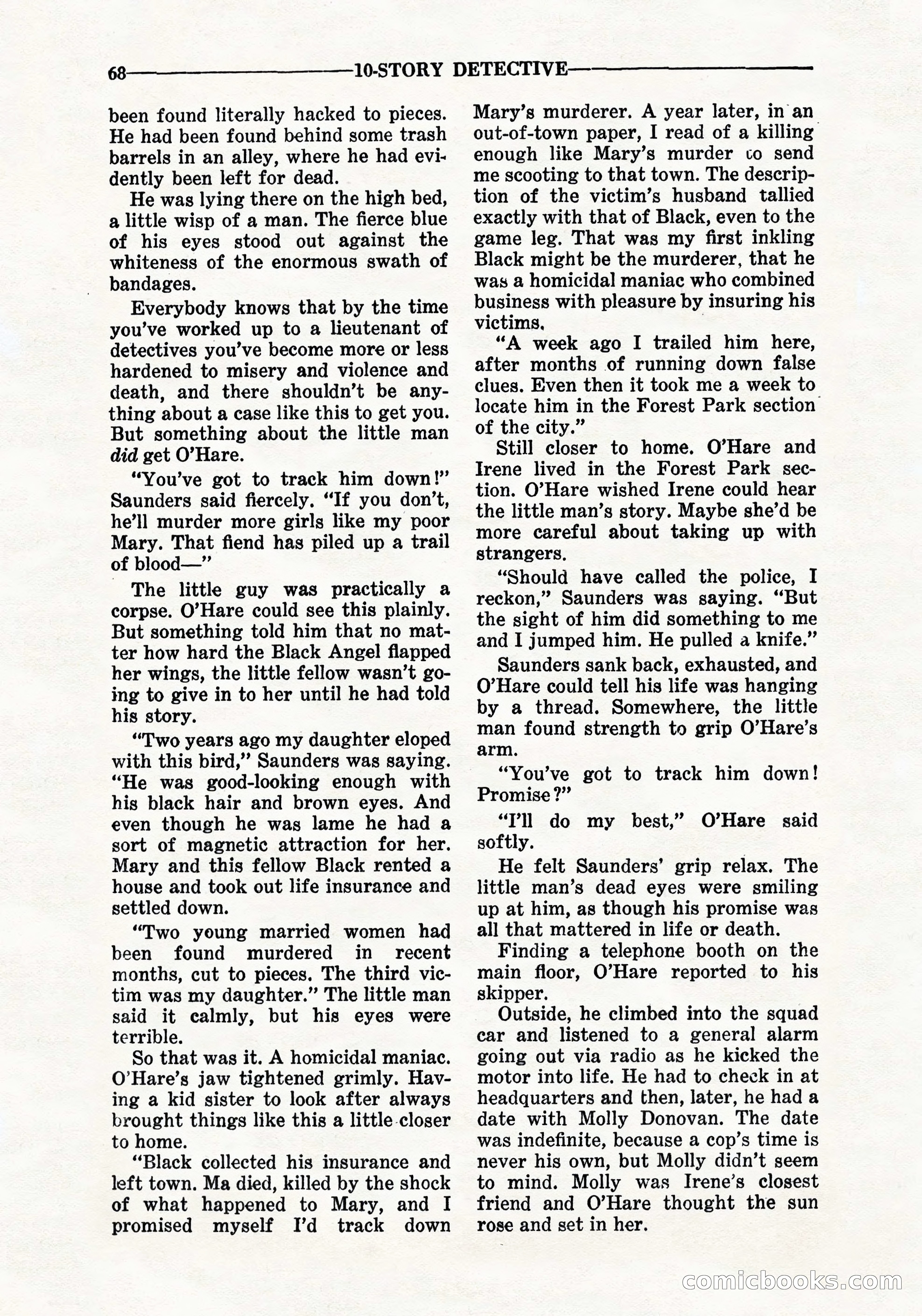
A restored page from Pulp Fiction, 1941. Page through the whole issue in the reader above.
📄 Transcribed text from this page (OCR, searchable)
Machine-transcribed from the original scan — historical spelling and the odd misread are preserved.
68 been found literally hacked to pieces. He had been found behind some trash barrels in an alley, where he had evi- dently been left for dead. He was lying there on the high bed, a little wisp of a man. The fierce blue of his eyes stood out against the whiteness of the enormous swath of bandages. Everybody knows that by the time you’ve worked up to a lieutenant of detectives you’ve become more or less hardened to misery and violence and death, and there shouldn’t be any- thing about a case like this to get you. But something about the little man did get O’Hare. “You’ve got to track him down!” Saunders said fiercely. “If you don’t, he’ll murder more girls like my poor Mary. That fiend has piled up a trail of blood—” The little guy was practically a corpse. O’Hare could see this plainly. But something told him that no mat- ter how hard the Black Angel flapped her wings, the little fellow wasn’t go- ing to give in to her until he had told his story. “Two years ago my daughter eloped with this bird,’’ Saunders was saying. “He was good-looking enough with his black hair and brown eyes. And even though he was lame he had a sort of magnetic attraction for her. Mary and this fellow Black rented a house and took out life insurance and settled down. “Two young married women had been found murdered in_ recent months, cut to pieces. The third vic- tim was my daughter.” The little man said it calmly, but his eyes were terrible. So that was it. A homicidal maniac. O’Hare’s jaw tightened grimly. Hav- ing a kid sister to look after always brought things like this a little-closer to home. “Black collected his insurance and left town. Ma died, killed by the shock of what happened to Mary, and I promised myself I’d track down 10-STORY DETECTIVE— Mary’s murderer. A year later, in an out-of-town paper, I read of a killing enough like Mary’s murder to send me scooting to that town. The descrip- tion of the victim’s husband tallied exactly with that of Black, even to the game leg. That was my first inkling Black might be the murderer, that he was a homicidal maniac who combined business with pleasure by insuring his victims, : “A week ago I trailed him here, after months of running down false clues. Even then it took me a week to locate him in the Forest Park section of the city.” Still closer to home. O’Hare and Irene lived in the Forest Park sec- tion. O’Hare wished Irene could hear the little man’s story. Maybe she’d be more careful about taking up with strangers. “Should have called the police, I reckon,” Saunders was saying. “But the sight of him did something to me and I jumped him. He pulled a knife.” Saunders sank back, exhausted, and O’Hare could tell his life was hanging by a thread. Somewhere, the little man found strength to grip O’Hare’s arm. “You’ve got to track him down! Promise?” “Tll do my _ best,” softly. He felt Saunders’ grip relax. The little man’s dead eyes were smiling up at him, as though his promise was all that mattered in life or death. Finding a telephone booth on the main floor, O’Hare reported to his skipper. | Outside, he climbed into the squad ear and listened to a general alarm going out via radio as he kicked the motor into life. He had to check in at headquarters and then, later, he had a date with Molly Donovan. The date was indefinite, because a cop’s time is never his own, but Molly didn’t seem to mind. Molly was Irene’s closest friend and O’Hare thought the sun rose and set in her. O’Hare said comicbool (©