
Pulp Fiction, 1941 · page 50 of 114
10-Story Detective, September 1941 — page 50: what you’re looking at
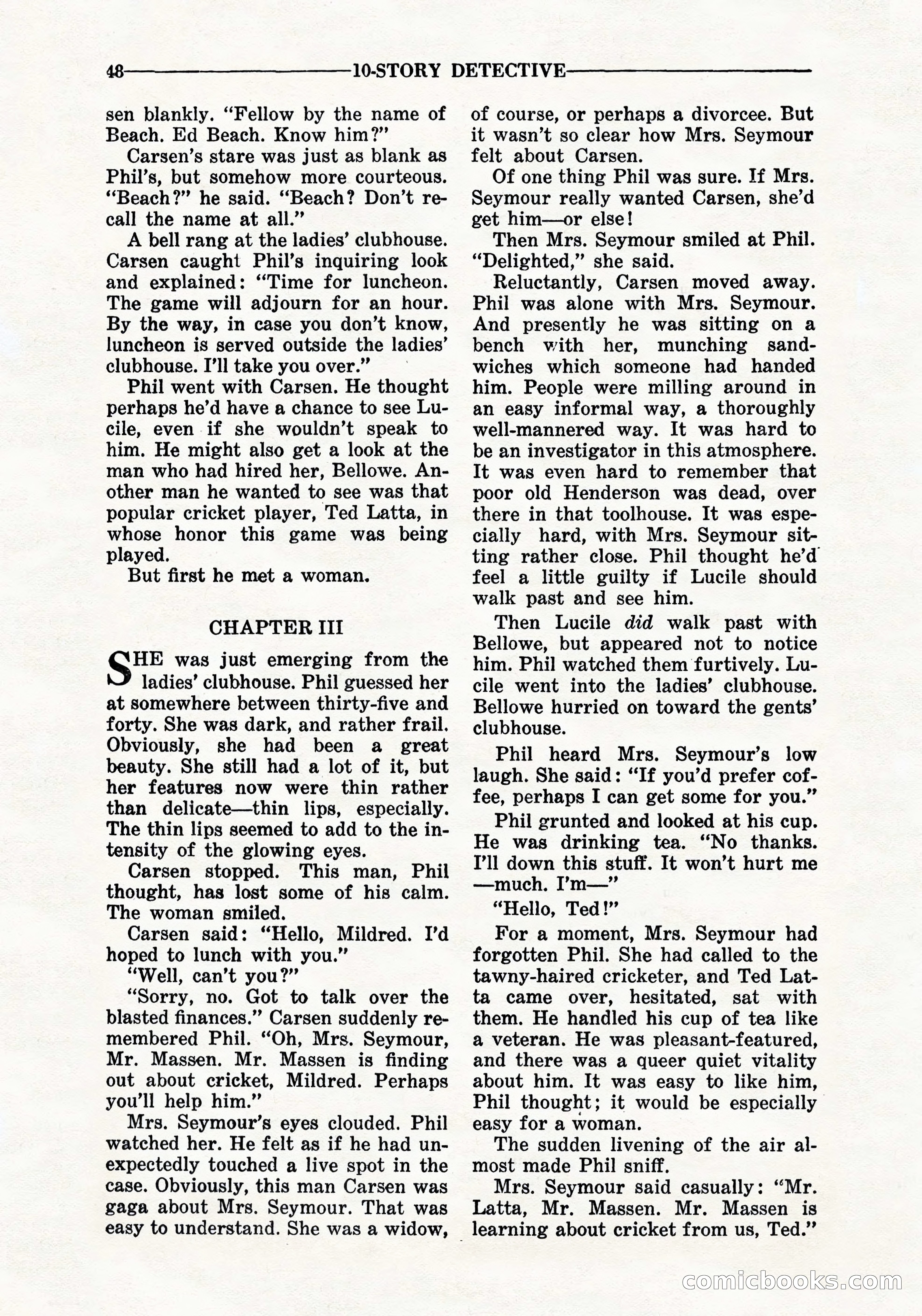
A restored page from Pulp Fiction, 1941. Page through the whole issue in the reader above.
📄 Transcribed text from this page (OCR, searchable)
Machine-transcribed from the original scan — historical spelling and the odd misread are preserved.
48 ————__—__—__—_——__——_10-STORY DETECTIVE sen blankly. “Fellow by the name of Beach. Ed Beach. Know him?” Carsen’s stare was just as blank as Phil’s, but somehow more courteous. ‘‘Beach?” he said. “Beach? Don’t re- call the name at all.” A bell rang at the ladies’ clubhouse. Carsen caught Phil’s inquiring look and explained: “Time for luncheon. The game will adjourn for an hour. By the way, in case you don’t know, luncheon is served outside the ladies’ clubhouse. I’ll take you over.” Phil went with Carsen. He thought perhaps he’d have a chance to see Lu- cile, even if she wouldn’t speak to him. He might also get a look at the man who had hired her, Bellowe. An- other man he wanted to see was that popular cricket player, Ted Latta, in whose honor this game was being played. But first he met a woman. CHAPTER III HE was just emerging from the ladies’ clubhouse. Phil guessed her at somewhere between thirty-five and forty. She was dark, and rather frail. Obviously, she had been a great beauty. She still had a lot of it, but her features now were thin rather than delicate—thin lips, especially. The thin lips seemed to add to the in- tensity of the glowing eyes. Carsen stopped. This man, Phil thought, has lost some of his calm. The woman smiled. Carsen said: “Hello, Mildred. I’d hoped to lunch with you.” “Well, can’t you?” “Sorry, no. Got to talk over the blasted finances.’”’ Carsen suddenly re- membered Phil. “Oh, Mrs. Seymour, Mr. Massen. Mr. Massen is finding out about cricket, Mildred. Perhaps you'll help him.” Mrs. Seymour’s eyes clouded. Phil watched her. He felt as if he had un- expectedly touched a live spot in the case. Obviously, this man Carsen was gaga about Mrs. Seymour. That was easy to understand. She was a widow, of course, or perhaps a divorcee. But it wasn’t so clear how Mrs. Seymour felt about Carsen. Of one thing Phil was sure. If Mrs. Seymour really wanted Carsen, she’d get him—or else! Then Mrs. Seymour smiled at Phil. “Delighted,” she said. Reluctantly, Carsen moved away. Phil was alone with Mrs. Seymour. And presently he was sitting on a bench with her, munching sand- wiches which someone had handed him. People were milling around in an easy informal way, a thoroughly well-mannered way. It was hard to be an investigator in this atmosphere. It was even hard to remember that poor old Henderson was dead, over there in that toolhouse. It was espe- cially hard, with Mrs. Seymour sit- ting rather close. Phil thought he’d feel a little guilty if Lucile should walk past and see him. Then Lucile did walk past with Bellowe, but appeared not to notice him. Phil watched them furtively. Lu- cile went into the ladies’ clubhouse. Bellowe hurried on toward the gents’ clubhouse. Phil heard Mrs. Seymour’s low laugh. She said: “If you’d prefer cof- fee, perhaps I can get some for you.” Phil grunted and looked at his cup. He was drinking tea. ‘No thanks. I'll down this stuff. It won’t hurt me —much. I’m—” “Hello, Ted!” For a moment, Mrs. Seymour had forgotten Phil. She had called to the tawny-haired cricketer, and Ted Lat- ta came over, hesitated, sat with them. He handled his cup of tea like a veteran. He was pleasant-featured, and there was a queer quiet vitality about him. It was easy to like him, Phil thought; it would be especially easy for a woman. The sudden livening of the air al- most made Phil sniff. Mrs. Seymour said casually: “Mr. Latta, Mr. Massen. Mr. Massen is _ learning about cricket from us, Ted.” comiclboolk (©