
Pulp Fiction, 1941 · page 46 of 114
10-Story Detective, September 1941 — page 46: what you’re looking at
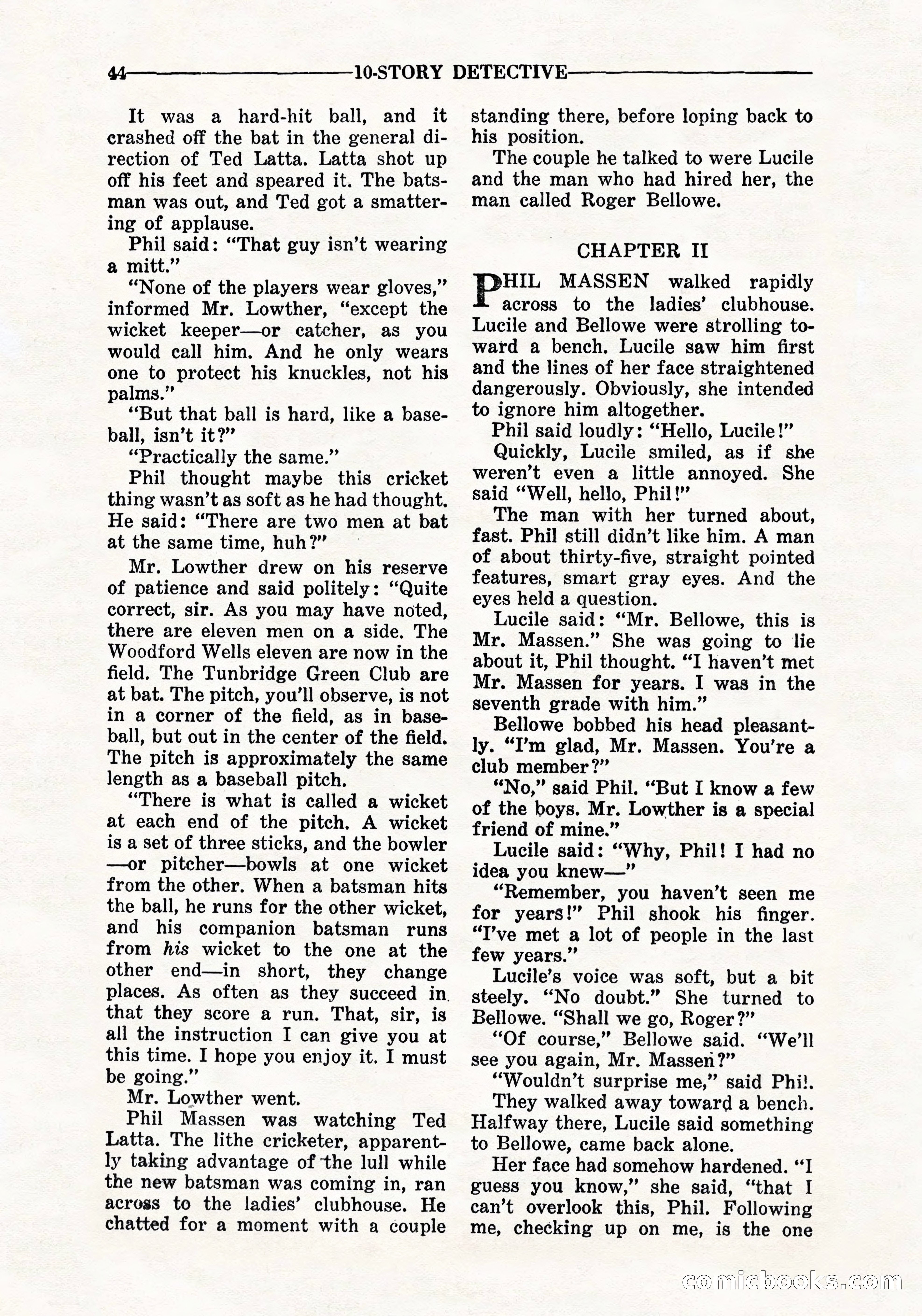
A restored page from Pulp Fiction, 1941. Page through the whole issue in the reader above.
📄 Transcribed text from this page (OCR, searchable)
Machine-transcribed from the original scan — historical spelling and the odd misread are preserved.
44——__—_—__——__—_—__—_—_10-STORY DETECTIVE It was a hard-hit ball, and it crashed off the bat in the general di- rection of Ted Latta. Latta shot up off his feet and speared it. The bats- man was out, and Ted got a smatter- ing of applause. Phil said: “That guy isn’t wearing a mitt.” “None of the players wear gloves,” informed Mr. Lowther, “except the wicket keeper—or catcher, as you would call him. And he only wears one to protect his knuckles, not his palms.” ‘But that ball is hard, like a base- ball, isn’t it?” “Practically the same.” Phil thought maybe this cricket thing wasn’t as soft as he had thought. He said: “There are two men at bat at the same time, huh?” Mr. Lowther drew on his reserve of patience and said politely: “Quite correct, sir. As you may have noted, there are eleven men on a side. The Woodford Wells eleven are now in the field. The Tunbridge Green Club are at bat. The pitch, you’ll observe, is not in a corner of the field, as in base- ball, but out in the center of the field. The pitch is approximately the same length as a baseball pitch. “There is what is called a wicket at each end of the pitch. A wicket is a set of three sticks, and the bowler —or pitcher—bowls at one wicket from the other. When a batsman hits the ball, he runs for the other wicket, and his companion batsman runs from his wicket to the one at the other end—in short, they change places. As often as they succeed in that they score a run. That, sir, is all the instruction I can give you at this time. I hope you enjoy it. I must be going.” Mr. Lowther went. Phil Massen was watching Ted Latta. The lithe cricketer, apparent- ly taking advantage of ‘the lull while the new batsman was coming in, ran across to the ladies’ clubhouse. He chatted for a moment with a couple standing there, before loping back to his position. The couple he talked to were Lucile and the man who had hired her, the man called Roger Bellowe. CHAPTER II HIL MASSEN walked rapidly across to the ladies’ clubhouse. Lucile and Bellowe were strolling to- ward a bench. Lucile saw him first and the lines of her face straightened dangerously. Obviously, she intended to ignore him altogether. Phil said loudly: “Hello, Lucile!” Quickly, Lucile smiled, as if she weren’t even a little annoyed. She said “Well, hello, Phil!’ The man with her turned about, fast. Phil still didn’t like him. A man of about thirty-five, straight pointed features, smart gray eyes. And the eyes held a question. Lucile said: “Mr. Bellowe, this is Mr. Massen.” She was going to lie about it, Phil thought. “I haven’t met Mr. Massen for years. I was in the seventh grade with him.” Bellowe bobbed his head pleasant- ly. “I’m glad, Mr. Massen. You’re a club member?” “No,” said Phil. “But I know a few of the boys. Mr. Lowther is a special friend of mine.” Lucile said: “Why, Phil! I had no idea you knew—” “Remember, you haven’t seen me for years!” Phil shook his finger. “T’ve met a lot of people in the last few years.” Lucile’s voice was soft, but a bit steely. “No doubt.” She turned to Bellowe. “Shall we go, Roger?” “Of course,” Bellowe said. “We’ll see you again, Mr. Massen?” “‘Wouldn’t surprise me,” said Phi’. They walked away toward a bench. Halfway there, Lucile said something to Bellowe, came back alone. Her face had somehow hardened. “I guess you know,” she said, “that I can’t overlook this, Phil. Following me, checking up on me, is the one Conn (Cc NOOK (©