
Pulp Fiction, 1941 · page 34 of 114
10-Story Detective, September 1941 — page 34: what you’re looking at
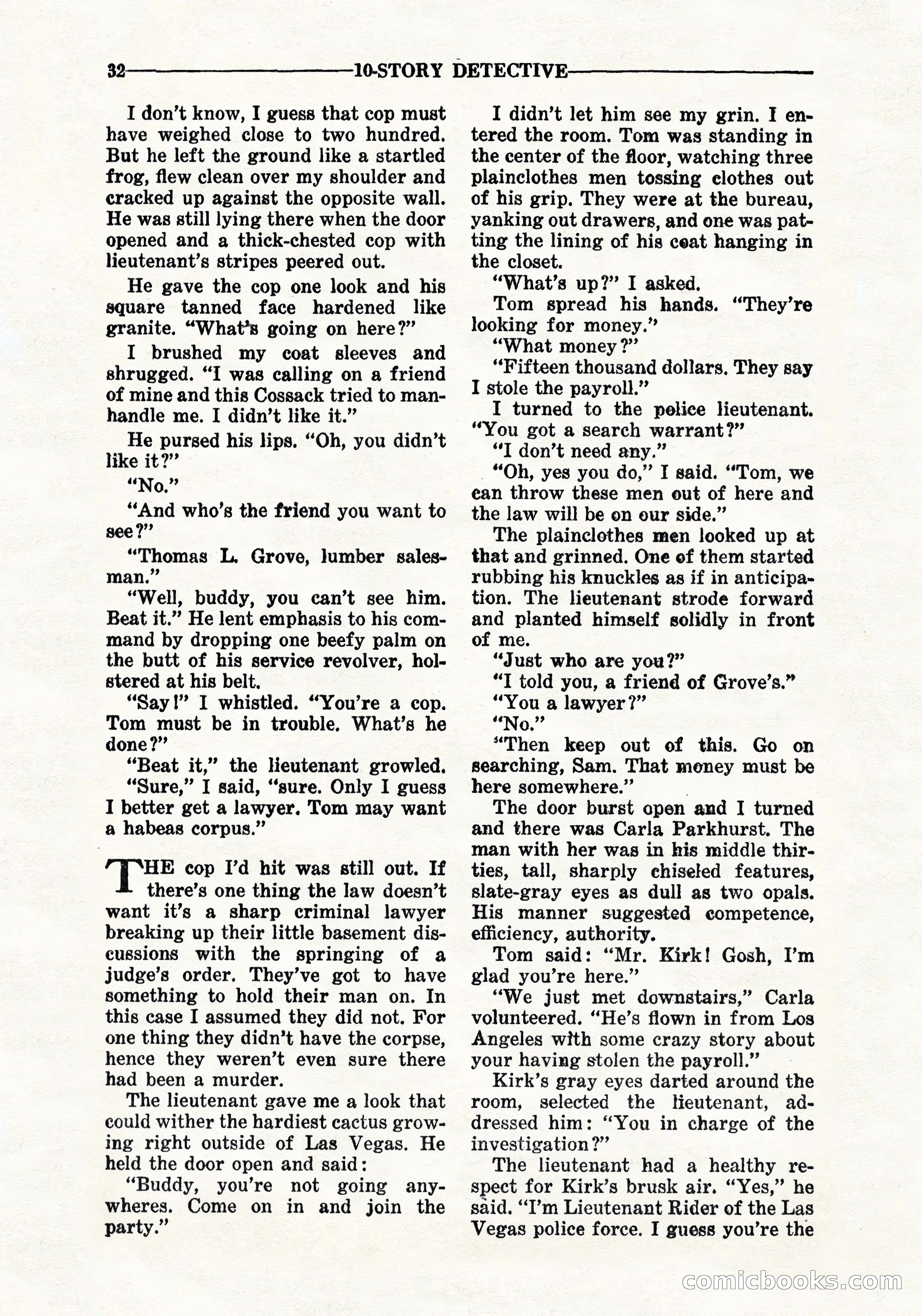
A restored page from Pulp Fiction, 1941. Page through the whole issue in the reader above.
📄 Transcribed text from this page (OCR, searchable)
Machine-transcribed from the original scan — historical spelling and the odd misread are preserved.
32 I don’t know, I guess that cop must have weighed close to two hundred. But he left the ground like a startled frog, flew clean over my shoulder and cracked up against the opposite wall. He was still lying there when the door opened and a thick-chested cop with lieutenant’s stripes peered out. He gave the cop one look and his square tanned face hardened like granite. “What’s going on here?” I brushed my coat sleeves and shrugged. “I was calling on a friend of mine and this Cossack tried to man- handle me. I didn’t like it.” He pursed his lips. “Oh, you didn’t like it?” “No.” “And who’s the friend you want to see?” “Thomas L, Grove, lumber sales- man.” “Well, buddy, you can’t see him. Beat it.” He lent emphasis to his com- mand by dropping one beefy palm on the butt of his service revolver, hol- stered at his belt. “Say!” I whistled. “You’re a cop. Tom must be in trouble. What’s he done?” “Beat it,” the Heutenant growled. “Sure,” I said, “sure. Only I guess I better get a lawyer. Tom may want a habeas corpus.” HE cop I’d hit was still out. If there’s one thing the law doesn’t want it’s a sharp criminal lawyer breaking up their little basement dis- eussions with the springing of a judge’s order. They’ve got to have something to hold their man on. In this case I assumed they did not. For one thing they didn’t have the corpse, hence they weren’t even sure there had been a murder. The lieutenant gave me a look that could wither the hardiest cactus grow- ing right outside of Las Vegas. He held the door open and said: “Buddy, you’re not going any- wheres. Come on in and join the party.” 10-STORY DETECTIVE I didn’t let him see my grin. I en- tered the room. Tom was standing in the center of the floor, watching three plainclothes men tossing elothes out of his grip. They were at the bureau, yanking out drawers, and one was pat- ting the lining of his ceat hanging in the closet. “What’s up?” I asked. Tom spread his hands. ‘“They’re looking for money.” “What money ?” “Fifteen thousand dollars, They say I stole the payroll.” I turned to the pelice lieutenant. “You got a search warrant?” “T don’t need any.” _ “Oh, yes you do,” I said. “Tom, we ean throw these men out of here and the law will be on our side.”’ The plainclothes men looked up at that and grinned. One of them started rubbing his knuckles as if in anticipa- tion. The lieutenant strode forward and planted himself solidly in front of me. “Just who are you?” “I told you, a friend of Grove’s.” “You a lawyer?” NG “Then keep out of this. Go on searching, Sam. That meney must be here somewhere.” | The door burst open and I turned and there was Carla Parkhurst. The man with her was in his middle thir- ties, tall, sharply chiseled features, slate-gray eyes as dull as two opals. His manner suggested competence, efficiency, authority. Tom said: “Mr. Kirk! Gosh, I’m glad you’re here.” “We just met downstairs,” Carla volunteered. “He’s flown in from Los Angeles with some crazy story about your having stolen the payroll.” Kirk’s gray eyes darted around the room, selected the leutenant, ad- dressed him: “You in charge of the investigation ?” The lieutenant had a healthy re- spect for Kirk’s brusk air. “Yes,” he said. “I’m Lieutenant Rider of the Las Vegas police force. I guess you’re the Conn CloOolkk (©