
Pulp Fiction, 1939 · page 56 of 116
10-Story Detective Magazine Cover — page 56: what you’re looking at
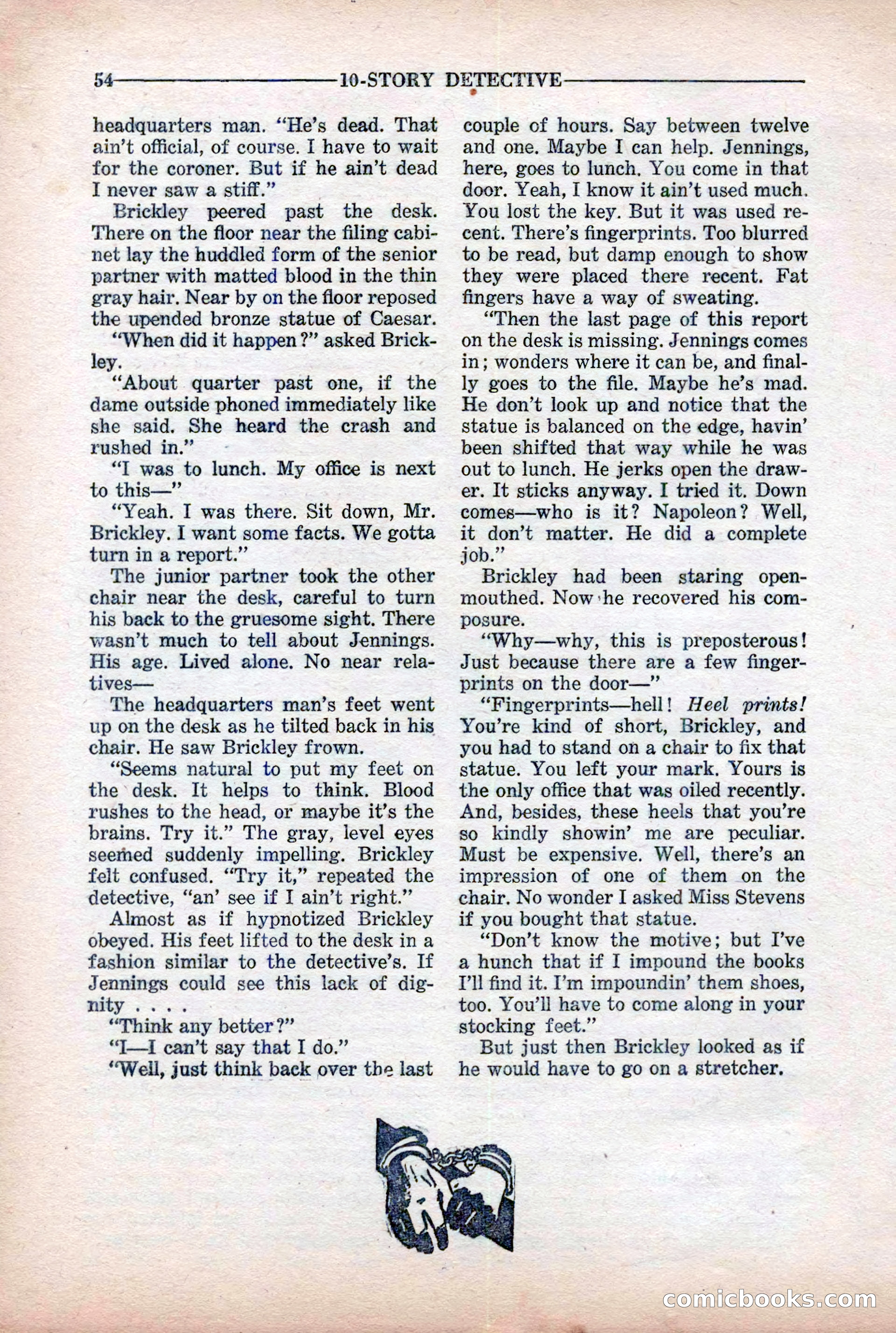
A restored page from Pulp Fiction, 1939. Page through the whole issue in the reader above.
📄 Transcribed text from this page (OCR, searchable)
Machine-transcribed from the original scan — historical spelling and the odd misread are preserved.
6 2-STORT DETECTIVE headquarters man. “‘He’s dead. That ain’t official, of course. I have to wait for the coroner. But if he ain’t dead I never saw a stiff.” Brickley peered past the desk. There on the floor near the filing cabi- net lay the huddled form of the senior partner with matted blood in the thin gray hair. Near by on the floor reposed the upended bronze statue of Caesar. “When did it happen?” asked Brick- ley. “About quarter past one, if the dame outside phoned immediately like she said. She heard the crash and rushed in.” “T was to lunch. My office is next to this—”’ “Yeah. I was there. Sit down, Mr. Brickley. I want some facts. We gotta turn in a report.” The junior partner took the other chair near the desk, careful to turn his back to the gruesome sight. There wasn’t much to tell about Jennings. His age. Lived alone. No near rela- tives— The headquarters man’s feet went up on the desk as he tilted back in his chair. He saw Brickley frown. “Seems natural to put my feet on the desk. It helps to think. Blood rushes to the head, or maybe it’s the brains. Try it.” The gray, level eyes seerned suddenly impelling. Brickley felt confused. “Try it,” repeated the detective, “an’ see if I ain’t right.” Almost as if hypnotized Brickley obeyed. His feet lifted to the desk in a fashion similar to the detective’s. If Jennings could see this lack of dig- mi¢y “Think any better?” “T—I can’t say that I do.” “Well, just think back over the last couple of hours. Say between twelve and one. Maybe I can help. Jennings, here, goes to lunch, You come in that door. Yeah, I know it ain’t used much. You lost the key. But it was used re- cent. There’s fingerprints. Too blurred to be read, but damp enough to show they were placed there recent. Fat fingers have a way of sweating. “Then the last page of this report on the desk is missing. Jennings comes in; wonders where it can be, and final- ly goes to the file. Maybe he’s mad. He don’t look up and notice that the statue is balanced on the edge, havin’ been shifted that way while he was out to lunch. He jerks open the draw- er. It sticks anyway. I tried it. Down comes—who is it? Napoleon? Well, it don’t matter. He did a complete job.” Brickley had been staring open- mouthed. Now he recovered his com- posure. ‘“Why—why, this is preposterous! Just because there are a few finger- prints on the door—” “Fingerprints—hell! Heel prints! You’re kind of short, Brickley, and you had to stand on a chair to fix that statue. You left your mark. Yours is the only office that was oiled recently. And, besides, these heels that you’re so kindly showin’ me are peculiar. Must be expensive. Well, there’s an impression of one of them on the chair. No wonder I asked Miss Stevens if you bought that statue. “Don’t know the motive; but I’ve a hunch that if I impound the books I’ll find it. ’m impoundin’ them shoes, too. You'll have to come along in your stocking feet.” But just then Brickley looked as if he would have to go on a stretcher, Gomichooks.com Ne See