
Pulp Fiction, 1939 · page 54 of 116
10-Story Detective Magazine Cover — page 54: what you’re looking at
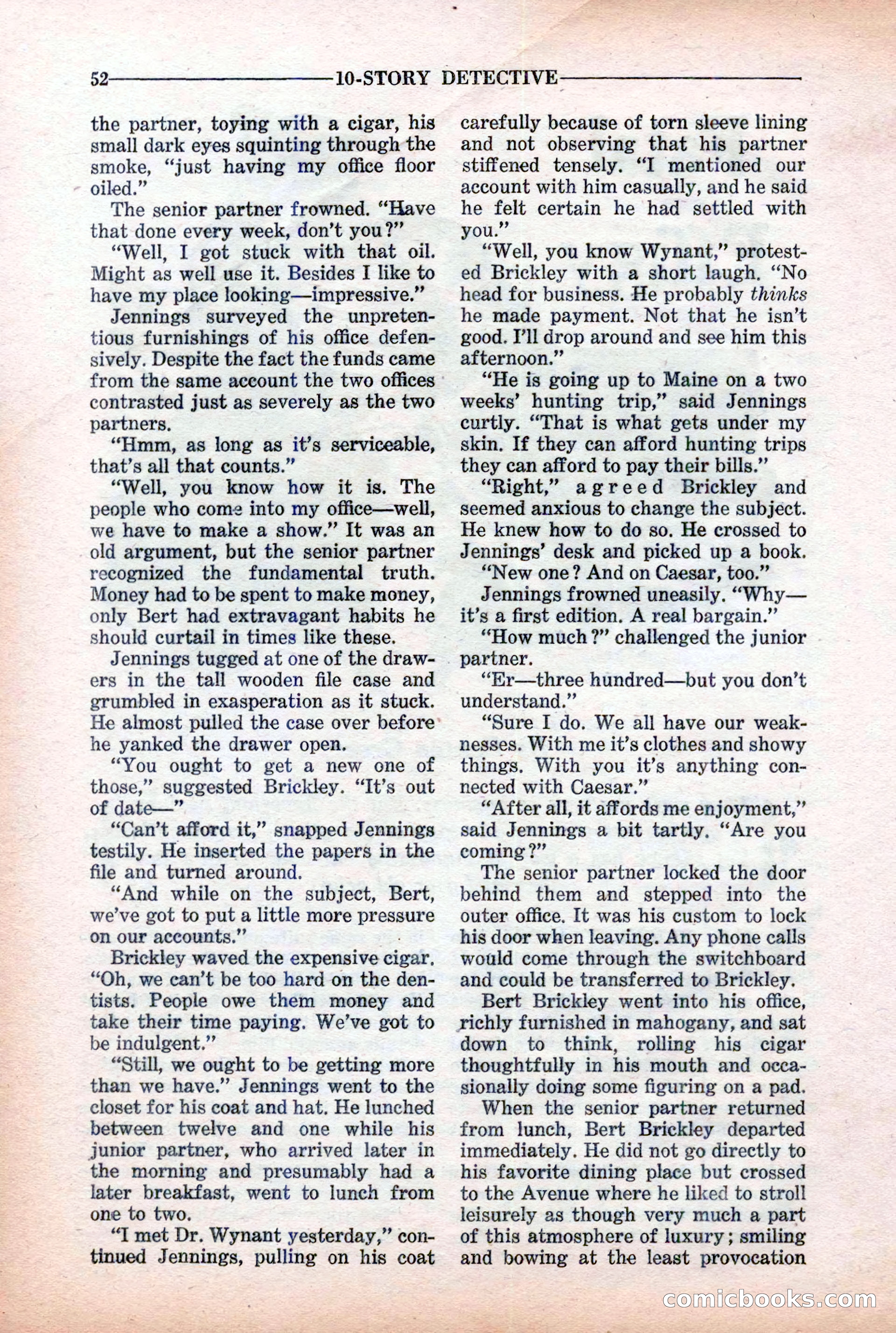
A restored page from Pulp Fiction, 1939. Page through the whole issue in the reader above.
📄 Transcribed text from this page (OCR, searchable)
Machine-transcribed from the original scan — historical spelling and the odd misread are preserved.
52 -____—10-STORY DETECTIVE: the partner, toying with a cigar, his small dark eyes squinting through the smoke, “just having my office floor oiled.” The senior partner frowned. “Have that done every week, don’t you?” “Well, I got stuck with that oil. Might as well use it. Besides I like to have my place looking—impressive.” Jennings surveyed the unpreten- tious furnishings of his office defen- sively. Despite the fact the funds came from the same account the two offices contrasted just as severely as the two partners. “Hmm, as long as it’s serviceable, that’s all that counts.” “Well, you know how it is. The people who come into my office—well, we have to make a show.” It was an old argument, but the senior partner recognized the fundamental truth. Money had to be spent to make money, only Bert had extravagant habits he should curtail in times like these. Jennings tugged at one of the draw- ers in the tall wooden file case and grumbled in exasperation as it stuck. He almost pulled the case over before’ he yanked the drawer open. “You ought to get a new one of those,” suggested Brickley. “It’s out of date—” “Can’t afford it,” snapped Jennings testily. He inserted the papers in the file and turned around. “And while on the subject, Bert, we've got to put a little more pressure on our accounts.” Brickley waved the expensive cigar. “Oh, we can’t be too hard on the den- tists. People owe them money and take their time paying. We’ve got to be indulgent.” “Still, we ought to be getting more than we have.” Jennings went to the closet for his coat and hat. He lunched between twelve and one while his junior partner, who arrived later in the morning and presumably had a later breakfast, went to lunch from one to two. “T met Dr. Wynant yesterday,” con- tinued Jennings, pulling on his coat carefully because of torn sleeve lining and not observing that his partner stiffened tensely. “I mentioned our account with him casually, and he said he felt certain he had settled with you.” “Well, you know Wynant,” protest- ed Brickley with a short laugh. “No head for business. He probably thinks he made payment. Not that he isn’t good. I’ll drop around and see him this afternoon.” “He is going up to Maine on a two weeks’ hunting trip,” said Jennings curtly. “That is what gets under my skin. If they can afford hunting trips they can afford to pay their bills.”’ “Right,” agreed Brickley and seemed anxious to change the subject. He knew how to do so. He crossed to Jennings’ desk and picked up a book. “New one? And on Caesar, too.” Jennings frowned uneasily. “Why— it’s a first edition. A real bargain.” “How much ?” challenged the junior _ partner. “Hr—three hundred—but you don’t understand.” “Sure I do. We all have our weak- nesses. With me it’s clothes and showy things. With you it’s anything con- nected with Caesar.” “After all, it affords me enjoyment,” said Jennings a bit tartly. “Are you coming ?” The senior partner locked the door behind them and stepped into the outer office. It was his custom to lock his door when leaving. Any phone calls would come through the switchboard and could be transferred to Brickley. Bert Brickley went into his office, richly furnished in mahogany, and sat down to think, rolling his cigar thoughtfully in his mouth and occa- sionally doing some figuring on a pad. When the senior partner returned from lunch, Bert Brickley departed immediately. He did not go directly to his favorite dining place but crossed to the Avenue where he liked to stroll leisurely as though very much a part of this atmosphere of luxury; smiling and bowing at the least provocation COMAIE KOOKS q(COMN => Page A = 7 a = ~