
Pulp Fiction, 1939 · page 24 of 116
10-Story Detective Magazine Cover — page 24: what you’re looking at
A restored page from Pulp Fiction, 1939. Page through the whole issue in the reader above.
📄 Transcribed text from this page (OCR, searchable)
Machine-transcribed from the original scan — historical spelling and the odd misread are preserved.
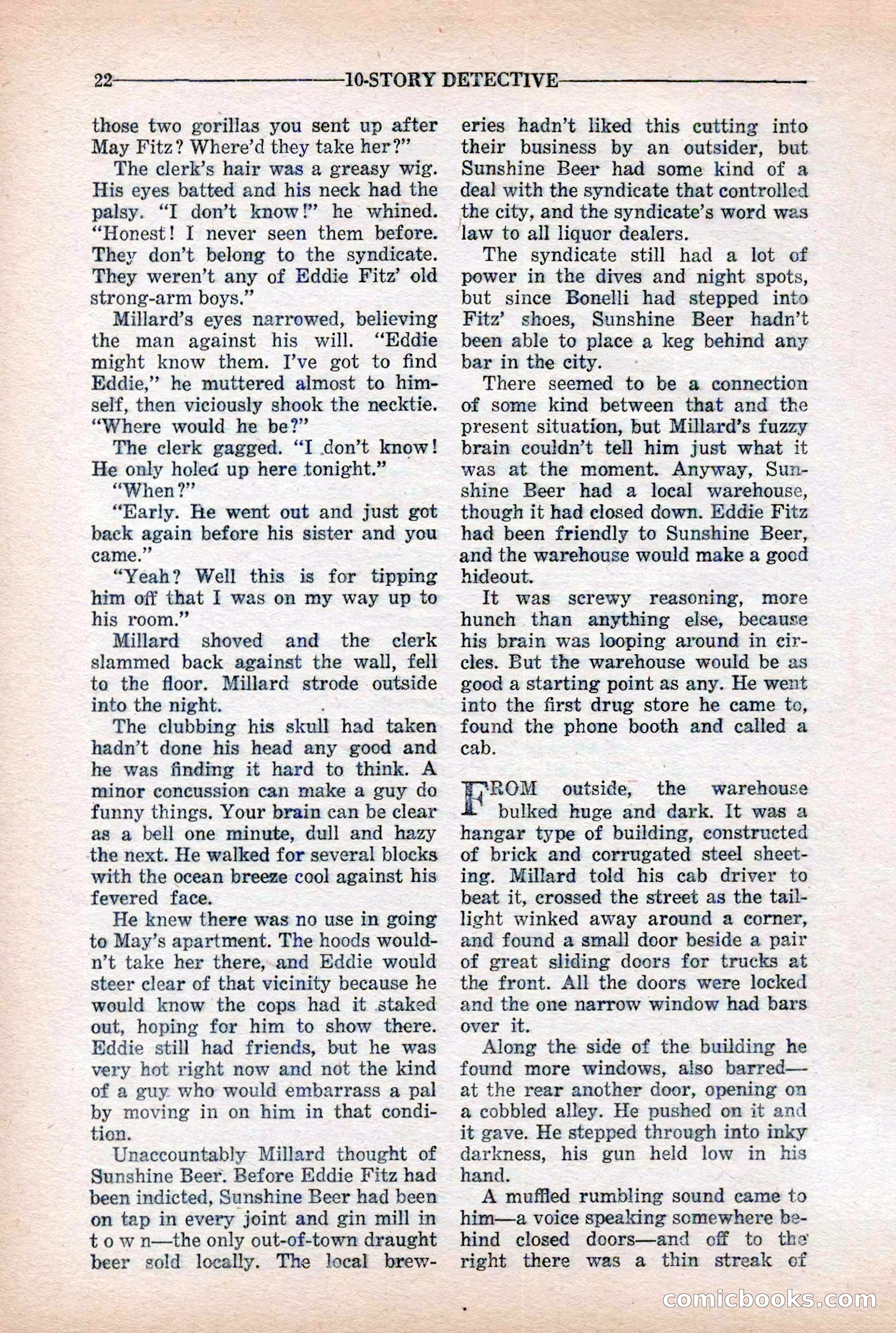
22-—__—_____—_—_——_——10-STORY DETECTIVE those two gorillas you sent up after May Fitz? Where’d they take her?” The clerk’s hair was a greasy wig. His eyes batted and his neck had the palsy. “I don’t know!” he whined. “Honest! I never seen them before. They don’t belong to the syndicate. They weren’t any of Eddie Fitz’ old strong-arm boys.” Millard’s eyes narrowed, believing the man against his will. “Eddie might know them. I’ve got to find Eddie,” he muttered almost to him- self, then viciously shook the necktie. “Where would he be?” The clerk gagged. “I don’t know! He only holed up here tonight.” “When?” “Early. He went out and just got back again before his sister and you came.” “Yeah? Well this is for tipping him off that I was on my way up to his room.” Millard shoved and the clerk slammed back against the wall, fell to the floor. Millard strode outside into the night. The clubbing his skull had taken hadn’t done his head any good and he was finding it hard to think. A minor concussion can make a guy do funny things. Your brain can be clear as a bell one minute, dull and hazy the next. He walked for several blocks with the ocean breeze cool against his fevered face. He knew there was no use in going to May’s apartment. The hoods would- n’t take her there, and Eddie would steer clear of that vicinity because he would know the cops had it staked out, hoping for him to show there. Eddie still had friends, but he was very hot right now and not the kind of a guy. who would embarrass a pal by moving in on him in that condi- tien. Unaccountably Millard thought of Sunshine Beer. Before Eddie Fitz had been indicted, Sunshine Beer had been on tap in every joint and gin mill in t o w n—the only out-of-town draught beer sold locally. The local brew- eries hadn’t liked this cutting into their business by an outsider, but Sunshine Beer had some kind of a deal with the syndicate that controlled the city, and the syndicate’s word was law to all liquor dealers. The syndicate still had a lot of power in the dives and night spots, but since Bonelli had stepped into Fitz’ shoes, Sunshine Beer hadn’t been able to place a keg behind any bar in the city. There seemed to be a connection of some kind between that and the present situation, but Millard’s fuzzy brain couldn’t tell him just what it was at the moment. Anyway, Sun- shine Beer had a local warehouse, though it had closed down. Eddie Fitz had been friendly to Sunshine Beer, and the warehouse would make a good hideout. It was screwy reasoning, more hunch than anything else, because his brain was looping around in cir- cles. But the warehouse would be as good a starting point as any. He went into the first drug store he came to, found the phone booth and called a cab. ROM outside, the warehouse bulked huge and dark. It was a hangar type of building, constructed of brick and corrugated steel sheet- ing. Millard told his cab driver to beat it, erossed the street as the tai!- light winked away around a corner, and found a small door beside a pair of great sliding doors for trucks at the front. All the doors were locked and the one narrow window had bars over it. Along the side of the building he found more windows, also barred— at the rear another door, opening on a cobbled alley. He pushed on it and it gave. He stepped through into inky darkness, his gun held low in his hand. A muffled rumbling sound came to him—a voice speaking somewhere be- hind closed doors—and off to the right there was a thin streak of Gomichookszcom