
Pulp Fiction, 1938 · page 93 of 116
10-Story Detective Magazine Cover — page 93: what you’re looking at
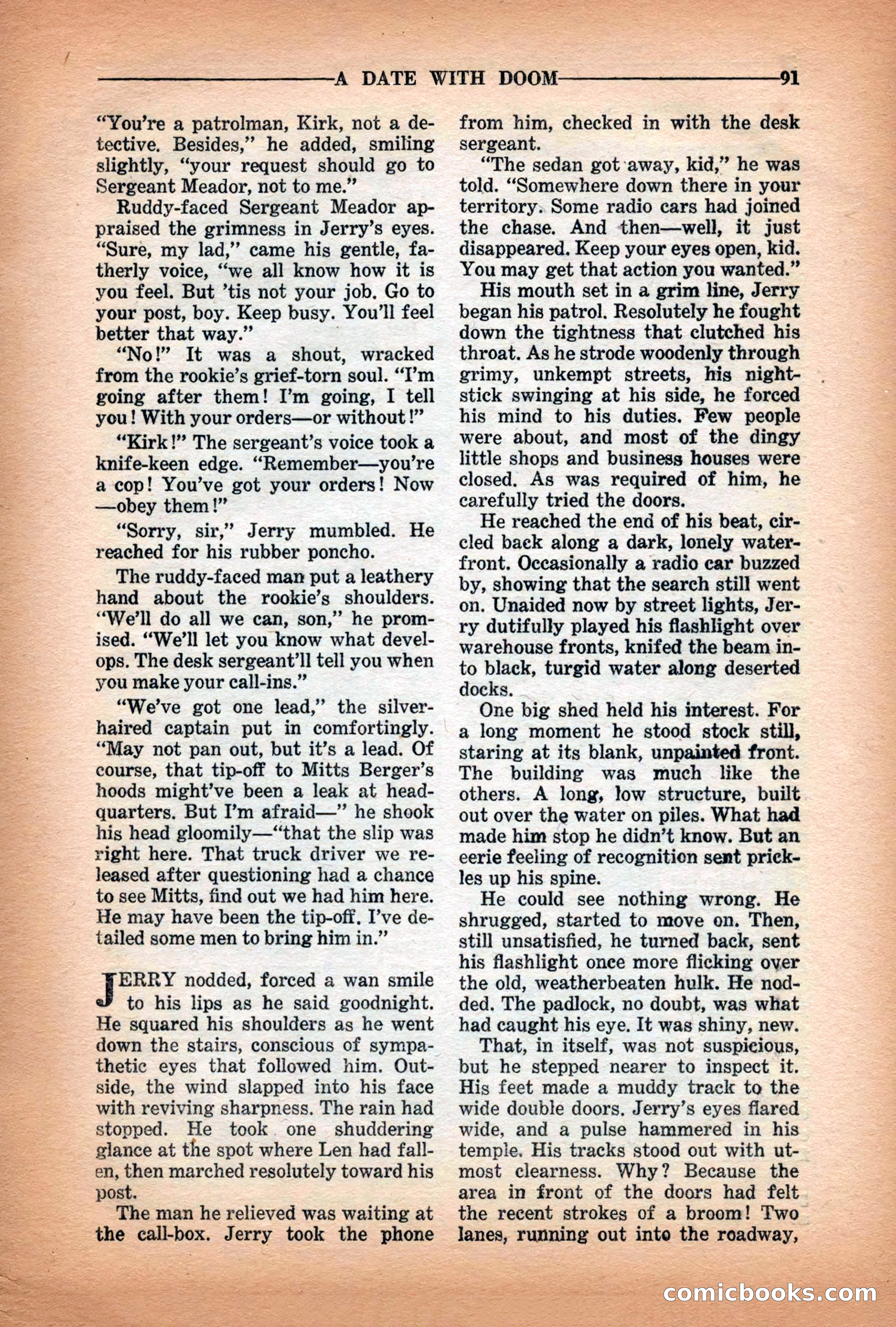
A restored page from Pulp Fiction, 1938. Page through the whole issue in the reader above.
📄 Transcribed text from this page (OCR, searchable)
Machine-transcribed from the original scan — historical spelling and the odd misread are preserved.
A DATE WITH DOOM——————————— 91 “You’re a patrolman, Kirk, not a de- tective. Besides,” he added, smiling slightly, “your request should go to Sergeant Meador, not to me.” Ruddy-faced Sergeant Meador ap- praised the grimness in Jerry’s eyes. “Sure, my lad,” came his gentle, fa- therly voice, “we all know how it is you feel. But ’tis not your job. Go to your post, boy. Keep busy. You’ll feel better that way.” | “No!” It was a shout, wracked from the rookie’s grief-torn soul. “I’m going after them! I’m going, I tell you! With your orders—or without!” “Kirk!” The sergeant’s voice took a knife-keen edge. “Remember—you’re a cop! You’ve got your orders! Now —obey them!” “Sorry, sir,’ Jerry mumbled. He reached for his rubber poncho. The ruddy-faced man put a leathery hand about the rookie’s shoulders. “We'll do all we can, son,” he prom- ised. “We'll let you know what devel- ops. The desk sergeant’ll tell you when you make your call-ins.” “We've got one lead,” the silver- haired captain put in comfortingly. “May not pan out, but it’s a lead. Of course, that tip-off to Mitts Berger’s hoods might’ve been a leak at head- quarters. But I’m afraid—” he shook his head gloomily—“‘that the slip was right here. That truck driver we re- leased after questioning had a chance to see Mitts, find out we had him here. He may have been the tip-off, I’ve de- tailed some men to bring him in.” ERRY nodded, forced a wan smile to his lips as he said goodnight. He squared his shoulders as he went down the stairs, conscious of sympa- thetic eyes that followed him. Out- side, the wind slapped into his face with reviving sharpness. The rain had stopped. He took one shuddering glance at the spot where Len had fall- en, then marched resolutely toward his post. The man he relieved was waiting at the call-box. Jerry took the phone from him, checked in with the desk sergeant. “The sedan got away, kid,” he was told. “Somewhere down there in your territory: Some radio cars had joined the chase. And then—well, it just disappeared. Keep your eyes open, kid. You may get that action you wanted.” His mouth set in a grim line, Jerry began his patrol. Resolutely he fought down the tightness that clutched his throat. As he strode woodenly through grimy, unkempt streets, his night- stick swinging at his side, he forced his mind to his duties. Few people were about, and most of the dingy little shops and business houses were closed. As was required of him, he carefully tried the doors. He reached the end of his beat, cir- cled baek along a dark, lonely water- front. Occasionally a radio car buzzed by, showing that the search still went on. Unaided now by street lights, Jer- ry dutifully played his flashlight over warehouse fronts, knifed the beam in- to black, turgid water along deserted docks. One big shed held his interest. For a long moment he stood stock still, staring at its blank, unpainted front. The building was much like the others. A long, low structure, built out over the water on piles. What had made him stop he didn’t know. But an eerie feeling of recognition sent prick- les up his spine. He could see nothing wrong. He shrugged, started to move on. Then, still unsatisfied, he turned back, sent his flashlight onee more flicking over the old, weatherbeaten hulk. He nad- ded. The padlock, no doubt, was what had caught his eye. It was shiny, new. That, in itself, was not suspicious, but he stepped nearer to inspect it. His feet made a muddy track to the wide double doors. Jerry’s eyes flared wide, and a pulse hammered in his tempie, His tracks stood out with ut- most clearness. Why? Because the area in front of the doors had felt the recent strokes of a broom! Two lanes, running out into the roadway, comicbooks (ele)