
Pulp Fiction, 1938 · page 85 of 116
10-Story Detective Magazine Cover — page 85: what you’re looking at
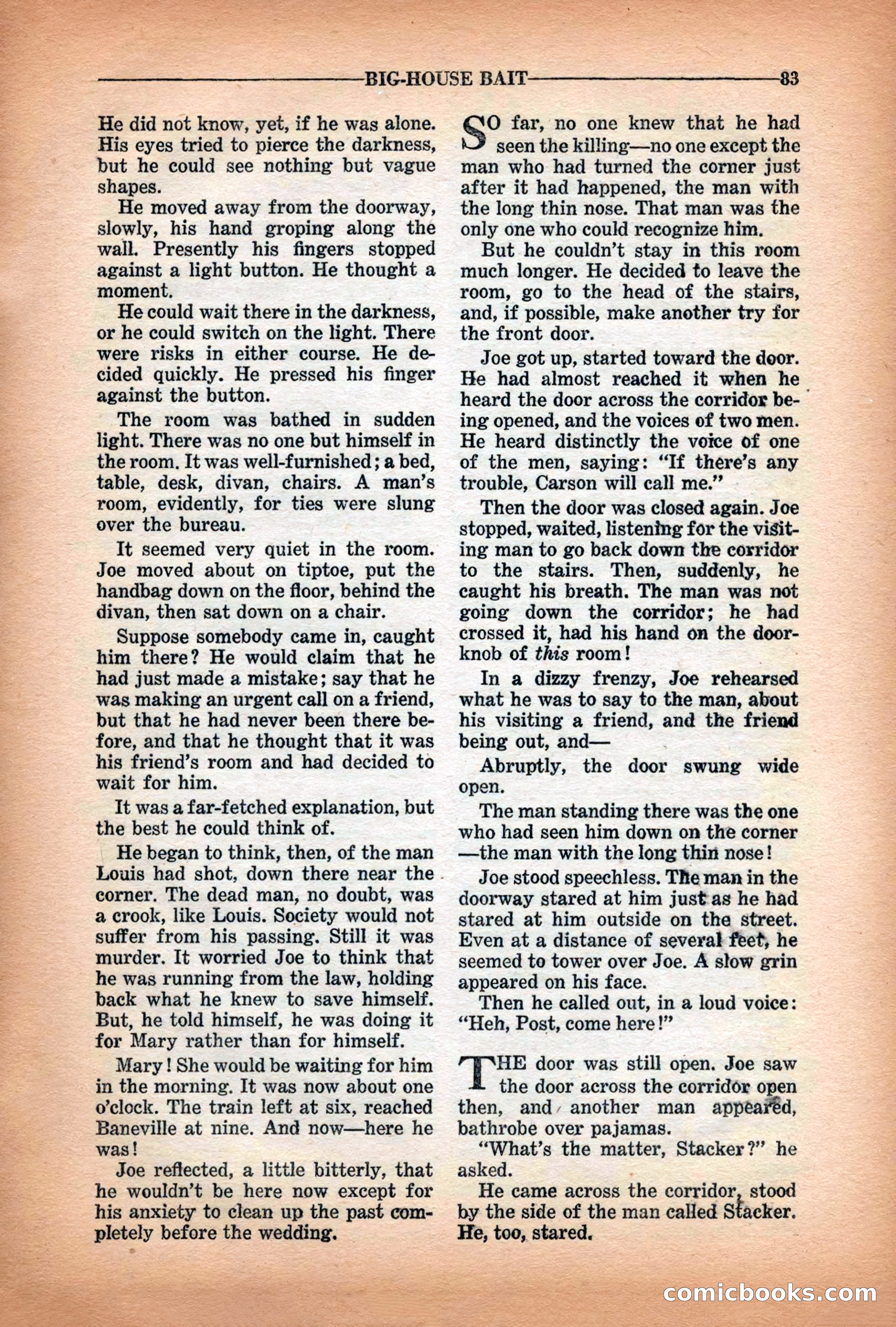
A restored page from Pulp Fiction, 1938. Page through the whole issue in the reader above.
📄 Transcribed text from this page (OCR, searchable)
Machine-transcribed from the original scan — historical spelling and the odd misread are preserved.
BIG-HOUSE BAIT——————-33 He did not know, yet, if he was alone. His eyes tried to pierce the darkness, but he could see nothing but vague shapes. He moved away from the doorway, slowly, his hand groping along the wall. Presently his fingers stopped against a light button. He thought a moment. He could wait there in the darkness, or he could switch on the light. There were risks in either course. He de- cided quickly. He pressed his finger against the button. The room was bathed in sudden light. There was no one but himself in the room. It was well-furnished; a bed, table, desk, divan, chairs. A man’s room, evidently, for ties were slung over the bureau. It seemed very quiet in the room. Joe moved about on tiptoe, put the handbag down on the floor, behind the divan, then sat down on a chair. Suppose somebody came in, caught him there? He would claim that he had just made a mistake; say that he was making an urgent call on a friend, but that he had never been there be- fore, and that he thought that it was his friend’s room and had decided to wait for him. It was a far-fetched explanation, but the best he could think of. He began to think, then, of the man Louis had shot, down there near the - corner. The dead man, no doubt, was a crook, like Louis. Society would not suffer from his passing. Still it was murder. It worried Joe to think that he was running from the law, holding back what he knew to save himself. But, he told himself, he was doing it for Mary rather than for himself. Mary ! She would be waiting for him in the morning. It was now about one o’clock. The train left at six, reached Baneville at nine. And now—here he was! Joe reflected, a little bitterly, that he wouldn’t be here now except for his anxiety to clean up the past com- pletely before the wedding. O far, no one knew that he had seen the killing—no one except the man who had turned the corner just after it had happened, the man with the long thin nose. That man was the only one who could recognize him. But he couldn’t stay in this room much longer. He decided to leave the room, go to the head of the stairs, and, if possible, make another try for the front door. Joe got up, started toward the door. He had almost reached it when he heard the door across the corridor be- ing opened, and the voices of two men. He heard distinctly the vorce of one of the men, saying: “If there’s any trouble, Carson will call me.” Then the door was closed again. Joe stopped, waited, listening for the visit- ing man to go back down the corridor to the stairs. Then, suddenly, he caught his breath. The man was not going down the corridor; he had crossed it, had his hand on the door- knob of this room! In a dizzy frenzy, Joe rehearsed what he was to say to the man, about his visiting a friend, and the friend being out, and— Abruptly, the door swung wide open. The man standing there was the one who had seen him down on the corner —the man with the long thin nose! Joe stood speechless. The man in the doorway stared at him just as he had stared at him outside on the street. Even at a distance of several feet, he seemed to tower over Joe. A slow grin appeared on his face. Then he called out, in a loud voice: “Heh, Post, come here!” HE door was still open. Joe saw the door across the corrid6r open then, and, another man appeared, bathrobe over pajamas. “What’s the matter, Stacker?” he asked. He came across the corridor, stood by the side of the man called Stacker. He, too, stared. . EComichoo cS (e(e)