
Pulp Fiction, 1938 · page 77 of 116
10-Story Detective Magazine Cover — page 77: what you’re looking at
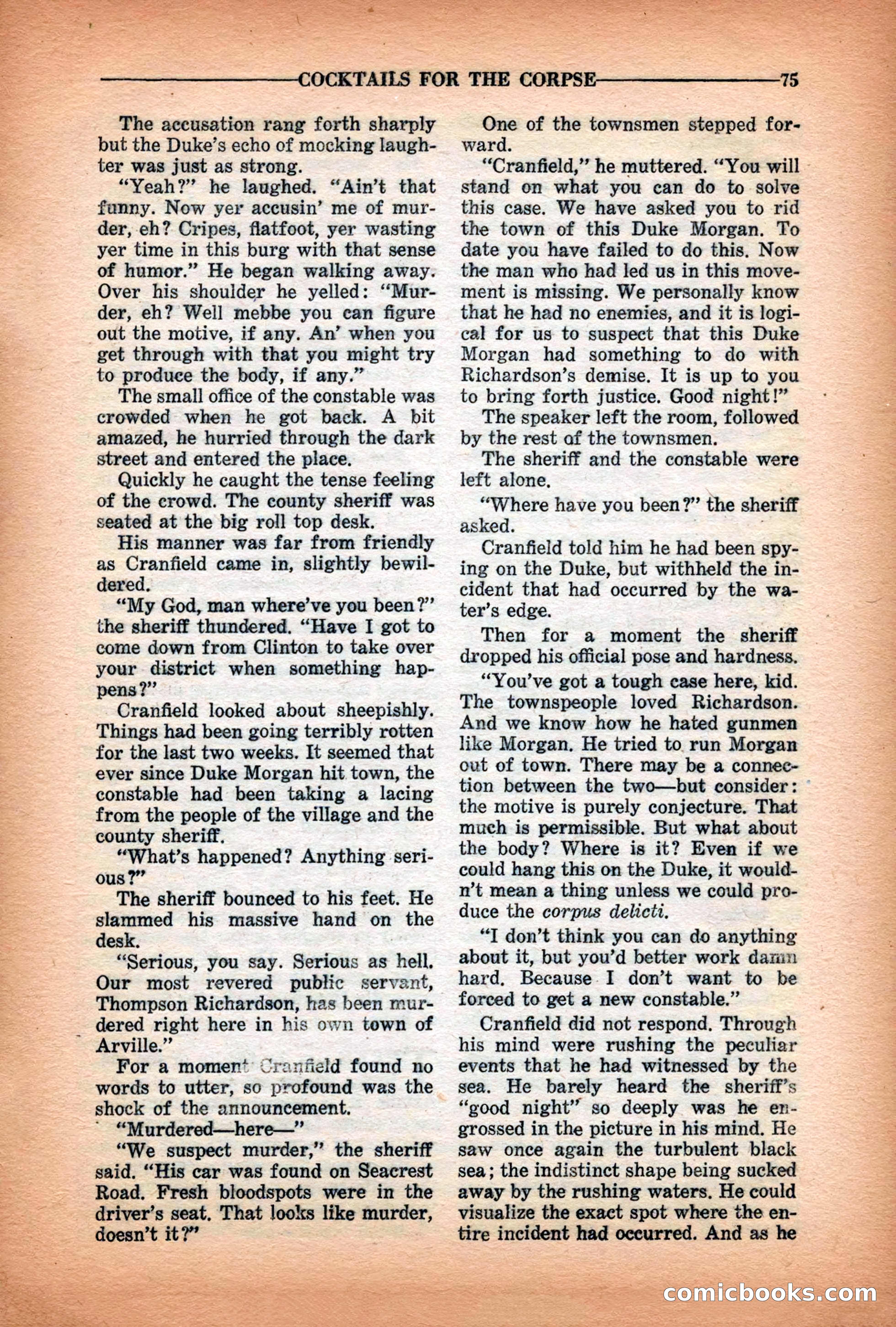
A restored page from Pulp Fiction, 1938. Page through the whole issue in the reader above.
📄 Transcribed text from this page (OCR, searchable)
Machine-transcribed from the original scan — historical spelling and the odd misread are preserved.
—————_ COCKTAILS FOR THE CORPSE—————_5 The accusation rang forth sharply but the Duke’s echo of mocking laugh- ter was just as strong. “Yeah?” he laughed. “Ain’t that funny. Now yer accusin’ me of mur- der, eh? Cripes, flatfoot, yer wasting yer time in this burg with that sense of humor.” He began walking away. Over his shoulder he yelled: “Mur- der, eh? Well mebbe you can figure out the motive, if any. An’ when you get through with that you might try to produce the body, if any.” The small office of the constable was crowded when he got back. A bit amazed, he hurried through the dark street and entered the place. Quickly he caught the tense feeling of the crowd. The county sheriff was seated at the big roll top desk. His manner was far from friendly as Cranfield came in, slightly bewil- dered. “My God, man where’ve you been?” the sheriff thundered. “Have I got to come down from Clinton to take over your district when something hap- pens?” Cranfield looked about sheepishly. Things had been going terribly rotten for the last two weeks. It seemed that ever since Duke Morgan hit town, the constable had been taking a lacing from the people of the village and the county sheriff, “What’s happened? Anything seri- ous?” The sheriff bounced to his feet. He slammed his massive hand on the desk. “Serious, you say. Serious as hell. Our most revered public servant, Thompson Richardson, has been mur- dered right here in his own town of ~ Arville.” 4 For a momen* Cranfield found no words to utter, so profound was the shock of the announcement. “Murdered—here—” “We suspect murder,” the sheriff said. “His car was found on Seacrest Road. Fresh bloodspots were in the driver’s seat, That looks like murder, doesn’t it?” One of the townsmen stepped for- ward. “Cranfield,” he muttered. “You will stand on what you can do to solve this case. We have asked you to rid the town of this Duke Morgan. To date you have failed to do this. Now the man who had led us in this move- ment is missing. We personally know that he had no enemies, and it is logi- cal for us to suspect that this Duke Morgan had something to do with Richardson’s demise. It is up to you to bring forth justice. Good night!” The speaker left the room, followed by the rest af the townsmen. The sheriff and the constable were left alone, “Where have you been?” the sheriff asked. Cranfield told him he had been spy- ing on the Duke, but withheld the in- cident that had occurred by the wa- ter’s edge. Then for a moment the sheriff dropped his official pose and hardness. *““You’ve got a tough case here, kid. The townspeople loved Richardson. And we know how he hated gunmen like Morgan. He tried to run Morgan out of town. There may be a connec- tion between the two—but consider: © the motive is purely conjecture. That much is permissible. But what about the body? Where is it? Even if we could hang this on the Duke, it would- n’t mean a thing unless we could pro- duce the corpus delicti. “T don’t think you can do anything about it, but you’d better work dazimn hard, Because. I don’t want to be forced to get a new constable.” Cranfield did not respond. Through his mind were rushing the peculiar events that he had witnessed by the sea. He barely heard the sheriff’s “ood night” so deeply was he en- grossed in the picture in his mind. He saw once again the turbulent black sea; the indistinct shape being sucked away by the rushing waters. He could visualize the exact spot where the en- tire incident had occurred. And as he , ‘ae, . ca Sb eae comicbooks.c