
Pulp Fiction, 1938 · page 31 of 116
10-Story Detective Magazine Cover — page 31: what you’re looking at
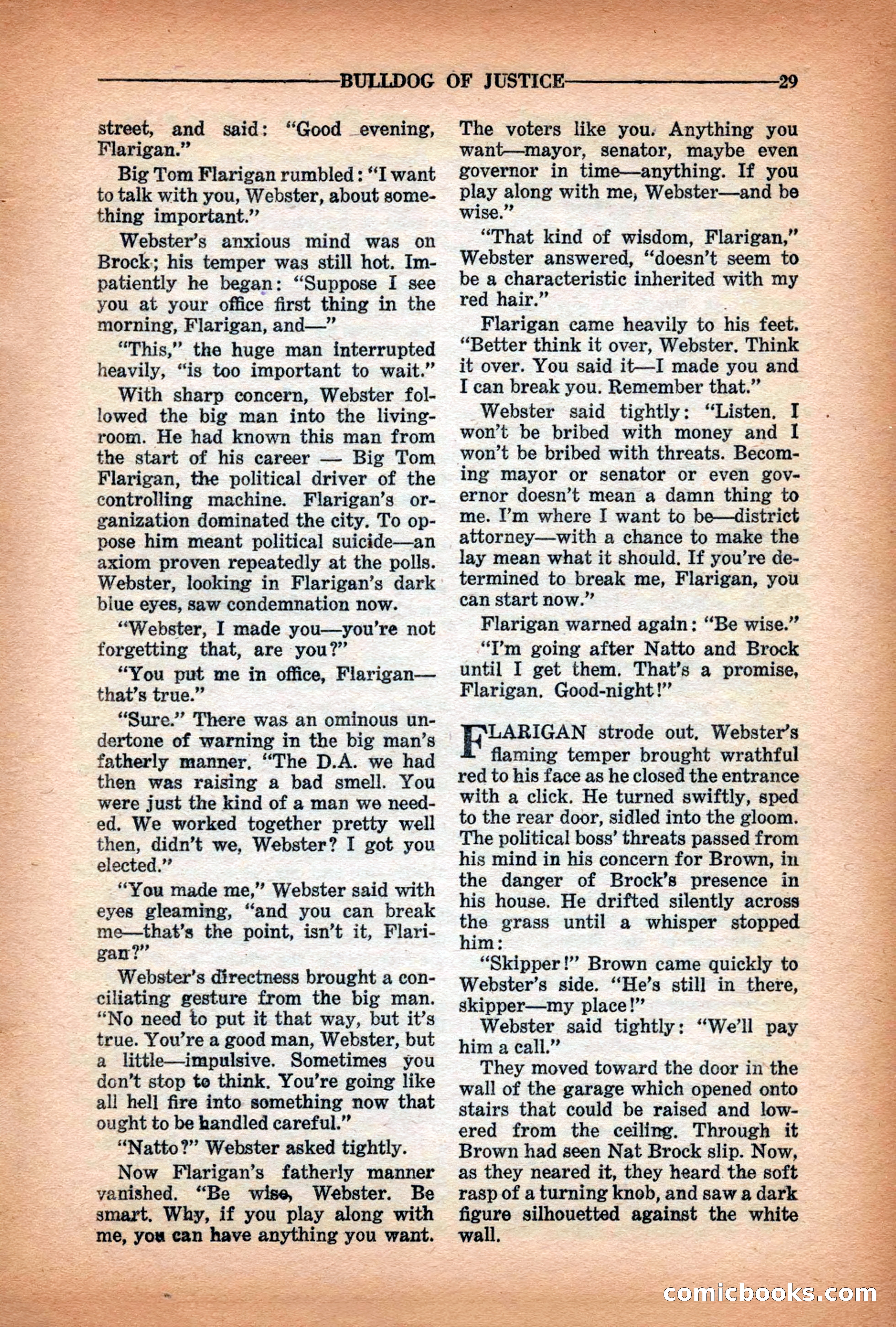
A restored page from Pulp Fiction, 1938. Page through the whole issue in the reader above.
📄 Transcribed text from this page (OCR, searchable)
Machine-transcribed from the original scan — historical spelling and the odd misread are preserved.
——BULLDOG OF JUSTICE street, and said: “Good evening, Flarigan.” Big Tom Flarigan rumbled: “I want to talk with you, Webster, about some- thing important.” Webster’s anxious mind was on Brock:; his temper was still hot. Im- patiently he began: “Suppose I see you at your office first thing in the morning, Flarigan, and—” “This,” the huge man interrupted heavily, “is too important to wait.” With sharp concern, Webster fol- lowed the big man into the living- room. He had known this man from the start of his career — Big Tom Flarigan, the political driver of the controlling machine. Flarigan’s or- ganization dominated the city. To op- pose him meant political suicide—an axiom proven repeatedly at the polls. Webster, looking in Flarigan’s dark blue eyes, saw condemnation now. “Webster, I made you—you’re not forgetting that, are you?” “You put me in office, Flarigan— that’s true.” “Sure.” There was an ominous un- dertone of warning in the big man’s fatherly manner, ‘The D.A. we had then was raising a bad smell. You were just the kind of a man we need- ed. We worked together pretty well then, didn’t we, Webster? I got you elected.” “You made me,” Webster said with eyes gleaming, “and you can break me—that’s the point, isn’t it, Flari- gan?” ! Webster’s directness brought a con- ciliating gesture from the big man. “No need to put it that way, but it’s true. You’re a good man, Webster, but a littl—impulsive. Sometimes you don’t stop te think. You’re going like all hell fire into something now that ought to be handled careful.” “Natto?” Webster asked tightly. Now Flarigan’s fatherly manner yanished. “Be wise, Webster. Be smart. Why, if you play along with me, you can have anything you want. The voters like you. Anything you want—mayor, senator, maybe even governor in time—anything. If you play along with me, Webster—and be wise.” “That kind of wisdom, Flarigan,” Webster answered, “doesn’t seem to be a characteristic inherited with my red hair.” Flarigan came heavily to his feet. “Better think it over, Webster. Think it over. You said it—I made you and I can break you. Remember that.” Webster said tightly: “Listen, I won't be bribed with money and I won't be bribed with threats. Becom- ing mayor or senator or even gov- ernor doesn’t mean a damn thing to me. ’m where I want to be—district attorney—with a chance to make the lay mean what it should, If you’re de- termined to break me, Flarigan, you can start now.” Flarigan warned again: “Be wise.” “I’m going after Natto and Brock until I get them. That’s a promise, Flarigan, Good-night!’’ LARIGAN strode out, Webster’s flaming temper brought wrathful red to his face as he closed the entrance with a click. He turned swiftly, sped to the rear door, sidled into the gloom. The political boss’ threats passed from his mind in his concern for Brown, in the danger of Brock’s presence in his house. He drifted silently across the grass until a whisper stopped him: “Skipper!”’ Brown came quickly to Webster’s side. “He’s still in there, skipper—my place!” Webster said tightly: “We’ll pay him a call.” They moved toward the door in the wall of the garage which opened onto stairs that could be raised and low- ered from the ceiling. Through it Brown had seen Nat Brock slip. Now, as they neared it, they heard the soft rasp of a turning knob, and saw a dark figure silhouetted against the white wall, (eo) chook (<(@)