
Pulp Fiction, 1938 · page 22 of 116
10-Story Detective Magazine Cover — page 22: what you’re looking at
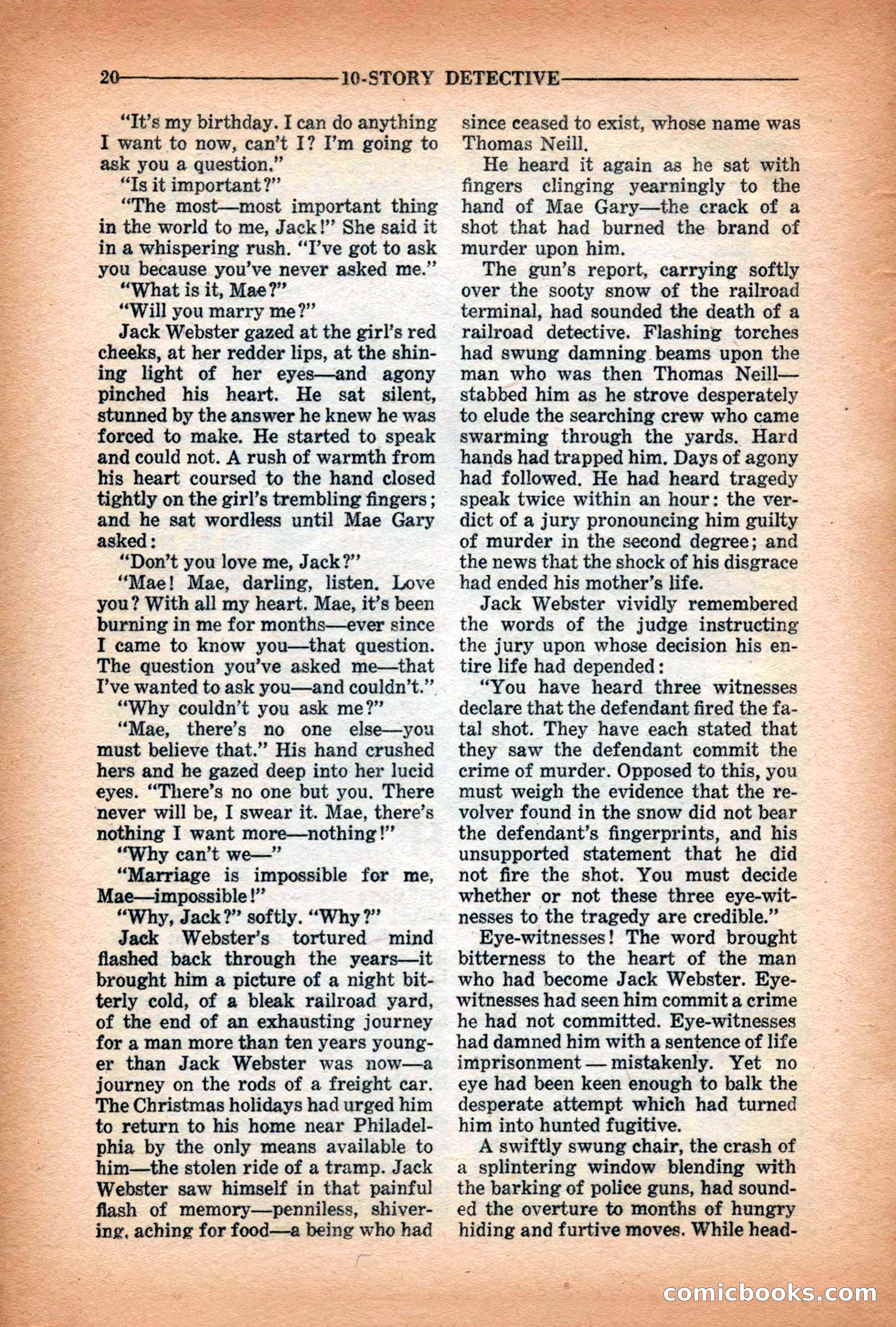
A restored page from Pulp Fiction, 1938. Page through the whole issue in the reader above.
📄 Transcribed text from this page (OCR, searchable)
Machine-transcribed from the original scan — historical spelling and the odd misread are preserved.
ee nee en _ a ee at ~~ =e allied a oa ~ 8 eS Sa a See Pe Cee apes epee la we deb PA 20-—______————_-10-STORY DETECTIVE “It’s my birthday. I can do anything I want to now, can’t I? I’m going to ask you a question.” “Is it important?” “The most—most important thing in the world to me, Jack!’ She said it in a whispering rush. “I’ve got to ask you because you’ve never asked me.”’ “What is it, Mae?” “Will you marry me?” Jack Webster gazed at the girl’s red cheeks, at her redder lips, at the shin- ing light of her eyes—and agony pinched his heart. He sat silent, stunned by the answer he knew he was forced to make. He started to speak and could not. A rush of warmth from his heart coursed to the hand closed tightly on the girl’s trembling fingers; and he sat wordless until Mae Gary asked: “Don’t you love me, Jack?”’ “Mae! Mae, darling, listen. Love you? With all my heart. Mae, it’s been burning in me for months—ever since I came to know you—that question. The question you’ve asked me—that I’ve wanted to ask you—and couldn’t.” “Why couldn’t you ask me?” “Mae, there’s no one else—you must believe that.” His hand crushed hers and he gazed deep into her lucid eyes. “There’s no one but you. There never will be, I swear it. Mae, there’s nothing I want more—nothing!”’ “Why can’t we—” “Marriage is impossible for me, Mae—impossible !” “Why, Jack?” softly. “Why ?” Jack Webster’s tortured mind flashed back through the years—it brought him a picture of a night bit- terly cold, of a bleak railroad yard, of the end of an exhausting journey for a man more than ten years young- er than Jack Webster was now—a journey on the rods of a freight car. The Christmas holidays had urged him to return to his home near Philadel- phia by the only means available to him—the stolen ride of a tramp. Jack Webster saw himself in that painful flash of memory—penniless, shiver- ing, aching for food—a being who had since ceased to exist, whose name was Thomas Neill. He heard it again as he sat with fingers clinging yearningly to the hand of Mae Gary—the crack of a shot that had burned the brand of murder upon him. The gun’s report, carrying softly over the sooty snow of the railroad terminal, had sounded the death of a railroad detective. Flashing torches had swung damning beams upon the man who was then Thomas Neill— stabbed him as he strove desperately to elude the searching crew who came swarming through the yards. Hard hands had trapped him, Days of agony had followed. He had heard tragedy speak twice within an hour: the ver- dict of a jury pronouncing him guilty of murder in the second degree; and the news that the shock of his disgrace had ended his mother’s life. Jack Webster vividly remembered the words of the judge instructing the jury upon whose decision his en- tire life had depended: “You have heard three witnesses declare that the defendant fired the fa- tal shot. They have each stated that they saw the defendant commit the crime of murder. Opposed to this, you must weigh the evidence that the re- volver found in the snow did not bear the defendant’s fingerprints, and his unsupported statement that he did not fire the shot. You must decide whether or not these three eye-wit- nesses to the tragedy are credible.” Eye-witnesses! The word brought bitterness to the heart of the man who had become Jack Webster. Eye- witnesses had seen him commit a crime he had not committed. Eye-witnesses had damned him with a sentence of life imprisonment — mistakenly. Yet no eye had been keen enough to balk the desperate attempt which had turned him into hunted fugitive. A swiftly swung chair, the crash of a splintering window blending with the barking of police guns, had sound- ed the overture to months of hungry hiding and furtive moves. While head- comicboo CS co