
Pulp Fiction, 1938 · page 19 of 116
10-Story Detective Magazine Cover — page 19: what you’re looking at
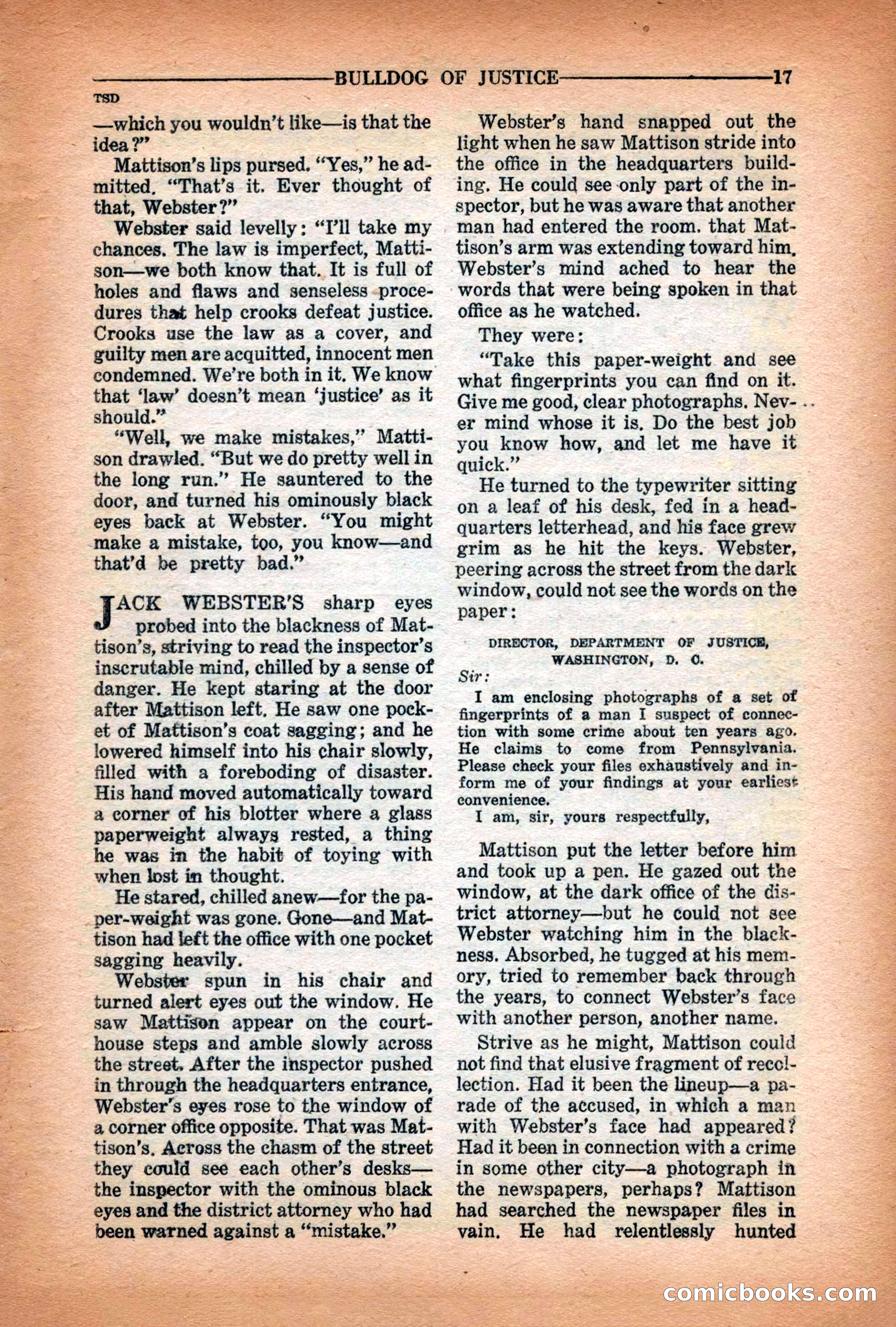
A restored page from Pulp Fiction, 1938. Page through the whole issue in the reader above.
📄 Transcribed text from this page (OCR, searchable)
Machine-transcribed from the original scan — historical spelling and the odd misread are preserved.
US oe, eae —which you wouldn’t tike—is that the idea ?” Mattison’s lips pursed. “Yes,” he ad- mitted, “That’s it. Ever thought of that, Webster?” Webster said levelly : “T’ll take my chances, The law is imperfect, Matti- son—we both know that. It is full of holes and flaws and senseless -proce- dures that help crooks defeat justice. Crooks use the law as a cover, and guilty men are acquitted, innocent men condemned. We’re both in it, We know that ‘law’ doesn’t mean ‘justice’ as it should.” “Well, we make mistakes,”’ Matti- son drawled. “But we do pretty well in the long run.’ He sauntered to the door, and turned his ominously black eyes back at Webster. “You might make a mistake, too, you know—and that’d be pretty bad.” ACK WEBSTER’S sharp eyes probed into the blackness of Mat- tison’s, striving to read the inspector’s inscrutable mind, chilled by a sense of danger. He kept staring at the door after Mattison left. He saw one pock- et of Mattison’s coat sagging; and he lowered himself into his chair slowly, filled with a foreboding of disaster. His hand moved automatically toward a corner of his blotter where a glass paperweight always rested, a thing he was in the habit of toying with when lost in thought. He stared, chilled anew—for the pa- _per-weight was gone. Gone—and Mat- tison had left the office with one pocket sagging heavily. Webster spun in his chair and turned alert eyes out the window. He saw Mattison appear on the court- house steps and amble slowly across the street. After the inspector pushed in through the headquarters entrance, Webster’s eyes rose to the window of a, corner office opposite. That was Mat- tison’s, Across the chasm of the street they could see each other’s desks— the inspector with the ominous black eyes and the district attorney who had been warned against a “mistake,” Saeee ee ee : BULLDOG OF JUSTICE ae —<——S * Webster’s hand snapped out the light when he saw Mattison stride into the office in the headquarters build- ing. He could see-only part of the in- spector, but he was aware that another man had entered the room. that Mat- tison’s arm was extending toward him, Webster’s mind ached to hear the words that were being spoken in that office as he watched. They were: “Take this paper-weight and see what fingerprints you can find on it. Give me good, clear photographs. Nev- .. er mind whose it is, Do the best job you know how, and let me have it quick.” He turned to the typewriter sitting on a leaf of his desk, fed in a head- quarters letterhead, and his face grew grim as he hit the keys. Webster, peering across the street from the dark window, could not see the words on the paper: DIRECTOR, DEPARTMENT OF JUSTICE, WASHINGTON, D. 0. Sir: I am enclosing photographs of a set of fingerprints of a man I suspect of connec- tion with some crime about ten years ago. He claims to come from Pennsylvania. Please check your files exhaustively and in- form me of your findings at your earliest convenience, I am, sir, yours respectfully, Mattison put the letter before him and took up a pen. He gazed out the window, at the dark office of the dis- trict attorney—but he could not see Webster watching him in the black- ness. Absorbed, he tugged at his mem- ory, tried to remember back through the years, to connect Webster’s face with another person, another name. Strive as he might, Mattison could not find that elusive fragment of reco!l- lection. Had it been the lineup—a pa- rade of the accused, in which a man with Webster’s face had appeared? Had it been in connection with a crime in some other city—a photograph in the newspapers, perhaps? Mattison had searched the newspaper files in vain. He had relentlessly hunted comicbooks co