
Penny Dreadfuls, 1877 · page 4 of 16
Young Briton, No. 422 — page 4: what you’re looking at
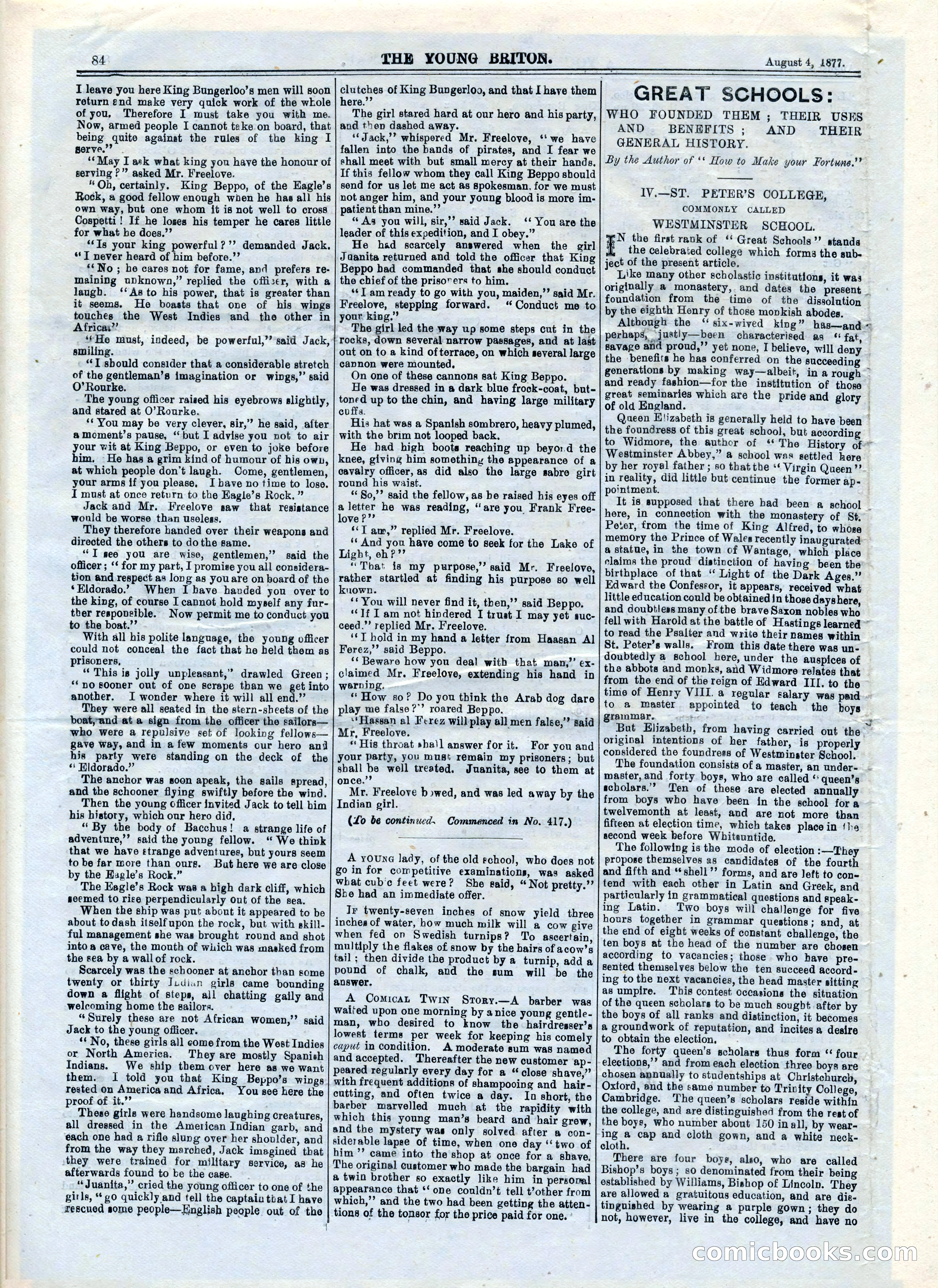
A restored page from Penny Dreadfuls, 1877. Page through the whole issue in the reader above.
📄 Transcribed text from this page (OCR, searchable)
Machine-transcribed from the original scan — historical spelling and the odd misread are preserved.
84 THE YOUNG BRITON. August 4, £877. I leave you here King Bungerloo’s men will soon return end make very quick work of the whole of you, Therefore I must take you with me. Now, armed people I cannot take on board, that being quite againet the rules of the king I serve.”’ ‘* May Task what king you have the honour of serving P” asked Mr. Freelove. © Oh, certainly. own way, but one whom it is not well to cross Cospetti! If he loses his temper he cares litile for what he does.’’ ‘‘Is your king powerful? ’’ demanded Jack. ‘IT never heard of him before.’’ **No ; he cares not for fame, and prefers re- maining unknown,” replied the offizer, with a ‘*As to his power, that is greater than He boasts that one of his wings touches the West Indies and the other in laugh. it seems. A fricay?’ ‘tHe must, indeed, be powerful,’ said Jack, smiling. “‘T sbould consider that a considerable stretch of the gentleman’s imagination or wings,’’ said O’ Rourke. The young officer raised his eyebrows slighily, and stared at O’Rourke. ‘*' You may be very clever, sir,’ he said, after & Moment’s pause, ‘but I advise you not to air your wit at King Beppo, or even to joke before him, He has a grim kind of humour of his own, at which people don’t laugh. Come, gentlemen, your arms if you please. I bave no time to lose. I must at once return to the Kagle’s Rock, ” Jack and Mr. would be worse than useless. They therefore handed over their weapons and directed the others to dothe same. “IT see you are wise, gentlemen,” said the officer ; ‘‘ for my part, I promise you all considera- tion and respect as long as youare on board of the When I have havded you over to the king, of course I cannot hold myself any fur- Now permit me to conduct you * Eldorado.’ ther responsible. to the boat.’’ With all his polite language, the young officer could not conceal the fact that he held them as prisoners, ** This is jolly unpleasant,” drawled Green ; **no sooner out of one scrape than we get into another. I wonder where it will all end.’’ They were all seated in the stern-sheets of the boatyand at a sign from the officer the sailors— who Were a repulsive set of looking fellows— gave way, and in afew moments our hero and his party were standing on the deck of the *’ Hldorado.”’ The anchor was soon apeak, the sails spread, and the schooner flying swiftly before the wind. Then the young Officer invited Jack to tell bim his history, which our hero did, “ By the body of Bacchus! a strange life of adventure,’’ said the young fellow. ‘ We think that we have strange adventures, but yours seem to be far more than ours. But here we are close by the Hagle’s Rock.” The Eagle’s Rock was a high dark cliff, which seemed to rise perpendicularly out of the sea. When the ship was put about it appeared to be about todash itselfupon the rock, but with skill- ful management she was brought round and shot into a cave, the mouth of which was masked from the sea by a wallof rock. Scarcely was the schooner at anchor than some twenty or thirty I.disn girls came bounding down a flight of steps, all chatting gaily and welcoming home the gailora. “Surely these are not African women,’ said Jack to the young Officer. ‘* No, these girls all come from the West Indies or North America. They are mostly Spanish Indians. We ship them over here as we want them. I told you that King Beppo’s wings rested on America and Africa. You see here the proof of it.”’ These girls were handsome laughing creatures, all dressed in the American Indian garb, and each one had a rifle slung over her shoulder, and from the way they marched, Jack imagined that they were trained for military service, as he afterwards found to ke the cage. “Juanita,” cried the young officer to one of the girls, ** go quickly and tell the captaia tbat I have rescued some people—English people out of the King Beppo, of the Eagle’s Rock, a good fellow enough when he has all his Freelove saw that resistance clutches of King Bungerloo, and that I have them here.”’ The girl stared hard at our hero and his party, and then dashed away. ‘‘Jack,’’ whispered Mr. Freelove, *‘ we have fallen into the bands of pirates, and I fear we ehall meet with but small mercy at their hands. If this fellow whom they call King Beppo should send for us let me act as spokesman, for we must not anger him, and your young blood is more im- patient than mine.’’ “As you will, sir,’’ said Jack. ‘* You are the leader of this expedition, and I obey.” He had scarcely answered when the girl Jdanita returned and told the officer that King Beppo bad commanded that she should conduct the chief of the prisovers to him. ‘¢] am ready to go with you, maiden,”’’ said Mr. Freelove, stepping forward. ‘Conduct me to your king,” The girl led the way up some steps cut in the rocks, down several narrow passages, and at last out on to a kind ofterrace, on which several large cannon were mounted. On one of these cannons sat King Beppo. He was dressed in a dark blue frock-coat, but- toned up to the chin, and having large military co ffa. His hat was a Spanish sombrero, heavy plumed, with the brim not looped back, He had high boots reaching up beyo:.d the knee, giving him somethiny the appearance of a cavalry officer, as did also the large sabre girt round his waist. ** So,’’ said the fellow, as be raised his eyes off a letter he was reading, “are you Frank Free- love P”’ ‘‘T am,” replied Mr. Freelove. ‘* And you have come to seek for the Lake of Light, eh?’’ “That is my purpose,’’ said Mr. Freelove, rather startled at finding his purpose so well kuown. ‘* You will never find it, then,’’ said Beppo. ‘Tf Lam not hindered I trust I may yet suc- ceed.”’ replied Mr. Freelove. ‘¢T hold in my hand a letter from Haasan Al Ferez,’’ said Beppo. ‘¢ Beware how you deal with that man,’’ ex- claimed Mr. Freelove, extending his hand in warning. ** How so? Do you think the Arab dog dare play me false ?’’ roared Beppo. ‘*Hassan al F’crez will play al] men false,’’ said Mr, Freelove. * His throat shall answer for it. For you and your party, you must remain my prisoners; but shall be well treated. Juanita, see to thom at once.’’ Mr. Freelove b wed, and was led away by the Indian girl. (Lo be continucd. Commenced in No. 417.) A youna lady, of the old echool, who does not go in for competitive examinations, was asked what cub'c feet were? She said, “ Not pretty.” She had an immediate offer. Ir twenty-seven inches of snow yield three inches of water, how much milk will a cow give when fed on Swedish turnips? To ascertain, multiply the flakes of snow by the hairs of acow’s tail ; then divide the product by a turnip, add a pound of chalk, and the sum will be the answer. A ComicaL Twin Srory.—A barber was waited upon one morning by anice young gentle- man, who desired to know the hairdresser’s lowest terms per week for keeping his comely caput in Condition. A moderate sum was named and accepted. Thereafter the new customer ap- peared regularly every day for a “ close shave,” with frequent additions of shampooing and hair- cutting, and often twice a day. In short, the barber marvelled much at the rapidity with which this young man’s beard and hair grew, and the mystery was only solved after a con- siderable lapse of time, when one day ‘two of him ’’ came into the shop at once for a shave, The original customer who made the bargain had a twin brother so exactly like him in persopal appearance that ‘‘ one conldn’t tell t’other from which,’’ and the two had been getting the atten- tions of the tonsor for the price paid for one. GREAT SCHOOLS: WHO FOUNDED THEM ; THEIR USES AND BENEFITS ; AND THEIR GENERAL HISTORY. By the Author of ‘* How to Make your Fortune.” IV.—ST. PETER’S COLLEGE, COMMONLY CALLED WESTMINSTER SCHOOL. N the first rank of ‘‘ Great Schools’? standa } the celebrated college which forms the sub- ject of the present article. Like many other scholastic institutions, it was originally a monastery, and dates the present _ foundation from the time of the dissolution by the eighth Henry of those monkish abodes. Although the ‘ six-wived king” has—and- perhaps, ‘justiy—been characterised ag “ fat, savage and proud,” yet none, I believe, will deny the benefits he has conferred on the generations by making way—albeit, ina rough and ready fashion—for the institution of those great seminaries which are the pride and glory of old England. Queen Hlizabeth is generally held to have been _ the foundress of this great school, but according A succeeding — ; e to Widmore, the author of ‘* The History of @ Westminster Abbey,” @ school was settled here by her royal father ; so that the ‘* Virgin Queen’? in reality, did little but centinue the former ap- pointment. It is supposed that there had been a school here, in connection with the monastery of St, Peter, from the time of King Alfred, to whose memory the Prince of Wales recently inaugurated a statue, in the town of Wantage, which place claims the proud distinction of having been the birthplace of that ‘“ Light of the Dark Ages.” Edward the Confesror, it appears, received what little education could be obtained jn those dayshere, and doubtless many of the brave Saxon nobles who fell with Harold at the battle of Hastings learned to read the Psalter and write their names within St. Peter’s walls. From this date there was un- doubtedly a school here, under the auspices of the abbots and monks, and Widmoro relates that from the end of the reign of Edward III. to the time of Henry VIII. a regular salary was paid to a Master appointed to teach the boys grammar. - But Elizabeth, from having carried out the origibal intentions of her father, is properly considered the foundress of Westminster School. The foundation consists of a master, an under- master,and forty boys, who are called ** queen’s scholars.” ‘Ten of these are elected annually from boys who have been in the school for a twelvemonth at least, and are not more than fifteen at election time, which takes place in {he second week before Whitauntide, The following is the mode of election :—They propose themselves as candidates of the fourth and fifth and ‘*shell’’ forms, and are left to con- tend with each other in Latin and Greek, and particularly in grammatical questions and speak- ing Latin. Two boys will challenge for five hours together in grammar questions; and, at the end of eight weeks of constant challenge, the ten boys at the head of the number are chosen according to vacancies; those who have pre- sented themselves below the ten succeed accord- ing to the next vacancies, the head master sitting as umpire. ‘This contest occasions the situation of the queen scholars to be much sought after by the boys of all ranks and distinction, it becomes a groundwork of reputation, and incites a desire to obtain the election, The forty queen’s scholars thus form “ four elections,’’ and from each election three boys are chosen annually to studentships at Christchurch, Oxford, and the same number to Trin ity College, Cambridge. ‘The queen’s scholars reside within the college, and are distinguished from the rest of the boys, who number about 150 inall, by wear- ing @ cap and cloth gown, and a white neck- cloth. There are four boys, also, who are called Bishop’s boys ; so denominated from their being established by Williams, Bishop of Lincoln. They are allowed a gratuitous education, and are die- tinguished by wearing a purple gown; they do not, however, live in the college, and have no COMMICOOOKS (E(O)