
Penny Dreadfuls, 1877 · page 13 of 16
Young Briton, No. 422 — page 13: what you’re looking at
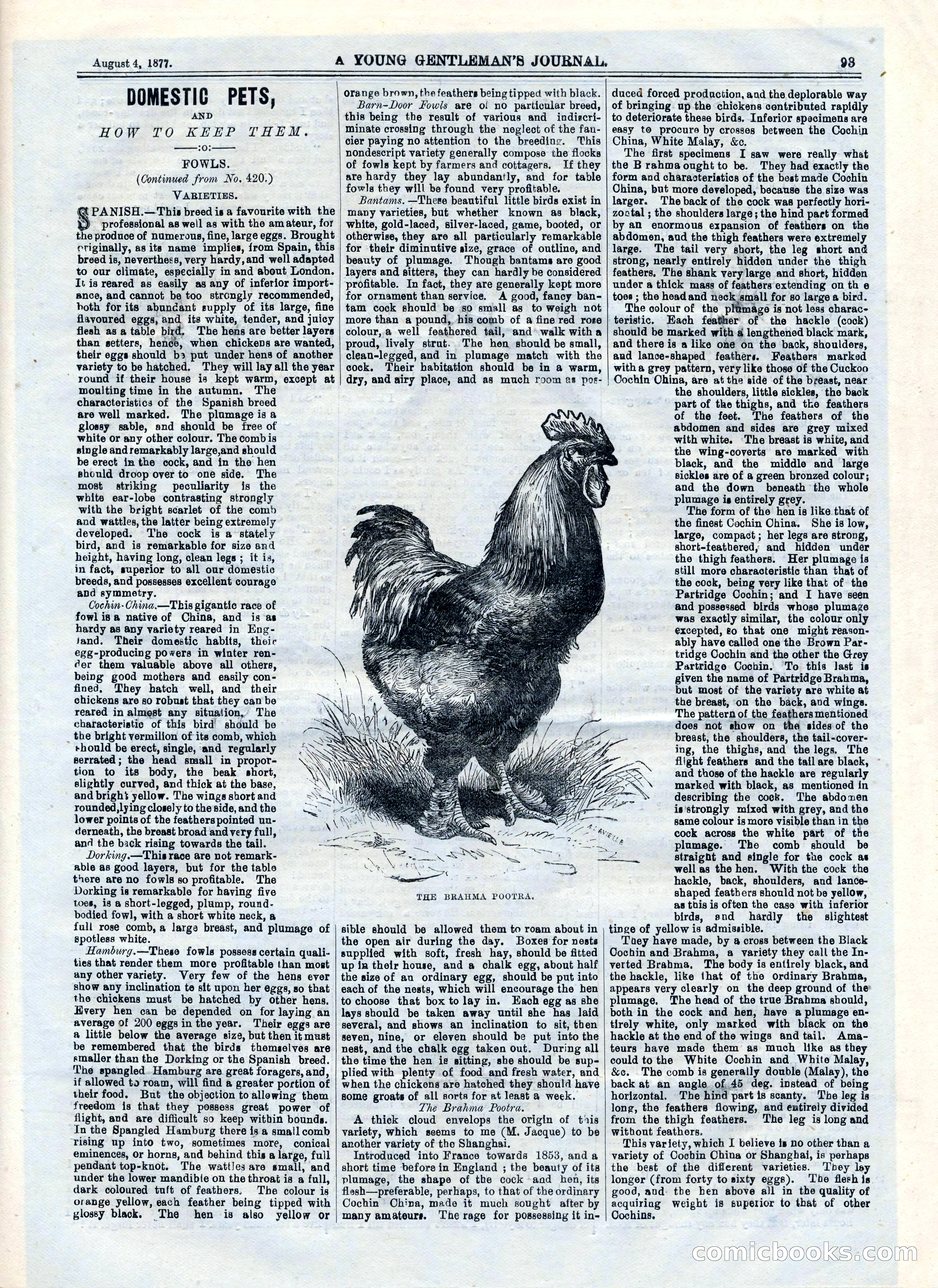
A restored page from Penny Dreadfuls, 1877. Page through the whole issue in the reader above.
📄 Transcribed text from this page (OCR, searchable)
Machine-transcribed from the original scan — historical spelling and the odd misread are preserved.
August 4, 1877. A YOUNG GENTLEMAN’S JOURNAL. 93 DOMESTIC PETS, HOW TO KEEP THEM. —:0; —. FOWLS. (Continued from No. 420.) VARIETIES. A PA NISH.—This breed is a favourite with the ) professional as well as with the amateur, for the produce of numerous, fine, large eggs. Brought originally, as its name implies, from Spain, this breed is, neverthess, very hardy,and well adapted to our climate, especially in and about London. It is reared as easily as any of inferior import- ance, and cannot be too strongly recommended, hoth for its abundant supply of its large, fine flavoured eggs, and its white, tender, and juicy flesh as a table bit d. The hens are better layers than setters, hence, when chickens are wanted, their eggs should b3 put under hens of another variety to be hatched. They will lay all the year - round if their house is kept warm, except at moulting time in the autumn. The characteristics of the Spanish breed are well marked. The plumage is a glossy sable, and should be free of white or any other colour. The comb is single andremarkably large,and should be erect in the cock, and in the hen should droop over to one side. The most striking peculiarity is the white ear-lobe contrasting strongly with the bright scarlet of the comb and wattles, the latter being extremely developed. ‘The cock is a stately bird, and is remarkable for size and height, having long, clean legs ; it is, in fact, superior to all our domestic breeds, and possesses excellent courage abd symmetry. Cochin- China. —T his gigantic race of fowl is a native of China, and is as hardy as any variety reared in Eng- jand. Their domestic habits, theic egg-producing powers in winter ren- cer them valuable above all others, being good mothers and easily con- fined, They hatch well, and their chickens are so robust that they can be reared in almost any situation, The characteristic of this bird’ should be _ the bright vermilion of its comb, which thould be erect, single, and regularly serrated ; the head small in propor- tion to its body, the beak short, slightly curved, and thick at the base, and brigh’ yellow. The wings short and rounded, lying closely to the side, and the lower points of the feathers pointed un- derneath, the breast broad and very full, and the back rising towards the tail. Dorking.—This race are not remark- able as good layers, but for the table there are no fowls so profitable. The Dorking is remarkable for having five toes, is a short-legged, plump, round- bodied fowl, with a short white neck, a full rose comb, a large breast, and plumage of spotless white. Hamburg.—These fowls possess certain quali- ties that render them more profitable than most any other variety. Very few of the hens ever show any inclination te sit upon her eggs, so that the chickens must be hatched by other hens. Hvery hen can be depended on for laying an average Of 200 eggs in the year. Their eggs are a little below the average size, but then it must be remembered that the birds themselves are smaller than the Dorking or the Spanish breed. The spangled. Hamburg are great foragers, and, if allowed to roam, will find a greater portion of their food. But the objection to allowing them freedom is that they possess great power of flight, and are difficult so keep within bounds. In the Spangled Hamburg there is a small comb rising up into two, sometimes more, conical eminences, Or horns, and behind this a large, full pendant top-knot. The wattles are small, and under the lower mandibie on the throat is a full, dark coloured tuft of feathers. The colour is orange yellow, each feather being tipped with glossy black. The hen is also yellow or orange brown, the feathers being tipped with black. Barn-Door Fowils are of no particular breed, this being the result of various and indircri- minate crossing through the neglect of the fan- cler paying no attention to the breeding. This nondescript variety generally compose the flocks of fowls kept by farmers and cottagers. If they are hardy they lay abundantly, and for table fowls they will be found very profitable. Bantams. —These beautiful little birds exist in many varieties, but whether known as black, white, gold-laced, silver-laced, game, booted, or otherwise, they are all particularly remarkable for their diminutive size, grace of outline, and beauty of plumage. Though bantams are good layers and sitters, they can hardly be considered profitable. In fact, they are generally kept more for ornament than service. A good, fancy ban- tam cock should be so small as to weigh not more than a pound, his comb of a fine red rose colour, a well feathered tail, and* walk witha proud, lively strut. The hen should be small, clean-legged, and in plumage match with the cock. Their habitation should be in a warm, dry, and airy place, and as much room as pos- = . ne Nae | ard THE BRAHMA POOTRA, sible should be allowed them to roam about in the open air during the day. Boxes for nests supplied with soft, fresh hay, should be fitted up in their house, and a chalk egg, about half the size of an ordinary egg, should be put into each of the nests, which will encourage the hen to choose that box to lay in. Hach egg as she lays should be taken away until she has laid several, and shows an inclination to sit, then seven, Dine, or eleven should be put into the nest, and the chalk egg taken out. During all the time the hen is sitting, she should be sup- plied with plenty of food and fresh water, and when the chickens are hatched they should have some groats of all sorts for at least a week, The Brahma Pootra. A thick cloud envelops the origin of tis variety, which seems to me (M. Jacque) to be another variety of the Shanghai. Introduced into France towards 1853, anda short time before in England ; the beauty of its plumage, the shape of the cock and hen, its flesh—preferable, perhaps, to that of the ordinary Cochin China, made it much sought after by many amateurs. The rage for possessing it in- = SE ae eS ea . ™—> Sk ¥ duced forced prodaction, and the deplorable way of bringing up the chickens contributed rapidly to deteriorate these birds. Inferior specimens are easy t@ procure by crosses between the Cochin China, White Malay, &c. The first specimens I saw were really what the B rahma ought to be. They had exactly the form and characteristics of the best made Cochin China, but more developed, because the size was larger. The back of the cock was perfectly hori- zoctal ; the shoulders large; the hind part formed by aN enormous expansion of feathers on the abdomen, aud the thigh feathers were extremely large. The tail very short, the leg short and strong, nearly entirely hidden under the thigh feathers, The shank very large and short, hidden under a thick mass of feathers extending on th e toes ; the head and neck small for so large a bird. The colour of the plamage is not less charac- teristic. Each feather of the hackle (cock) should be marked with a lengthened black mark, and there is a like one on the back, shoulders, and lance-shaped feathers. Feathers marked with a grey pattern, very like those of the Cuckoo Cochin Ohina, are atthe side of the breast, near the shoulders, little sickles, the back part of the thighs, and tke feathers of the feet. The feathers of the abdomen and sides are grey mixed with white. The breast is white, and the wing-coverts are marked with black, and the middle and large sickles are of a green bronzed colour; and the down beneath the whole plumage is entirely grey. The form of the hen is like that of the finest Cochin China. She is low, large, compact; her legs are strong, short-featbered, and hidden under the thigh feathers. Her plumage is still more characteristic than that of the cock, being very like that of the Partridge Cochin; and I have seen and possessed birds whose plumage was exactly similar, the colour only excepted, &0 that one might reason- ably have called one the Brown Par- tridge Cochin and the other the Grey Partridge Cochin. To this last is given the name of Partridge Brahma, but most of the variety are white at the breast, on the back, and wings. The pattern of the feathers mentioned does not show on the sides of the breast, the shoulders, the tail-cover- ing, the thighs, and the legs, The flight feathers and the tail are black, and those of the hackle are regularly marked with black, as mentioned in describing the coek. The abdomen is'strongly mixed with grey, and the same colour is more visible than in the cock across the white part of the plumage. The comb should be < straight and single for the cock as wellas the hen. With the cock the hackle, back, shoulders, and lance- shaped feathers should not be yellow, as this is often the case with inferior birds, sand hardly the slightest tinge of yellow is admissible. Toey have made, by a cross between the Black Cochin and Brahma, a variety they call the In- verted Brahma, The body is entirely black, and the hackle, like that of the ordinary Brahma, appears very clearly on the deep ground of the plumage. The head of the true Brahma should, both in the cock and hen, have a plumage en- tirely white, only marked with black on the hackle at the end of the wings and tail. Ama- teurs have made them as much like as they could to the White Cochin and White Malay, &c. The comb is generally double (Malay), the back at an angle of 45 deg. instead of being horizontal. The hind part is scanty. The leg is long, the feathers flowing, and entirely divided from the thigh feathers. The leg is long and without feathers. This variety, which I believe is no other than a variety of Cochin China or Shanghai, is perhaps the best of the different varieties. ‘They ley longer (from forty to sixty eggs). ‘The flesh is good, aud: the hen above all in the quality of acquiring weight is superior to that of other Oochins. CORMIELOOO S (C(O)